Bruce Stainsby's Blog: Muttering from the mo

“I’ve got a mate”

August 10th, 2011

This is great for the person who has the mate and probably great for the mate but it can be very costly for business.

“I’ve got a mate” is usually associated with a client who has a mate who he believes will be able to save him money by getting a job done more cheaply.

The opposite is usually true.

The mate probably doesn’t want the job, because he knows he will have to do it for cost.

He therefore cuts corners, doesn’t ask questions and just wants to get the job out of the way.

He might be the totally wrong person for the job but does it because he’s a mate.

He could even be charging far more for the job because he isn’t set up to handle it.

But yet he still goes ahead, because he’s a mate.

So many jobs that are handled by mates turn to disaster.

It’s not the mate’s fault but a misguided belief, by his mate, that paying the right money to get a job done professionally isn’t good business.

How do I know all this?

My mate told me.

Legislation or education?

August 1st, 2011

With the unfortunate death of another Victorian bike rider, concerned groups are asking for tougher legislation.

“People who drive less than a metre from cyclists should face harsh penalties, bike groups have said.” The Age, July 26, 2011.

This approach seems to be the only answer to so many ‘concerned groups’. This has led many to believe that Australia is becoming a Nanny Nation.

We now have calls for stricter controls on advertising to kids. Health warnings on alcohol and so many signs on our streets, telling us what to do and what not to do, that they have become a source of increased visual pollution.

Continuing on a theme of telling us what to do is Metro, the operator of the Melbourne rail system.

As well as subjecting us to a barrage of verbal warnings they have now plastered their escalators with more instructions on how to behave.

I wonder if the millions that it’s costing us, to introduce and enforce this new legislation and behavior, wouldn’t be better spent on educating people to think more for themselves.

Isn’t it better to know what is right rather than be told what is wrong?

Le Tour – winners and losers.

July 24th, 2011

I am a fan of the Tour de France.

So for the last three weeks I haven’t been into bed until way after midnight.

One of the biggest attractions has been the magnificent scenery along the route.

And last night’s time trial was amongst the most gripping TV I have seen in a long time. True, it was only guys racing the clock but there was so much at stake for Australia’s Cadel Evans.

He’s a machine.

I can’t wait to see him ride down the Champs-Élysées tonight as the winner. Only the third non-European to have won the race in its 108 year’s history.

There was another winner in this year’s tour and that was the SBS Tour Tracker App. This was a great example of well designed and well written application code. Even the live TV feeds worked.

Now for the losers.

I am afraid they were the advertisements. It was definitely the cycling and the scenery that kept me awake each night, not the ads.

Apart from the original SBS promo ad, which was excellent, the rest was crap.


If they had only run each ad once a night, then they would have been bearable but they ran them at every break and then night after night. Apart from Skoda, all the major sponsors had only produced one ad and they seemed to run them continually.

There was once a theory in media buying that frequency was the most powerful way to builds a brand message.

I think that frequency, at these levels, is the fastest way to damage a brand.

Form follows fun.

July 20th, 2011

We have got the last of our stuff out of storage, which included all our books.

As a result, I have just rediscovered ‘The Little Book of Design Classics‘ by Catherine McDermott.

As the name suggests this is a small book. It’s only 100mm wide and 145mm deep however it: “…contains more than 100 key pieces of design that have come the fabric of modern life.”

There are some serious pieces of design in here, like the Chrysler Building, in New York but there are also some more trivial things, like the Michael Graves Whistling Kettle, manufactured by Alessi.

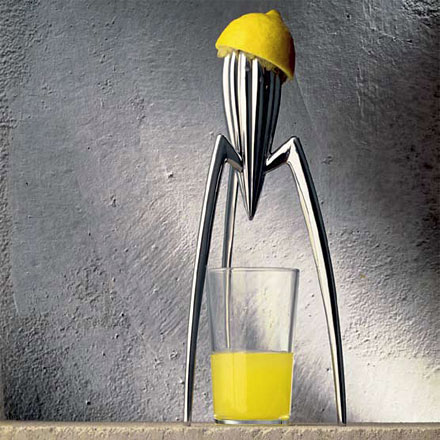
It was due to this little book that I went and bought the Juicy Salif, Citrus-squeezer, designed by Philippe Starck and also manufactured by Alessi.

This would have to be the world’s worst citrus squeezer, as you have to place the glass underneath and provide your own strainer to catch the pips.

And even then the juice goes everywhere.

But that’s all beside the point, because every time I see it sitting on the kitchen bench, it makes me smile.

There is another great book that came out of the black hole of the storage cartons and that’s, ‘A Smile in the Mind‘ by Beryl McAlhone and David Stuart.

This is all about witty thinking in graphic design.

Sometimes a smile is all you ask of a design to make it worthwhile.

No news is bad news.

July 7th, 2011

The phone tapping scandal by Rupert Murdoch’s News of the World has been on the front pages here as well as in the UK.

Well, almost all of the front pages.

There was, however, a noticeable absence of this story in the Herald Sun, a News Limited publication.

I have always been led to believe that reporters are meant to report the big stories.

I guess it all comes down to what is regarded as a good story to report.

The News of the World may have shown no ethics but at least their advertisers have displayed some balls and pulled large hunks of advertising from their pages.

Even a brand that’s as tawdry as this one can be damaged by public opinion.

As the story broke yesterday, I would have loved to have been a fly on the wall in the Herald Sun’s editors office, or maybe I should have just hacked his phone.

Shit, I didn’t know that.

July 5th, 2011

How do you sell a proposition to a market that is disinterested or negative about what you’re flogging?

You reveal a point of view that gives them a new insight into the issue.

Bob Brown, leader of the Australian Greens, has discovered the power of numbers.

In a speech to the Canberra Press Club, Bob revealed that the Australian mining industry is 83% owned by offshore investors.

This suddenly casts a new light on a mining tax.

This new tax means that now we aren’t taxing Australian companies but overseas ones.

He went on to support his argument with more facts:

“Some $50 billion reaped from Australia’s mineral resources will be sent overseas as dividends to foreign owners…”

“In the next five years foreign owners will earn about $265 billion from their investments in Australia’s mineral resources.”

“For every dollar of sales, mining companies make an after-tax profit of 26% versus the average across all industries of 8%.”

What the politicians need, isn’t more spin-doctors, opinion polls or one-liners but more marketers who know how to ‘sell’ an idea.

The concept of using facts to bolster an argument has been around forever.

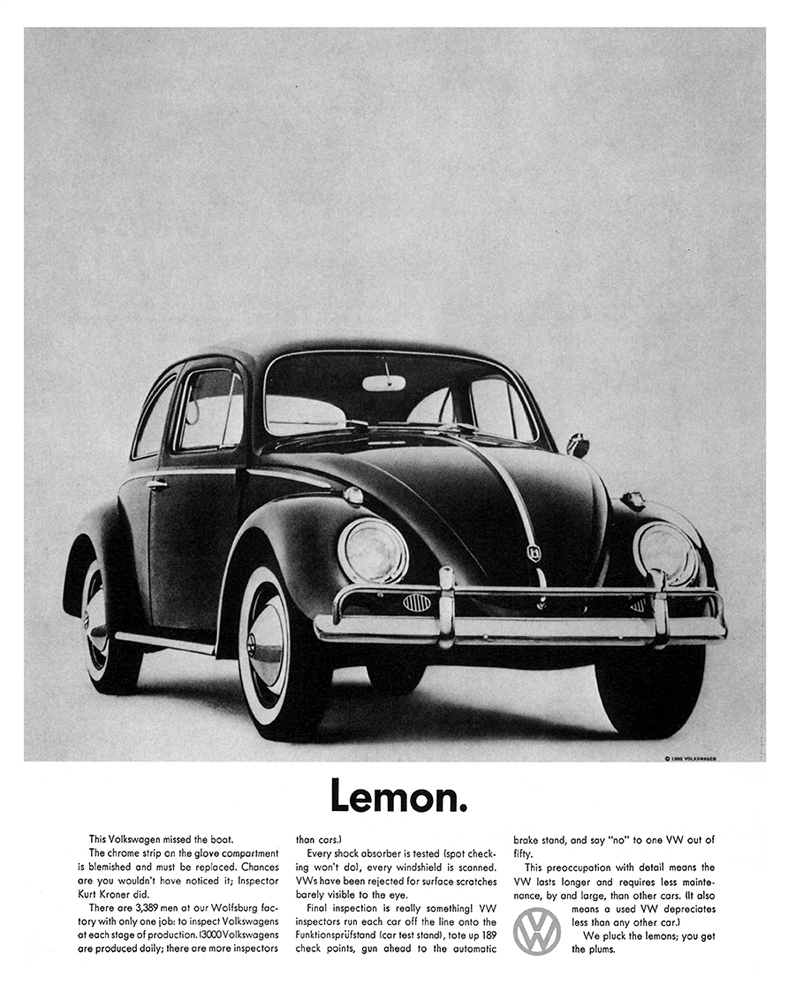
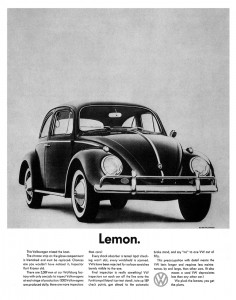
Back in the 50s and 60s Bill Bernbach, sold the new Beetle on facts, wrapped in a blanket of self-deprecating humor.

Many regard ‘Lemon’ as one of the greatest ads of all time and it’s full of facts.

“There are 3,389 men at our Wolfsburg factory with only one job: to inspect Volkswagens at each stage of production. (3,000 Volkswagens are produced daily; there are more inspectors than cars.)

“Final inspection is really something! VW inspectors run each car off the line onto the Funktionsprüfstand (car test stand), tote up 189 check points, gun ahead to the automatic brake stand and say “no” to one VW out of fifty.

Bernbach could have waxed lyrical about build quality of the VW. Except he chose to highlight the negative fact that sometimes a lemon is discovered on the production line, and that’s why you won’t get one.

This was all done at a time when ‘big was beautiful’ in American automotive design. Equally, platitudes and clichés formed the basis of most advertising copy.

If you tell people something they didn’t know, in a persuasive and entertaining way, there is a lot more chance that they will side with your point of view.

Empathy.

June 24th, 2011

Over the last three nights SBS, Australia have aired a TV show called Go Back To Where You Came From.

It has been described by the producers as a social experiment.

Here is a description of the format.

“Go Back To Where You Came from is a world first, three day television event following six ordinary Australians who agree to challenge their preconceived notions about refugees and asylum seekers by embarking on a confronting 25 day journey. Tracing in reverse the journeys that refugees have taken to reach Australia, they travel to some of the most dangerous and desperate corners of the world, with no idea what’s in store for them along the way.”

SBS is Australia’s multicultural TV channel so the audience would have a positive bias towards the subject. However what has been interesting is that over the last three nights the ratings of SBS have skyrocketed, culminating in over 600,000 viewers tuning in last night.

It wasn’t to everyone’s taste, as Channel Ten’s MasterChef Australia had an audience of over 1.5 million.

What is amazing is the interest and sympathy it has created in the subject of asylum seekers.

By placing these six people in the shoes of the refugees they have also opened the eyes of the average viewer to their plight.

So much so that the interest in the program went way beyond our shores and became the most tweeted subject in the world for several hours last night.

Empathy is a very powerful communications tool.

Water, Water Everywhere or water wars?

June 20th, 2011

Hayden’s latest app, Water, Water Everywhere, has just been made the Guardian Newspaper’s Consumer App of The Week.

That’s great news for the cause and for Hayden, as the app was praised for its ease of use.

It’s worth going to the comments section that’s down below the main article.

There are the usual trite comments on the pros and cons of using tap water but there is one interesting little battle that is being fought.

Apparently there is a ‘rival’ to Water, Water Everywhere called tapwater.org.

Now they may have very good ideals but they are, after all, ultimately trying to flog a drinking bottle.

It’s worth continuing down the comments because in an act of accord, Ben Kay, the creator of Water, Water Everywhere, has suggested they collaborate and share their locations.

Here is where a noble act could be perverted by a commercial imperative.

This remains to be seen.

What is more important than any of this, is the fact that many of us are still drinking bottled water, when we don’t have to, and that bottled water is costing us money and damaging the environment.

Surely the battle should be about reducing the consumption of bottled water and not about who’s got the best app or the most locations.

Water, Water Everywhere.

June 16th, 2011

Hayden has just developed another iPhone App.

This one is for ‘Water, Water Everywhere’ and is designed to show where people can get fresh, non-bottled, drinking water.

Here is part of the blurb that’s on the app.

“Bottled water is a huge unnecessary expense and creates massive environmental damage all over the world.

So why not use tap instead?

The Water Water Everywhere app shows you thousands of locations around the UK where you can ask for free tap water.”

It’s a great app that allows you to add places where you can find free, fresh, water.

At the moment all the sites are in the UK, which is useless for people who don’t live there.

So why not download it and add your own fresh water sites as you find them?

Here in Australia we have some of the best drinking tap water in the world yet so many of us buy bottled water.

It is now up on the Apple Apps Store.

This app is also an excellent example of collaboration as the idea came from Ben Kay in London. The graphics came from Crystal Lee, I guess she’s in the UK as well, and the development came from Hayden in Barcelona, then it was tested here in Australia.

Perception and reality.

June 13th, 2011

Australians have been shocked by the cruelty that’s being inflicted on animals in Indonesian slaughterhouses.

So much so that domestic red meat sales have dropped.

The meat and livestock industry have always been very careful to separate what we throw on the barbie from how it got there.

The supermarket or butcher has always been the middleman, shielding us from reality.

Now the consumer has been confronted with the reality that your prime porterhouse actually comes from a real animal, not a polystyrene tray.

I must confess that I am a blood-sucking carnivore and even I felt a pang of conscience as I tossed my slab of steak onto the flames the other night.

The interesting fact is that it’s only the butchers and markets feeling the financial pain, not supermarkets.

Does this mean that the perception of supermarket meat as being ‘faux’ animal is still the reality for most people?