First impressions are in many ways the strongest.
As we came off the ferry from Corsica into Santa Teresa Gallura, Sardinia, I had a feeling that life was simpler here.
The feeling is like Rosebud or Rye, on Melbourne’s Mornington Peninsula, during the summer holidays. There were family groups taking a break and enjoying the long days and warm evenings.
It’s not surprising that things feel familiar, as most of those beaches are the natural habitat of expatriate Italians.
At Santa Teresa Gallura we walked around the Capo Testa, a wilderness park at the end of the peninsula.
From there we drove via Tempio Pausani to Alghero and stopped off at the Nuraghe Majori. There are about 7,000 Middle Bronze Age Nuraghe in Sardinia, dating back to 1,600 BC. Much of their existence was based on the exploitation of mineral resources.
It’s easy to understand why they survived for over a thousand years when you see how much metal has been mined here.
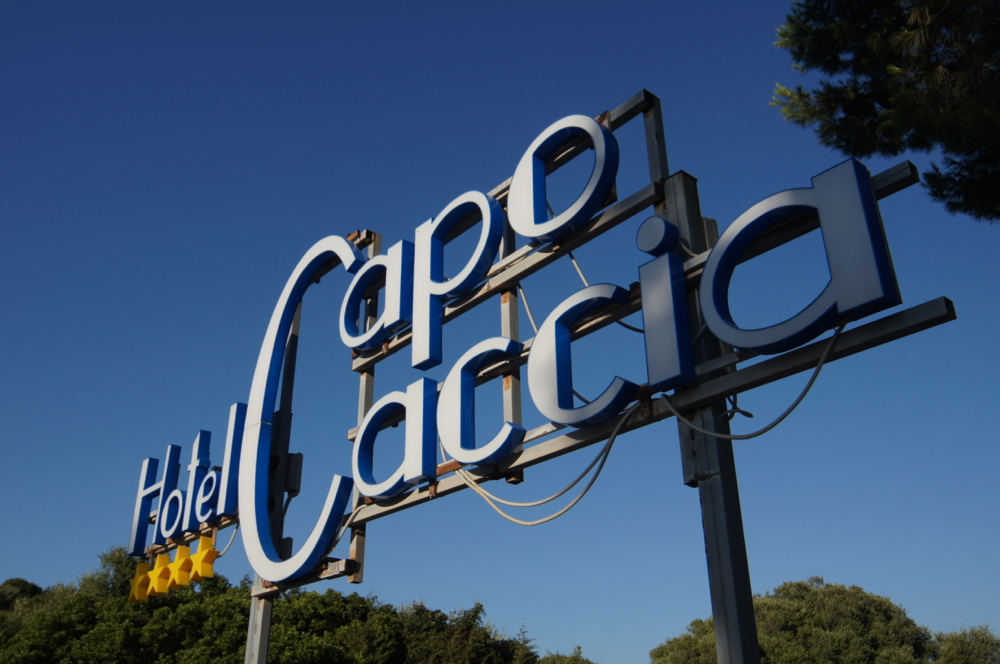
This feeling of simplicity strengthened when we booked into the Hotel Capo Caccia, a holiday resort frozen in time since the 70s’.
There were lots of extended family groups with young children and packs of teenagers, moving en-mass, around the hotel.
Italy is in the midst of an unseasonably early heat wave. It has lasted for several weeks, with temperatures in the early to mid 30s’.
On one of these very warm days we decided to descend the 674 step, known as Escala del Cabirol, or goat’s steps, down to Neptune’s Grotto a series of subterranean caves and tunnels.
Unfortunately we then has to climb back up.
Hungry for more pre history, we then visited the Anghelu Ruji Tombs, near Alghero.
These tombs, or Domus de Janas, comprising one or more chambers or corridors cut into the rock, are from the late Neolithic period. They are simply adorned with carvings in bas-relief of bovine heads and horns, simple geometric motifs and stylised human figures.
Like their Egyptian equivalent they are preparing the dead to enter the afterlife, however these are much more basic.
From there we drove to the Oristano region, down the coast road, via Bosa.
That’s after we had convinced our Sat Nav that this was the best route to take.
Bosa was a beautiful little seaside town with castle ruins set high on the hill behind.
Triposo had described it as a working town, without pretentiousness. They are right, as fishing boats, not luxury yachts line the riverside port.
Our next four nights were at Serra Pitta, an Agriturismo farm stay, just north of Oristano.
According to the regional tourist guide, rural tourism was established by Sardinian farming women in the 70s’.
As we found in Tuscany, it brings you closer to the local people and gives you an opportunity to see and experience working properties first hand.
In Tenuta de Papena we catered for ourselves but here we ate with the family and other farm stay guests, for two of the nights, and experienced the local food and wine. Much of which was grown outside our bedroom window.
Like all of our Sardinian experiences, this farm stay was simple and uncomplicated.
A lot of the farm work on Serra Pitta was done by hand and the family car was a tractor.
From the farm we did day trips to Oristano, Tharros and a long loop around the man-made Lago Omedeo.
The elegantly simple twelfth century church of San Pietro was moved to Zuri to make way when the valley was flooded.
While we were searching for the prehistoric funeral tower ‘Menhir Cuccura Tundu’ we happened upon an abandoned burial site, similar to the Anghelu Ruji Tombs. This site wasn’t only abandoned by it’s original Bronze Age inhabitants but by the local tourist authority as well.
There was nothing there except an empty ticket office and an overgrown and desolate car park.
Our last few days on Sardinia were spent just outside Cagliari at the Hotel Restaurant Calamosca.
The hotel part of the Calamosca combination was another time grab from the 70s’ but nowhere near as charming as the Hotel Capo Caccia.
However in the evenings the restaurant was the place to be.
The official opening hours were 8:00 to 9:00pm but the holiday makers, glowing from a day in the sun, were still lining up at 11 to get a seat.
This is one of the few hotels in Italy where the public beach is actually better than the private one.
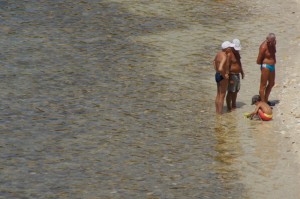
The day is spent standing, sitting, walking and talking in the shallows or on the beach. The constant chatter, that starts at 7am, is only broken by the approach of another plane load of tourists coming in to land or the whining of a small child who has had too many hours in the sun.
It’s hard to imagine, but as English speaking travellers we were as rare in Sardinia as we were in Bulgaria.
Lonely Planet describe Sardinia as the ‘Forgotten Island’. I think that most Italians who holiday here would prefer to keep it that way.
The migrating Flamingos, that were dotted around the waterways near Cagliari, seem to like it as well.







The highs and lows of Montenegro. (July 2012)
August 3rd, 2012Having spent the last few weeks near coastal resorts, during a heat wave, we decided to head for the cool of the mountains in Montenegro.
The rugged mountain ranges near Kolasin and Zabijak are dotted with glacial lakes that are set amidst world heritage national parks.
During the winter months, and they are long and cold in this part of the Balkans, these mountains towns are ski resorts.
Summer tourism is relatively new and the infrastructure is still under development.
Much of the accommodation is in apartments or 70s’ hotels that have seen better days. The meals are big but the beers are small (250mm) and warm.
However the scenery is spectacular and well worth the winding, bumpy mountain passes you have to take to get there.
We eventually did get down to the coast at Kotor, which was still in the grip of the heat wave.
Due to the lack of any real beaches, this medieval walled city isn’t as crowded as Budvar which is further south on the Montenegro Riviera.
The mountains are never far away and they loom large as an impressive backdrop to the town.
The harbour is almost in the centre and the cruise ship docked there appeared to be parked in the main street.
Dwarfed by the liner were the the usual array of sleek, tax evasion yachts, flying the flags of Nassau and the Cayman Islands.
The resorts are only now getting back to the tourist numbers they experienced before the Bosnian War (1992-1995).
As a result there is a big contrast in the service you receive, not only between the city and the country but also within the same establishment.
We were soon to discover the difference between waiting and serving.
On two nights we ate at the same restaurant in Kotor that was right on the water’s edge.
The first night we were served by an enthusiastic guy from Bosnia.
He was very attentive and continually checked on our progress and satisfaction level.
So much so that we engaged him in conversation and learnt a bit about him.
This gave us a richer cultural experience.
On the second night we were served by one of the locals from Kotor.
The service was prompt and efficient but there was no interaction.
He got a tip, just as the guy on the first night, but he didn’t earn it in the same way.
He served us our food but didn’t wait on our expectations.
Posted in Comment, Photography | No Comments »