Archive for the ‘Grumbling’ Category

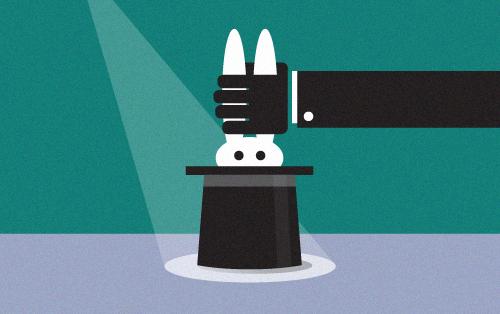
Put the magic back into advertising.

Thursday, February 11th, 2016

rabbit_and_hat_6

The only way a client will buy an idea is if it’s sold to them.

These days they just don’t buy it without a solid, business based, rationale.

In the past an ad agency was a magnet for clients. They were drawn there because it was a wonderful world of clever thinking and creativity.

Yes, there was booze, long lunches and pretty girls but there were strange people who dressed differently and, more importantly, thought differently. They were challenging, aggressive and they had ideas that were beyond the client’s grasp but, strangely, they seemed to work.

Clients trusted the agency to create solutions that would help their business grow.

So why did the clients suddenly decide they could do it all themselves?

It wasn’t sudden, it took years, because over time we abrogated our responsibility.

We took the path of least resistance.

We failed to quantify the ROI that good creativity can deliver and settled for delivering ‘what the client wanted’ rather than ‘what the client needed’

In other words it was easier to capitulate than fight. This resulted in the client believing that he was right.

Once that happened it took the magic out of advertising.

The client then believed that they could come up with the ideas and they could make the ads. All they needed was a Mac and a technician.

The rest is history.

They now have the Macs, the technicians and a belief that agencies are nothing but a cost centre that they can probably do without.

There is also a belief that the media is the message.

Success won’t come by simply having a presence on Facebook or YouTube. These messages still need to have an idea, one that will catapult them beyond being just a public announcement.

We have to put the magic back.

This will only happen once we give our clients something that they can’t do themselves. And that is still clever creative thinking.

However there is no magic wand that we can wave to return the status quo. We now have to ‘prove’ our worth by justifying the value of that creativity.

This will come down to statistics and the ability to quantify how a creative approach is worth the perceived risk.

It will also come from reintroducing the idea that a creative solution is also better value for money than a mediocre one, or no idea at all.

Creativity sells, it always has done and still does now.

Agencies once promoted themselves as being the conduit between the client and the consumer – we have forgotten how important that is. By connecting the client and consumer, through great advertising ideas, we can again prove our worth.

Short term thinking and instant rewards are no excuse for taking the easy way out. Clients need to look seriously at their brand, its lifecycle and then be made aware of how important building a sustainable, long term, brand image is.

We must educate them to be able to articulate the importance of their brands to their senior managers.

In most cases we are not dealing with decision makers within our client’s business. At best we are talking to the people who have the power to say “Maybe”.

Arming the timid marketing person with the arguments to sell strategies and great ideas must be part of what we do.

Great work isn’t bought by clients, it’s sold by agencies. Advertising is the art of selling and great ideas need to be sold.
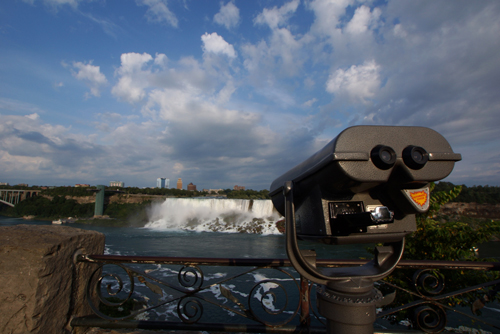
Niagara Falls, one of the un-natural
wonders of the world. (August 2015)

Tuesday, December 8th, 2015

DSC07061

We wanted to see Niagara Falls and were told that the best views were from the Canadian side. Both the American and Horseshoe Falls can be seen from the western side of the Niagara River and this is in Ontario, Canada.

We arrived mid afternoon and as our motel was a fair distance from the attractions we decided to walk down to the falls and stay there for dinner.

Visiting Niagara Falls is like seeing one of the Wonders of the Natural World on a wide screen TV.

Apart from the falls themselves there is nothing natural about the surroundings or experience. They are the pinnacle of commercial exploitation of a natural phenomena.

Hotels, restaurants, fast food outlets, casinos, shopping centres and viewing points dominate the scene.

Then after dark the falls are bathed in an un-natural spectacle of coloured flood lights with a fireworks display on Friday and Saturday nights.

To compound the influence tourism has had, the water is regulated to flow less, after dark, when the tourists aren’t around. This is primarily to allow more water to be diverted for hydro electricity generation – it’s still screwing with nature.

The falls are spectacular, if you look beyond the commercialism, but it is a strain on the imagination.

This however isn’t a new phenomenon with world acclaimed tourist destinations.

The view of the Golden Arches (AKA McDonalds) behind the pyramids of Giza, is testament to this.

The first recorded siting of the falls, by a westerner, was by the French explorer Samuel de Champlain in 1604. I am sure that what he viewed with amazement back then, looks nothing like what tourists fall over themselves to see today.

What a fuck up. or When travelling goes
horribly wrong. (March 2015)

Friday, May 1st, 2015

Now I am not normally superstitious, but our problems did start on Friday the 13th of March, 2015.

On our last full day in Cuba we had to move from our Casa Particular to a hotel because our agent hadn’t made the correct booking and had us leaving a day earlier than we should have.

Then, the next day, the taxi we had pre-booked to take us to the airport didn’t turn up and we had to get another one.

At the airport the time came and went for our Air Cubana flight from Santiago de Cuba to Havana. This turned into a 6 hour delay, causing us to miss our connecting flight to Mexico City.

When we finally boarded we found that the call button on the Air Cubana flight was just there for show, and didn’t actually work – I guess that summed up customer service on Air Cubana.

Getting to Mexico was crucial, as we had accommodation booked there for two nights and were then due to fly to Puerto Vallarta, on the coast, to meet Ev and Steph.

Once we realised our dilemma, we started to make enquiries as to how to sort it out. We were sent from office to office, but no one seemed to want to help.

Finally we tracked down the Air Cubana supervisor, who said he would sort it all out, but this was a total lie.

He then clocked off, confidently telling us that he had organised everything with the new supervisor. She had no idea what to do and then sent us to a desk, one that we had already visited, and again they couldn’t help.

The biggest issue we were facing was that our connecting flight to Mexico wasn’t with Air Cubana but with Aero Mexico and the Air Cubana staff didn’t see it as their problem.

Everything was compounded by the fact that another Air Cubana flight, this one to Paris, was cancelled. It was a Jumbo and full of very angry French tourists.

Clearly a couple of more laid-back Aussies could wait.

We had been up since 5am and apart from the seventy minute flight from Santiago de Cuba had been hanging around at airports – it was now 9pm.

At this point all we wanted to do was leave Cuba ASAP.

At about 10pm we were finally helped out by an Air Cubana staff member who, realising we were desperate, took us to the office of CopaAirlines.

There we discovered that the next morning there was a flight to Panama with a connecting one, an hour later, to Mexico City.

We tried to book it then but were told that couldn’t be done until 4am the next morning, as they were shutting up for the night.

We had no choice but to stay at the airport as it was now 11pm.

Still carting our luggage around we found some vacant seats and tried to get a few hours sleep.

Without anyone around to keep the airport warm the air conditioning reduced the temperature down into the low teens and we were forced to pull jumpers and coats from our packs.

At 4am we went off to buy our tickets. Earlier we had been told we could pay by Visa but were then told that we now needed cash.

This meant finding an ATM that would, firstly, accept our cards and secondly, cough up enough money to buy the tickets – tickets that we so desperately needed.

By 5:20am we had the tickets and had to rush to get the plane as the gates were closing at 5:30.

What a nightmare 24 hours.

There was something positive that came out of this experience – Copa Airlines. They are based in Panama and have good aircraft, great service and wonderful, friendly staff.

Our trip so far. (October 2014)

Sunday, October 12th, 2014

I have written 14 blogs and taken over 3,000 snaps, but not been able to publish a thing.

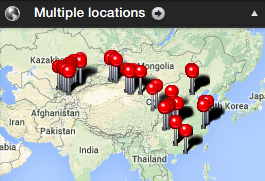
The internet has been so poor in Hong Kong, Guilin, Chongqing, Hangzhou, Beijing, Shanghai, Xi’an, Lanzhou, Jiayuguan, Yangshuo, Turpan, Urumqi, Almaty, Bishkek, Cholpon-Ata, Arslanbob, Osh, Fergana and now Tashkent, that I will have to resort to this map, from iPhoto, showing where we have been.

Hopefully we will get a good connection soon and I can start to post for real.

Our trip so far

First Class, Business Class, Economy Class
and now Amoeba Class. (May 2014)

Monday, June 23rd, 2014

Amoeba

We usually fly economy, especially on shorter journeys. The service, food and legroom has alway been of a high standard, especially with Emirates, our preferred carrier for flights to Asia or Europe.

On our recent trip to Tonga we flew with Air New Zealand.

Little did we know that we had purchased a basic flight option, which was called ‘Seat+Bag’ This was, as it suggests, a seat in the plane and 1 checked bag.

Nothing else.

No food, no drinks, no movies, just tea, coffee and water.

We made the trip to Tonga in two legs. Melbourne to Auckland (3h 30m) then Auckland to Nuku’alofa (2h 50m)

We arrived in Tonga at 10pm, so by the time we had been processed through customs and immigration, and made the slow drive to our hotel, it was midnight.

As expected, the kitchen at the Little Italy Hotel was closed.

Another by-product of Amoeba Class is that, because it costs extra to have stowed luggage, a lot of passengers only travel with cabin bags.

Some of these are huge and way larger than the official size.

We seemed to always be the last to be called on board, so by the time we got to our seats all the overhead lockers were full. You are then forced to stuff leftover luggage under the seat in front of you.

Now the Amoeba is one of the lowest forms of life, and that’s how we were made to feel on Air New Zealand.

But I guess that’s a consequence of budget travel.

The worst drivers in the world. (October 2013)

Wednesday, October 30th, 2013

It doesn’t matter if you are in Barcelona, Brisbane or Berlin, the world’s worst drivers are the ones that drive taxis.

Japan is a country where manners and civility are part of the culture. Road rage is non existent and people respect each other.

Here the taxis are retro 70s’ Toyotas and Nissans, with the occasional ‘green’, Prius. The drivers all wear ties and hats and many also have white gloves. They will even get out of the cab and help you with your luggage.

But, and there is always a but with cabbies, once they are behind the wheel they are as rude, arrogant and selfish as any of their counterparts around the world.

Cabbies are professional drivers who spend 8 to 10 hours day behind the wheel. They should be the best drivers in the world but almost to a man (and most of them are men) they are the worst.


Fewer choices than Gutenberg.

Monday, April 8th, 2013

Johannes Gutenberg (1398-1468) was a German blacksmith, goldsmith, publisher and most importantly a printer. He  introduced moveable type into Europe and by doing so started the ‘Printing Revolution’

This invention is regarded as being the most important event of the modern era. It allowed books to be mass produced and empowered the average person to attain knowledge.

Gutenberg’s first publication was in 1439, a bible set in a German Blackletter font. The importance of his invention was quickly recognised and typographers very soon developed new typefaces to work with this groundbreaking technology.

Within a few years hundreds of type styles were available in movable fonts.

Today’s designers are able to choose from tens of thousands of fonts when they want to print conventionally (Ink on paper).

This isn’t the case with web design.

Due to the restrictions of HTML, the language that is used to program web pages, screen quality and computer platforms, the web designer is limited to a hand full of font styles.

Google Websafe Fonts are touted as the answer but even these are subject to vagaries of technology.

A font that works well on Safari looks like crap on Firefox.

Hayden and I had a discussion the other night that followed the usual banter between a programmer, who follows logic, and a dreamer, who just wants it to be the way they want it to be.

Here is a part of the transcript of that chat.


Bruce:

G’day

Hayden:

Hey


Bruce:

We seem to have issues with Google Fonts. They look different between the Mac and PC.


Hayden:

Hmmm. What browser is Thea using?


Bruce:

Firefox.


Hayden:

Right, don’t worry, that’s normal.


Bruce:

Thea is showing me how the Google Fonts don’t work on her monitor.

So what’s the answer – Times New Roman?


Hayden:

Helvetica, Verdana.


Bruce:

Bugger that, I thought that we had some creative flexibility.


Hayden:

Well, you do.


Bruce:

But not with the fonts I want.


Hayden:

The problem is crappy font support in some browsers on Windows by the look of it.


Bruce:

This sucks. I think we should go back to HTML websites (Sites that are not WordPress) where the designers have the say and the clients just have to pay for it.


Hayden:

But these are HTML websites.

The problem is that you don’t have control over the browser used to view the sites.


Bruce:

Well they should be done in InDesign.

The smarty that develops that interface will make a fortune.


Hayden:

You can’t design a proper website in InDesign. Because InDesign doesn’t move.


Bruce:

I am talking figuratively, in that we (Designers) need to have flexibility to design.


Hayden: 

Complain to Firefox, Microsoft, Google and Apple, plus the mobile manufacturers.

It’s due to incompatibility that there are so many issues.


Bruce:

If the computer industry hadn’t embraced film editor’s thinking when they designed editing software, we would still be doing it on a Steenbeck (old film editing machines that were first developed in the 1930s’).


Hayden:

Yes but every format has its limitations.

I am still sure that there must be a way to get better fonts on here. But I’m not sure how.

I mean Titanium (A  Google Websafe Font) looks okay, except on Chrome.


Bruce:

But isn’t Chrome a Google interface and if so why doesn’t it support Google Fonts?


Hayden:

I have no idea. At the end of the day the fonts are probably handled by the operating system.


Bruce:

It’s not your fault, it’s that the industry is still run by the geeks and and not by the designers. Once it’s controlled by the creatives, not the techos, it will improve. That’s just history.


Hayden:

I’m not sure. Because at the end of the day, you’re frustrated because you’re used to a different system.

Younger designers have grown up with the current limitations. In fact they’ve grown up with more restrictions than currently exist.

So, perhaps they’ll never know.


Bruce:

Ah, but there in lies the solution. Develop a system that has unlimited creative possibilities.


Hayden:

Technically impossible.

Look at Adobe products. They don’t allow unlimited creative possibilities and they’ve been in development for over 20 years.


Bruce:

I disagree, they allowed the designer to experiment with thousands of fonts, on as many layout options as they could imagine, and they did it all in a fraction of the time it took them to do it conventionally.


Hayden:

Perhaps I’m being pessimistic.


Bruce:

Remember I was there when there was only hot metal type and a layout pad…. 

it’s come a long way since then. 


Hayden:

Yes it has.


Bruce:

We should have this discussion in 5 years time. I think it will have changed a lot by then.


Hayden: 

And you’ll be complaining that you can’t do everything you want to. (-:


Bruce:

But that’s what it’s all about. If we don’t aspire to do it differently, it will never happen.

Letterset (Rub-down letters) came into existence because typographers couldn’t kern type tightly enough with hot metal. Then when computers took over Quark had a kerning option. The same thing will happen to web design, someone will come up with a better way, they always do.

So getting back to basics, I’m stuck with Helvetica? It’s a bit like being stuck in the 60s’


Hayden:

Well now. Google fonts should work okay. I don’t know why they don’t. Perhaps you could search for the best way to use a wide range on fonts on web sites.

I’ll have a look a bit later. But I’m in the middle of some IOS development at the moment.


Bruce:

It’s not your problem, it’s just that I thought that Google Fonts were the answer but apparently there are still many issues.


Hayden:

Well I’m the programmer for Caffeine Concepts, so it’s at least partly my responsibility.


Bruce:

Touche.

That’s the extent of my French, so I will leave you to earn a Euro/Dollar.


Hayden:

You missed out the accent I think.

Touché.


Bruce:

My French isn’t that good.


Hayden:

Neither is mine.

Democracy is failing us.

Monday, December 10th, 2012

“People are good, it’s the politicians who are the problem.”

We have heard this thought thoughout our travels, expressed by young and old alike.

The majority of people we have met have been honest and open, willing to listen and understand your point of view.

They all see political posturing as a hindrance to understanding and accepting our collective differences.

We heard this in Egypt, Jordan, Turkey, Bulgaria and Romania.

We also heard the same thought expressed in Spain, Italy, France and the UK.

These are all countries that have gone through, or are going through, difficult times, of varying degrees.

Politicians polarise opinions and bipartisanism seems to be a strategy of the past.

As the Governator* put it,”…a worldview that put parties ahead of people…”

Political parties have become so partisan that they try to win favour with the voters by doggedly adhering to an extremist point of view.

Political leaders aren’t winning the popular vote by developing an enlightened vision for the future, but rather stagnating the system by offering the voters no real choice.

Immediately they get into power, even if it’s by the smallest margin, their primary goal is to remain there, while the opposition’s approach is to be obstructionist.

Australia, like the rest of the world, is stuck in this malaise. Our problem is that we are in dire need of ‘Big Vision Politics’.

While most of Europe struggles under the flip-flop of political ideals, they are fortunate in that the big thinking in infrastructure has been done and executed.

There is a network of Autobahns, Autostradas, Autoroutes, Autopistas and Motorways throughout Europe. Most largish cities have a highly developed underground or tramway sytem in place. They keep cars out of the city centers and encourage the tourists and locals alike to use public transport and then provide a sytem that will cope with it.

Many cities have a single charge for any trip taken within the hour.

Nuremberg and Bordeaux have an excellent tram and trolly bus sytem, Valencia has a Metro as does Lyon.

These are cities with populations ranging from 400,000 to 1.2 million.

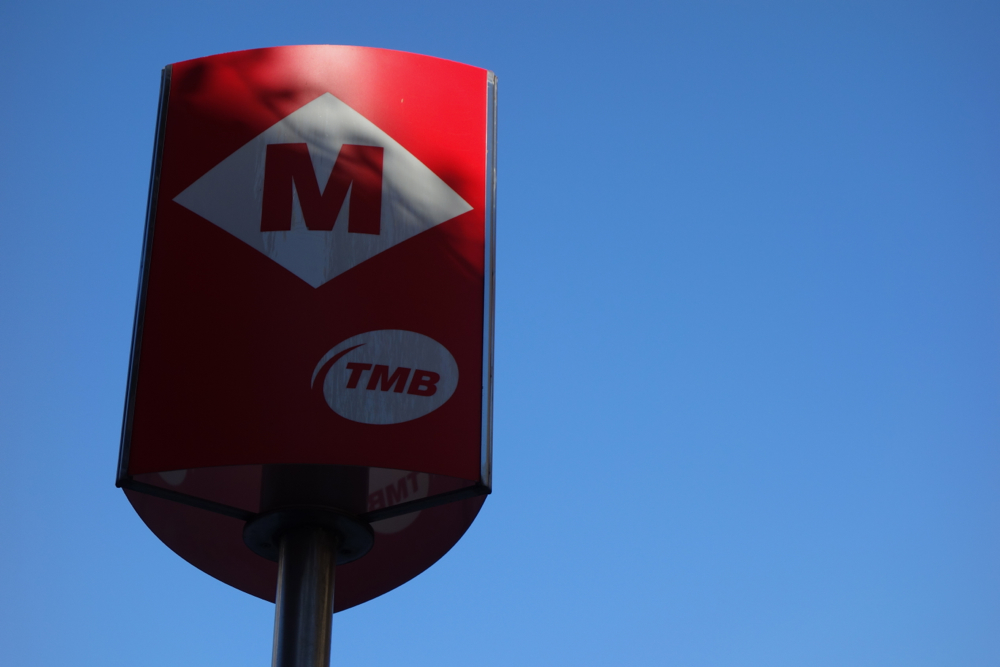
Barcelona has a comprehensive underground, overground, tram and bus sytem. All to service a population of 5 million.

In 2020 Melbourne’s population is expected to reach that number.

It’s time for the politicians to stop talking about more public transport and start to put a plan, any plan, into action.

As the Victorian oposition spokesperson has said, you can’t catch a feasibility study to work.

Therein lies the problem, they had years to do something about it when they were in government and again all they did was talk.

There has to be a better system, the current one is broken.

*(Page 555) Total Recal by Arnold Schwarzenegger

Our Pythonesque experience. (September 2012)

Monday, September 24th, 2012

We are in Land’s End, Cornwall and have just had the most bizarre experience.

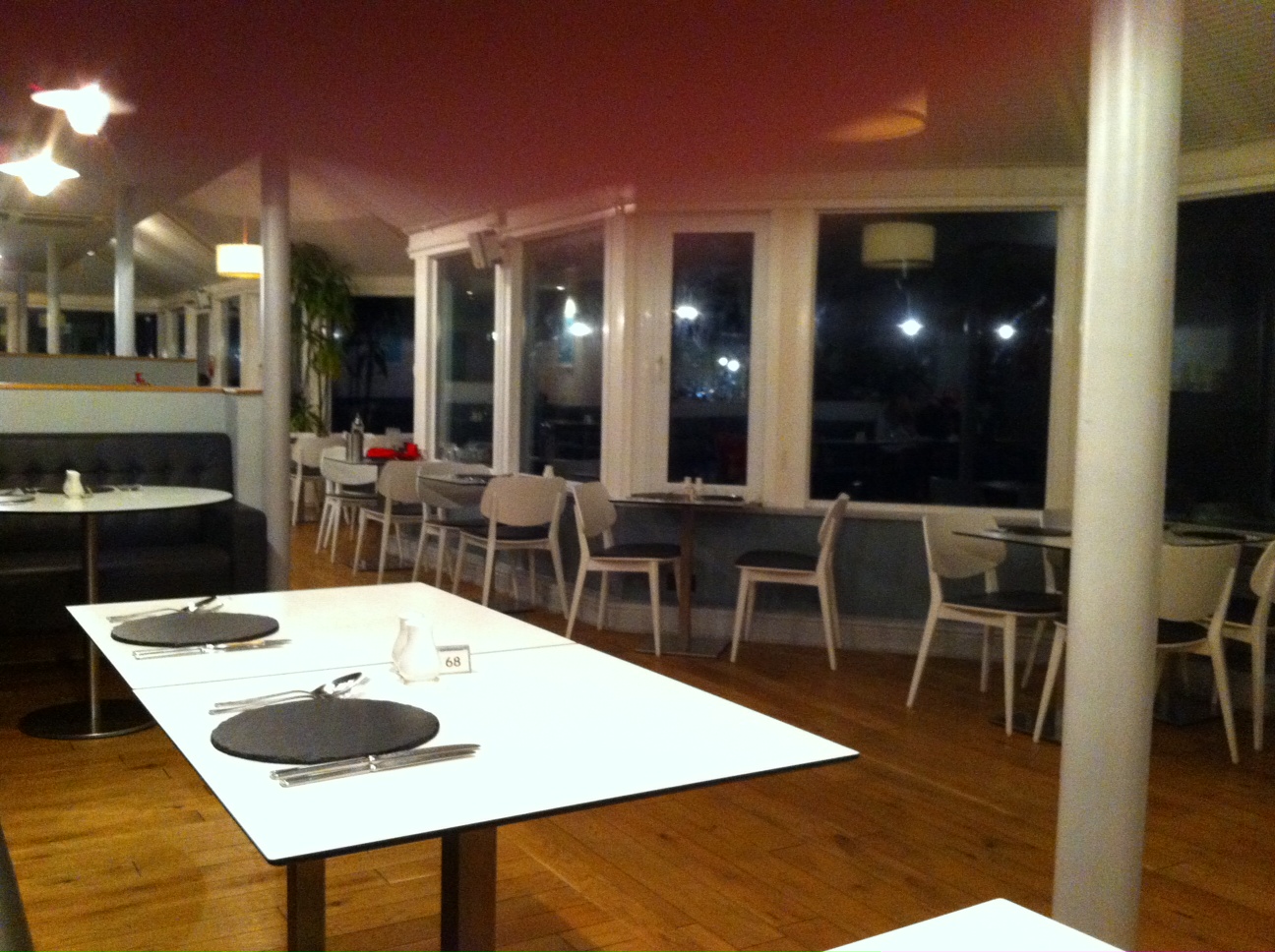
Over the last two nights we have booked dinner at the Land’s End Hotel restaurant. Each time we arrived at 8pm and the place was almost empty.

Tonight we arrived at 7:30 and not having booked, asked for a table. Like the previous two nights, there were far more empty tables than guests.

We were told that the next sitting wasn’t until 8:15 and we would have to wait, as the kitchen was overloaded and they were expecting a rush of guests at 7:45.

Come 7:45 the restaurant was still empty and we were still waiting.

I wonder if this was the place that inspired John Cleese to create Fawlty Towers?

Vodafone.

Tuesday, September 4th, 2012

We cancelled our contract with Vodafone in Australia because of their poor performance and inability to deliver on their promises.

Vodafone consistently spend large media dollars in hyping up their services. They have adopted the approach that if you continually promote a fallacy, it will become fact.

Their inability to deliver has lead to a class action in Australia and a mass exodus of their clients.

They have now suspended their considerable media spend, while they attempt to improve their coverage and services.

We stupidly selected Vodafone to purchase a broadband ‘Módem USB Stick’ for coverage in Spain.

Apparently this corporate leopard doesn’t easily change its spots.

The connection was poor and there were problems in recharging our account online.

So much so that we had to drive back to where we purchased the key and get it manually recharged there.

Their explanation was that the online service wasn’t working today but would be ok, ‘mañana’.

It still isn’t working.

Marketing works well when the delivery lives up to the promise.

Vodafone in Spain are following the Australian or more possibly the international strategy of promise first then try and deliver later.

Advertising will only work when it’s based on truth, anything else is phoney.