Bruce Stainsby's Blog: Muttering from the mo

Town and country around Cienfuegos. (March 2015)

April 9th, 2015

DSC02691

There are a number of ways to travel around Cuba.

We initially chose to use taxis and our first trip out of Havana was to Cienfuegos.

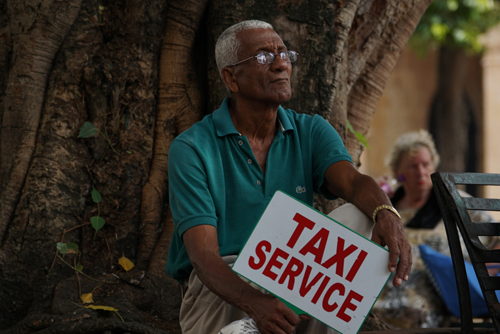
Taxis sound expensive but they’re extremely cheap, especially considering the flexibility and the fact that we are solo travellers and therefore don’t want to be reliant on airline or bus schedules.

Also our agent in Cuba, Yosvany, said he could arrange everything at very reasonable prices.

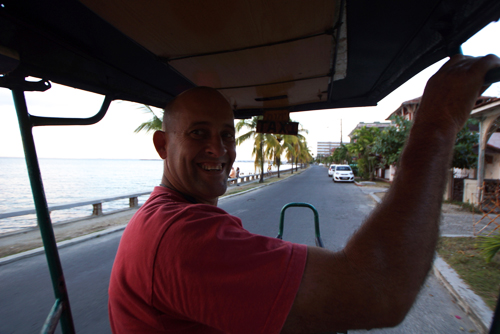
Oscar was our taxi driver to Cienfuegos which is about 238km from Havana.

It was motorway most of the way, starting out with four wide lanes then reducing to three as we got into the country.

Two thirds of the way to Cienfuegos is a small town, of about 6,000 people, called Australia. This was said to have been Fidel Castro’s base of operations during the Bay of Pigs operation in 1961.

Oscar felt the roads were bad. I thought they were fine, especially compared to many we had been on.

Cuba must go down as a country with the hardest seats in the world. Most of the restaurant seats are metal or timber and none have cushions. It’s really hard to have a long, leisurly meal in most places.

In Cuba cars are divided into three distinct eras.

There’s the pre 1962 ‘Classico Americano’, the post 1962 Russian models that are mainly Ladas and the modern era with a predominance of Korean and Chinese makes and some Europeans.

We drove in all of them.

Cienfuegos has a decidedly Francophile feeling. The original immigrants were French, coming from New Orleans and Philadelphia in the US and Bordeaux in France in 1819.

Once we had settled into our Casa Particular, Hostel Damilsy, we went out to discover the area.

The city centres around Parque Jose Martí. This is a UNESCO Heritage site with a celebrated collection of colonial architecture.

We then went for a long walk along Paseo el Prado down to the Punta Gorda, a small recreational area at the end of the peninsula.

This is where the rich families of Cienfuegos built their mansions.

One rather grandiose, but crumbling, edifice was the Palacio de Valle, with it’s very Spanish come Moorish influences.

The following day, at the insistence of our host, we drove to El Nicho National Park. This was with Rafael, in his 33 year old Moskvitch. It had a Lada engine and gear box and one handle to wind the windows up and down – this was the air conditioning control.

The Moskvitch was Rafael’s pride and joy.

The horn was more of a whistle that had a variety of different tonal expressions. The most commonly used was the ‘cat call’, which was sounded whenever a pretty girl caught Rafael’s eye.

Which happened a lot.

The radio was permanently playing Salsa but was drowned out by the roar of the Lada motor as we struggled up some of the steeper gradients.

The road is notoriously full of twists and turns with mango, orange, pineapple, bananas and coffee growing on either side.

And of course there’s hundreds of acres of sugar cane as well.

We walked to the waterfall with Rafael constantly pointing out the local bird life. Either we were too slow or they were too fast, because I couldn’t get a snap of any of them.

Rafael sent us off to explore the top of the waterfall and the lookout that’s just near by.

There we were befriended by one of the local guides who took us off on a ‘secret path’ to the caves further up the mountain. He also pointed out the local flora and fauna and even found a small snake which he insisted that we all hold.

I took photos.

This was all at a cost of course, but it was worth it.

We then had our most traditional food so far, when we lunched at Rafael’s favourite local Casa Particular.

The place was a menagerie of dogs, cats, birds and one unidentifiable rodent in a cage.

It was then back around the bends and down the mountain to Cienfuegos.

We had dinner at the Cafe Cantante Benny Moré, which was very fitting, as he is one of Cienfuegos favourite sons.

In the 1950s he became known as the Prince of Mambo and with his 40 piece orchestra toured the Americas and even played at an Oscars ceremony in 1957.

Music is in the air and it’s everywhere.(February/March 2015)

April 1st, 2015

DSC03192

We arrived in Havana late in the evening, primarily due to a two hour ordeal getting through customs, immigration and baggage claim.

It wasn’t complicated just painstakingly slow.

When we were dropped off at our Casa Particular (private accommodation) it was in the right street, but both the name and numbers was different to what we were expecting.

We never did work out what happened.

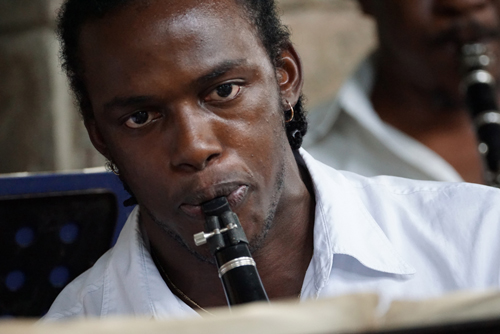
We were in the old colonial area and every bar and restaurant had live music.

This was a theme that was repeated wherever we went.

Yes, there are the old American cars and a medley of architectural styles, but it’s the music that’s the soul of Havana.

Having said that, the diversity of architecture is a treat, yet there would be only one building in five hundred that has been renovated.

The rest are slowly decaying away.

There is a plan to return this city to its former glory but it’s a long, slow and costly exercise.

Eusebio Leal Spenger is the city’s historian who has been the mastermind behind the rejuvenation of Old Havana.

Not only is music in the air but so is the aroma of Cuban cigars.

Smoking is actively encouraged, especially a fine Montecristo.

On our first morning we took the Hop-on Hop-off bus around the city. At $5 per person it was the cheapest city tour we have ever had.

This gave us a good idea of the layout of Havana and meant we could plan where to explore further.

In the afternoon we did a city walk through Habana Vieja, the old colonial area and the part of the city that has undergone the most renovation.

We ended up in the Plaza Vieja and there discovered the Factoriea Plaza Vieja Micro Brewery. This is an inspired addition to the tourist agenda and it never seems to have a spare table.

This could have something to do with the five litre beer towers that the customers line up to try.

Another example of Havana’s hospitality creativity is La Imprenta, a restaurant just near Plaza Vieja. It was formally an old print house or newspaper as it has a type themed decor and a display of old printing equipment.

It only occupies the ground floor as the upper part of the building is just a shell – like many buildings around the city.

The quality of the interior design unfortunately didn’t run to the food, as it lacked flavour, even though it was well presented.

And much to Thea’s disgust, white wine wasn’t even on the menu – that’s like having a type library without Times New Roman.

La Imprenta is typical of many restaurants that have sprung up since Raul Castro took over power and encouraged privately owned business.

It will take time, and the development of a quality restaurant supply chain, before Cuba becomes known for its cuisine.

After dinner we walked to Plaza de San Francisco de Asis only to discover an exhibition of Buddy Bears. We had seen these in Kuala Lumpur in 2012.

Another result of Cuba’s isolation is the lack of Internet services.

The contemporary tourist relies heavily on being connected in order to plan their movements and stay in contact.

We certainly do.

Telstra obviously don’t have a network partner in Cuba so we were in a connectivity black hole.

The next day we went looking for WiFi.

When we did track down a connection it was in a five star hotel and all we could do was download our emails from our iPhones, but not send.

Carlos III, is the shopping centre where the locals go. It has a decided lack of any branded products, well at least brands that I recognise.

There was Heineken and Adidas and that was about it.

Consuming large quantities of fast food seemed to be the most popular shopping experience at Carlos III, so I guess buying isn’t that important.

In Havana, Cristal is the local beer and it’s drunk like bottled water is in Australia. Adults of all ages seem to have a can or bottle in their hand as they walk around the streets. This could be mid morning, mid afternoon or late at night.

On our way back from the shopping plaza we popped into the local Catholic Church, Parroquia Sagrado Corazón de Jesús y Ignacio de Loyola.

This is a large church, in a Spanish Modernist style, with a very impressive interior of high ceilings and stained glass.

Late in the afternoon we had a quick visit to the The Palacio de los Capitanes Generales, which houses the Havana Museum. This is a beautiful building, made from the local coastal rock and housing a good collection of colonial artifacts. It was here that we had heard a rather good orchestra perform a couple of days earlier.

More music in Havana.

On our final day we took a taxi through the tunnel to the twin forts of Moro Castle (1589) and La Cabaña (1590).

These are on the other side of Havana Bay and from there you can get great views of the city.

This is the largest fortress complex in the the New World yet it was put under siege and captured by the British in 1762.

There are so many canons and canon balls in Havana that they are used as street furniture.

In the afternoon we took a one hour trip around Havana in 1954 Chevrolet Convertible.

This was definitely on the wish list of things to do. The sky was bright blue, just like the Chevy, so it was a perfect ending to a great adventure in Havana.

There is an entire industry built around restoring and maintaining these old ‘Yank Tanks’. There are people who rebuild the engines, others that look after the bodywork and even more who recreate the interior trim and soft tops.

The only concession to modernity is the inclusion of power assisted brakes. This is a government initiative designed to protect the tourists.

In the evening we had a final stroll around Plaza Vieja and then walked down to the Iberostar Parque Central Hotel. We were primarily there to check email, this time with our laptops. We stayed for dinner, where our wine mysteriously disappeared while we were at the buffet – we had only taken a sip.

It was very quickly replaced and became the running joke of the evening.

We never left our table unattended again that night.

Art, culture, resorts and tourists. (February 2015)

March 26th, 2015

DSC02332

We hired a car in Santo Domingo and drove ninety minutes east to the Hotel Vecchia Caserma, not far from La Romano.

This is the third largest town in the Dominican Republic and the area surrounding it has recently become a big tourist destination. Cruise ships can dock in the Romano River and there is the added incentive of an international airport.

And there’s golf.

Just outside of La Romana is Casa de Campo, a mega resort of 7,000 acres, built on land formally occupied by a sugar plantation.

There are three championship golf courses on the estate which is surrounded by luxury villas, condominiums and resort hotels.

On the eastern side and overlooking the Chavón River Gorge is Altos de Chavón.

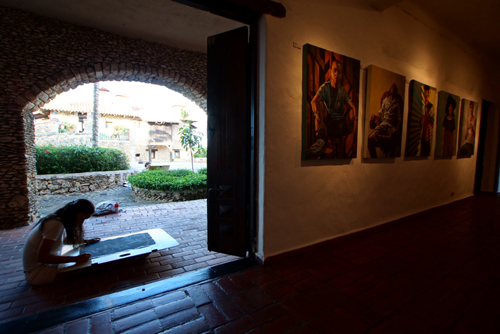
Inspired by medieval Europe and built by Hollywood, this replica Mediterranean village is a tourist attraction, that also houses a museum and art colony.

Roberto Copa, a former set designer had the idea and his friend, Charles Bluhdorn the chairman of Paramount Pictures, funded his dream.

This complex is like Montsalvat on steroids.

Construction started in 1976, using stone from a local road building project, and was completed in the 1980s.

It sounds rather kitsch but in fact it’s a very pleasant place to visit.

The 15th century Italian style village is a great stage for the numerous restaurants, bars and boutiques. However it’s also a great cultural experience.

The compact, but well curated museum, covers the periods from 4,000 BC to 1492, the year Columbus arrived. While the art school and galleries are part of the Altos de Chavón Foundation that give local Caribbean artists an opportunity to further their studies abroad.

There’s even a Roman styled, 5,000 seat amphitheater where such diverse artists as Frank Sinatra and The Pet Shop Boys have performed.

As the light faded in the late afternoon we went to see the beach used by the ‘Day Trippers’

That night at dinner there was a large table of ‘God Botherers’ sitting near us. They were so close, and so loud, that we couldn’t help but be engulfed in the sermon that the group were subjected to, once they had all eaten their fill from the buffet.

It was full of platitudes and jargon about the subject of ‘grace’, none of which made sense to me.

It brought to mind the Stephen Fry rant about what sort of god would create a world that is so unjust.

I must agree with Stephen, where is the grace in a god that allows so much suffering and poverty.

The group were 15 American missionaries that seemed very pleased with themselves and the work they were doing, in the name of god.

They were here to help build a new church. I would have thought that a school would have been of more value.

Education rather than indoctrination.

I couldn’t help but think that the Conquistadors and the Catholic Clergy that followed Columbus in 1492 had the same religious zeal. And look how they devastated entire ancient societies in the New World – and all in the name of god.

The next day we decided to drive around the eastern part of the Island.

Our first stop was Bayahibe, a small fishing village and resort east of La Romana.

That was the last real village we got to see for many hours.

As we drove east to Punta Cana and then north along the coast to towards El Cedro there was nothing but resorts, all with boom gates and heavy security.

The entire coast has been taken over by private enterprise, only catering to the packaged tourists.

We had heard that many of the roads were poor – our experience was very different. The ones we used were in excellent condition, however the road signs were quite ambiguous.

It was only after we headed south, over the mountains near El Seibo, that conditions got a little hairy. This had nothing to do with the roads, but rather the many landslides that had recently occurred as a result of the heavy rain.

The only other road hazard was the numerous speed humps that stood sentry on either side of every village and at most intersections.

These speed traps varied in height from a mere bump in the road to something resembling a rallycross circuit.

At one point we were stuck behind a fully laden pick-up truck who struggle to get over the hump.

Some of these obstacles were painted yellow, so you could see them coming, however the vast majority we unmarked and therefore unexpected.

The Kia’s suspension took a pounding.

It was a great road trip, my only regret being that I couldn’t get any snaps along the way.

The roads were windy, with cavernous drains on either side and all marked with double lines, making stopping impossible.

On our last day we headed out in the car again. This time we did a loop, travelling north and west, via Hato Mayor and then down into La Romana.

This is a large town, by Dominican standards, but not really set up for tourists. They come in and are immediately whisked away to the resorts. These are self contained enclaves that don’t really encourage their patrons venturing off the resort grounds.

Just like Christopher. (February 2015)

March 26th, 2015

DSC03108

Santo Domingo was our first stop in the Dominican Republic and our port of entry to the Americas.

Christopher Columbus visited here in 1492 and in 1496 his brother, Bartolome, set up a settlement.

At every turn the early history of the Americas leaps out to greet you.

Our hotel was in the old part of the city known as Zona Colonial, which is a UNESCO World Heritage Site.

This is a colourful place.

The full time job of most of the locals, including the school kids, is to separate you from your money.

Most of the kids just want you to take their photo, however some want money for the snap and others just ask straight out for a handout of cash.

They haven’t yet leant the more sophisticated scams of their parents.

On our first morning we were having breakfast in Calle El Conde, which is the main pedestrian strip. There were hundreds of school children, of all ages, filing past. We later discovered that they were on an excursion to visit the El Altar de la Patria, or the Altar of the Homeland.

It was originally built to be the mausoleum of the dictator, Rafael Leónidas Trujillo Molina, but ultimately given over to the three founding fathers of the republic, Juan Pablo Duarte, Francisco del Rosario Sánchez, and Ramón Matías Mella.

The 31 years of the Trujillo tyranny was believed to have resulted in the deaths of over 50,000 Dominicans.

We also walked down Calle Billini, a newly renovated street containing Convento de los Dominicos, the site of the New World’s first university. It’s also a street with some rather original ‘lamp post art’.

Many of the old streets are being rebuilt and there are signs out the front showing what renovations are being done. It’s to be hoped that during the renovations the power and telecommunications cables will find their way underground.

It was then on to Parque Colón, the centre of life in Santo Domingo. To one side of the park is the Cathedral of Santa María la Menor, built between 1512 and 1530, it’s the oldest cathedral in the Americas. On the other side are bars, restaurants and buskers of all varieties.

Fortaleza Ozama (The Fortress) dominates the riverfront and was built between 1502 and 1505. It’s also the oldest European styled medieval fortress in the Americas and was designed to protect the port of Santo Domingo.

The next day we went to the other side of the old colonial town and visited the Panteón Nacional and the Alcázar de Colón.

The Pantheon houses the remains of all the other heroes of the republic, while the Columbus Alcazar is the oldest viceregal building in the Americas and built by Christopher Columbus’s son, Diego.

Santo Domingo is really a family affair.

Then it was down to the ocean to see the waterfront boulevard and it started to pour.

This was tropical rain, the sort we hadn’t seen in months.

Before the deluge I did manage to get a snap of the giant statue of Fray Anton Montesinos.

In 1511 he spoke out about equal rights for the Taino Indians, the original inhabitants of the Island. Sadly the international fight for human rights is still continuing, over 500 years later.

Seeking somewhere to shelter from the rain we sort refuge in the cathedral.

This felt strange, as recently we had been scampering to a bar or pub when the weather turned sour.

However the rain kept up and we reverted to form and eventually found a bar – you can only spend so long in a church.

The skies were clearer for our final morning in Santo Domingo and we took a walk down to the waterfront – it wasn’t worth the effort. The buildings were run down and what beach there was, was awash with garbage.

The Americas. (February 2015)

February 26th, 2015
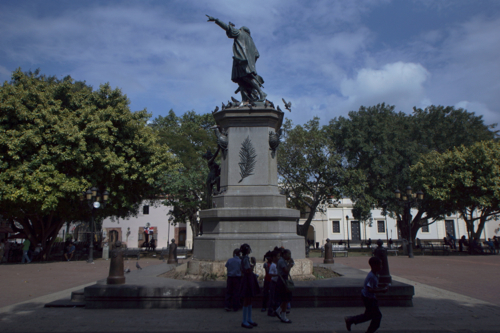
Christopher Columbus pointing north in Santo Domingo

Christopher Columbus pointing north in Santo Domingo

We are in the Dominican Republic and our first stop was Santo Domingo.

Christopher Columbus visited here in 1492 and there is a statue in the Parque Colón of him again pointing the way – this time towards yet discovered lands to the north.

This is very appropriate as that’s where we are hopefully headed.

As predicted the internet is poor and will probably get worse when we arrive in Cuba.

The New World. (February 2015)

February 19th, 2015
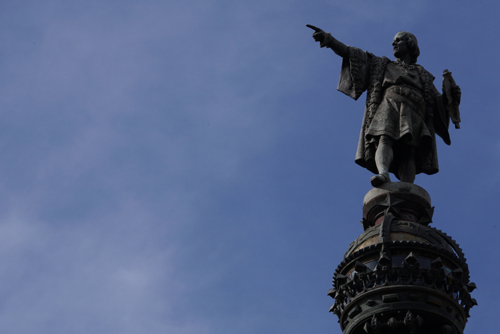
Christopher Columbus pointing towards his home of Genova, Italy

Christopher Columbus pointing towards his home of Genova in Italy

We have made the decision to continue our trip, this time to the New World.

Christopher Columbus, under the direction and finance of the Catholic Monarchs of Spain, set out on a voyage of discovery in 1492. He believed he was going to Asia but instead ended up in the Bahamas.

Ours trip hopefully won’t be as dramatic, as we are flying not sailing and we think we know where we’re going.

Our biggest problem might be the lack of connectivity.

A hotchpotch of places.
(December 2014/January 2015)

February 14th, 2015


Hotchpotch

We arrived in Barcelona in early December, with no plans other than catching up with Evan, Stephanie, Hayden and Andrea.

We did manage to squeeze in some sightseeing in Barcelona, pre and post Christmas, and then in Paris, on the way to the UK.

In London we spent time, both before and after our Christmas trip to Iceland.

This blog and the accompanying photos is a hotchpotch of miscellaneous sites and experiences from these various trips.

Barcelona, December 2014.

I have been to Mount Tibidabo a number of times but never to the top of the Temple Expiatori del Sagrat Cor. This is a Roman Catholic church and minor basilica located on the summit and visible from everywhere around the city.

The view of Barcelona from Tibidabo is always spectacular, especially on a clear day. This particular day was clear but very cold and the views past the statues of the twelve Apostles gave a new perspective to one of my favourite cities.

Paris, December 2104.

We took the fast train to Paris and spent two nights in a small hotel in the Montmartre area.

The hotel was small as were the rooms.

We spent most of the time walking around soaking up the pre Christmas Parisian atmosphere.

One highlight was a stroll along the Promenade Plantée, a disused elevated railway track.

London, December 2014.

London was the next stop with just enough time to buy a few Christmas gifts to take to Iceland.

The hotel room here was smaller that the one in Paris – I didn’t think this was possible. I wrote in my hotel review that there wasn’t enough room to ‘swing a budgie’. I think this description may have been lost on many.

The lights in London were better and brighter than Paris. This could have something to do with the fact that they were sponsored.

The Regent Street lights not only promoted the festive season but also the latest version of the annoyingly stupid, Night at the Museum, ‘Secret of the Tomb’

We spent a pleasant afternoon in Harrods where most people seemed to be like us, looking rather than shopping.

Then it was off to Iceland for Christmas.

London 2014/15. 

We returned to London to celebrate the New Year with Denis and Martine, our friends from Switzerland.

We rented an apartment in Canary Wharf, which turned out to be a great springboard for some long London walks.

And it was also a lot larger than the hotels we had been experiencing.

We strolled along the Thames, Camden Canal, Hyde Park and the Houses of Parliament and visited a couple of museums.

This was punctuated by frequent stops at London pubs.

After the New Year we had two cultural experiences. These were both photographic exhibitions that were poles apart, as far as subject matter and the way in which they were curated.

The first was at the Tate Modern and titled ‘Conflict Time Photography. This showed a large collection of photos that were taken after various conflicts, covering the 150 years since photography was invented. The exhibition was divided into time periods and covered the events seconds after, weeks after, months after and even decades after.

The second exhibition was at the Queen’s Gallery, Buckingham Palace and titled ‘Cairo to Constantinople, Early Photographs of the Middle East’. This was the work of the Royal Photographer, Francis Bedford (1815-1894) and chronicled the four month journey that the then Prince of Wales (later King Edward) took in 1862.

The Prince toured Egypt, Palestine, the Holy Lands, Syria, Lebanon, Turkey and Greece. It was interesting to see some of the places we had seen in 2010, 150 years later.

Our passports were groaning under the weight of stamps and visas. So much so, that we were forced to get them renewed.

We had to wait to get an appointment at Australia House and this gave us enough time for a side trip to Brighton.

Brighton by the sea 2015.

A walk along the famous pier, with its collection of bars, restaurants and amusement arcades gave us a real feel for this very British seaside resort.

Our hotel was right on the ‘front’ so we upgraded to get a room with a view. This was wonderful for our first day, as we could see the sun setting over the channel. It was a waste of money for the remainder of our stay as, in typical English fashion, the weather turned sour.

Our recent strategy has been, when it rains visit a shopping centre, and as Churchill Square was just around the corner we went there for a few hours.

The one place we did want to visit was the Brighton Pavilion, with its amazing history and faux Indian architecture, combined with Chinese interior design. The eccentricities of the British are encapsulated in this bizarre monument to King George IV.

On our last day we enjoyed a long Sunday lunch in an English pub, with excellent English ale, Spanish wine and typical British fare.

Then it was back to London for our passport interview. We paid for the quick service, to get our passports processed in three days. This was far cheaper than staying in a small London hotel for three weeks.

Then clutching our virgin passports we headed back to Barcelona. On arrival they were duly stamped on the first page – a good start to 2015.

Barcelona 2015.

Having seen all the significant sites around the city, we made it a plan to walk, rather than take the metro, to some of the places we had already visited. By doing this we would hopefully see some new things along the way.

We hiked to the top of Montjuic and back, twice.

On our first trip we walked around the fort, and the second time we visited the Botanical Gardens and the Montjuïc Cemetery.

Another day we visited the Barcelona Pavilion. This was the German stand for the 1929 International Exhibition and designed by Ludwig Mies van der Rohe (1886-1969). It’s a landmark building in modern architecture, using a very minimalist approach in its design.

Featured in the building, both then and now, is the Barcelona Chair, also designed by Ludwig Mies van der Rohe, with Lilly Reich (1885-1947).

The Barcelona Pavilion is very close to the Museu Nacional d’Art de Catalunya, so we spent a pleasant couple of hours there. This was made even more enjoyable by the fact that on Saturday afternoons, it’s fee.

Lacking a bit of Catalan culture we decided to visit Casa Batlló.

This is one of the most famous of the Antoni Gaudí houses in Barcelona, that was remodeled in 1905 on an existing building. Casa Batlló is privately owned and the commentary is much more commercial than in the state owned properties.

Despite the hard sell to buy at the gift shop, Casa Batlló was yet another exquisitely designed Gaudí masterpiece.

We also spent a very pleasant afternoon at the Palau Güell that was built between 1886 and 1888. This mansion was built for the extremely rich industrial tycoon, Eusebi Güell and is situated in the Raval district, very close to where we stayed.

It has been completely renovated in recent years and is a showcase of Gaudí’s early work. It highlights his use of the parabolic arch in the windows, fireplaces and the facade. Eusebi Güell was a main sponsor of Gaudí and even at the dawn of his career, believed in his talents.

Another who believed that Gaudí would prove to be a modern master was his university professor, Elies Rogent (1821-1897) who apparently wrote on Gaudí’s diploma, “We have given this title to a madman or a genius, only time will tell.”

We discovered another of Gaudi’s masterpieces, this one by accident, as we were wandering through the Gràcia area. Casa Vicens was another of his earlier works and built for the industrialist Manuel Vicens between 1883-1889. It was made a UNESCO World Heritage Site in 2005 and is only able to be viewed from the outside.

Casa Vicens shows the Moorish influence on Gaudi’s work, with red brick and an abundance of ceramic tiles. Manuel Vicens owned a tile and brick company, so it’s no surprise that Gaudi favoured these materials.

There were many architects in the Art Nouveau period but Gaudí stands out and being one of the most influential and creative minds of all time.

So much so, that the city of Barcelona continues the Gaudí tradition in the way they encourage new and exciting architecture. Even the design of street furniture in local parks and gardens seems to have been influenced by the spirit of his genius.

We enjoyed our ‘long Sunday lunch’ in Brighton so much, that we decided to make it a ritual.

Sitges.

We took a train ride 35km south down the coast to Sitges.

This is a beautiful coastal town overlooking the Mediterranean.

Our primary reason for the trip was lunch but there were some good opportunities to take some snaps.

My serious cameras hadn’t been out of their bag since Iceland so I almost needed a refresher course.

The Church of Saint Bartolomeu and Santa Tecla sits on top of a large rocky outcrop that divides the coastline. This dominates the scenery and seems to appear in most of my shots.

Barceloneta. 

Another Sunday, another lunch, this time down on the beach at Barceloneta.

We walk down to the beach via the Three Chimneys Park on the Parallel. The authorities in Barcelona seem to have a love of preserving old chimneys.

Where we lived in Montgat, in 2012, there were chimney stacks remaining from industrial revolution factories – long after the factories had disappeared. Then there are the Three Chimneys in Sant Adria del Besos. Originally built for a giant thermoelectric plant, they are now just a landmark that dominates the skyline.

After a wonderful lunch, outside and overlooking the Mediterranean we wandered down to watch a group of Slackliners – this is a type of gymnastics on a loose tight rope.

Their skills were amazing.

Vic.

Having lunch on Sunday was becoming a habit. This time we took the train 60km north to Vic.

This is a medium size town with a long history dating back to Roman times.

The highlight for me was the Roman temple which dates from the second century AD. It wasn’t unearthed until 1882 after it was discovered beneath the Castle of els Montcada. The temple was in excellent condition with only the portico needing major reconstruction.

We were completely at odds with the locals. We had coffee when they were drinking beer and wine. The opposite was the case in the late afternoon.

The Plaça Major is the centre of Vic, with a huge earthen rectangle surrounded by a mixture of colonnaded buildings. The only restaurants and bars that were open on this chilly Sunday afternoon faced west, making the most of the winter sun.

Raval.

After our travels in Paris, the UK and Iceland we returned to Barcelona, as we needed to stop, take stock and rejuvenate.

We had been travelling for over five months and needed to formulate a plan for the future.

Through Ev, Steph, Hayden and Andrea we had discovered the wonders or AirBnB, so we decided to give it a go.

We ended up in Raval.

Now this is a much maligned area of Barcelona, having been the centre of drugs and prostitution and now containing a large proportion (over 47%) of residents with overseas backgrounds.

We have found Raval to be one of the highlights of our trip, as it’s vibrant colourful and very entertaining. It offers a far richer experience than you normally find in the more sanitised tourist area of this wonderful city.

Raval is an area that is upwardly mobile, to use a hackneyed seventies expression. There is an ever increasing number of trendy restaurants and bars as well as ‘vintage’ clothing shops popping up at a frantic rate.

The Sant Antoni market, built between 1872 and 1882, in is in the midst of redevelopment and will be a focal point of this exciting part of Barcelona.

Raval also has art, and in particular a wonderful sculpture titled, ‘El gato del Raval’ by Fernando Botero. He’s the same artist who had several similar pieces in the Cascade in Yerevan, Armenia.

Like the Gothic quarter, frequented by the tourist hoards, Raval is a labyrinth of lanes and alleys. The big difference being that there are real people here, living and working, without any reliance on the tourist dollar.

There are no postcards for sale in Raval.

I am certain that there are more hairdressers or peluqueros here than any other place on earth. There are at least six within a hundred meters of our apartment and they are all offering a men’s haircut for €4, about AU$5.90.

Ironically, in a country that prides itself on its jamón (ham), there is also an abundance of Halal butchers.

Many of the local mini marts and a number of the bars and restaurants are run by the local muslims, yet many of them serve or sell alcohol.

Raval is a area of paradoxes and that’s what makes it such an exciting place to stay.

Our last day in Barcelona.

For six weeks we had been promising ourselves a visit to the Parc del Laberint d’Horta.

This large garden complex, situated on the outskirts of the city, is located in the former estate of the Desvalls family. It was built during the 18th and 19th centuries and featuring a rather challenging maze.

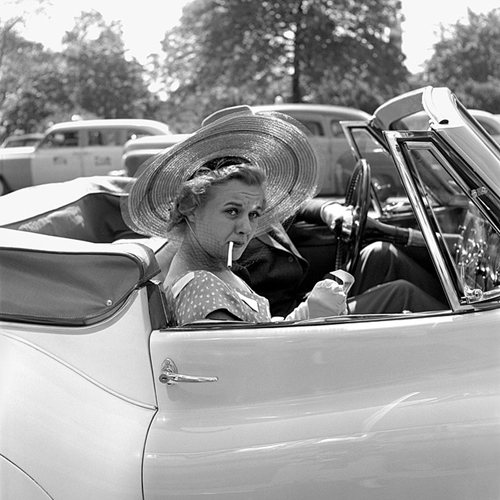
More about Vivian Maier.

February 13th, 2015

Untitled_1

Untitled

In July 2013 I wrote a blog about the amazing nanny come street photographer Vivian Maier.

Just today I received an email from Anthony at Artsy, an online art collectors website. He suggested that I might like to put up a link to their archive of Vivian Maier’s work.

It looks like a good site and if you had a spare US$3,000 you would be able to pick up a print of one of her photographs.

The light is always perfect, there’s just
not much of it. (December 2014)

February 8th, 2015

DSC02982

All the family came together in Barcleona to help Hayden celebrate the defence of his PhD. And as we were going to be in Europe for Christmas, we asked everyone where they would like to go – it was our shout. The only restrictions being that it had to be close to Europe and a place that none of us had been to before. It was our first Christmas together in seven years, so it had to be special.

Iceland came out the clear winner.

Now winter in Iceland offers two guarantees – the temperatures are low and the days are short. The sun rises around 11am and sets again four hours later at 3pm. However the twilight extends the available light for another two hours. Iceland is located at 64°08′ N and tucked up under the Artic circle. In winter the sun barely peeps above the horizon, even when it has fully risen.

But what magic light it is.

In winter the low light adds to the eeriness of the bleak, white landscape.

We arrived late in Reykjavik and once we were settled into our AirBnB, we very tentatively headed out over the icy streets to find dinner.

Staying upright was a challenge and we were constantly warning each other to beware of the slippery conditions.

We walked around Reykjavik, this included the Hallgrímskirkja church, port area, shopping street, lake and the flee market full of retro clothes and shoes.

Hallgrímskirkja is an Iclandic Lutheran church that was designed by Guōjón Samúelsson in 1937. It took 38 years to build with work starting in 1945. Its expressionist style looks far more contemporary than a building designed in the first half of the 20th century.

With a smaller population than Canberra, Iceland is better educated, more sophisticated and more self reliant than most countries. The locals eat, drink and consume Icelandic products and produce – not because they have to but because they want to.

They are fiercely independent and very proud of their heritage. Reykjavík is one of the cleanest, greeness and safest cities in the world.

There are more book shops per capita than any other place on earth.

Due to volcanic activity geothermal heating is available to 90% of all buildings in Iceland.

We decided to hire a car and ended up getting a Toyota Hiace 4WD van, as we needed room for six people and their luggage. We wanted a 4WD as the road conditions were deteriorating with the onset of winter. When we picked up the Hiace we were given all sorts of dire warnings about the conditions of the roads.

We were therefore very glad that we had chosen to get something that could handle the icy conditions.

On our drive to Vik we made a detour to visit the Mid-Atlantic Drift fault line, in the Thingvellir National Park.

In the North Atlantic, this fault line separates the Eurasian and North American plates that passes through the centre of Iceland.

We also stopped off at Geysir, which is the original geyser and the origin of the name. The Great Geysir doesn’t do much any more but the nearby Strokkur Geyser erupts every few minutes, spouting boiling water about 30 metres in the air.

Next day we made the two hour drive to Svinafellsjökull Glacier, a magical place where the ice on the glacier is clear and blue. We spent over one and a half hours exploring an extremely small area. This is a glacial tongue that comes from the Vatnajökull ice cap. It’s the largest ice cap in Iceland, covering an area of 8,100 square kilometres and, in places, over 1,000 metres thick.

We walked along the black sand beach near Vik with the famous, Reynisdrangur rock formations just off the coast. And in what was left of the afternoon light we visited the 62m high Skógafoss and Seljalandsfoss waterfalls. Their slippery ice paths almost take you to the base of the falls.

In the evening we went looking for the Aurora Borealis. It was only moderate but we got a good idea of the spectacle.

I took some snaps using my Gorilla Grip but they weren’t a patch on Evan’s shots using a traditional tripod.

On Christmas Day we did the very Australian thing and went to the beach.

This wasn’t to play cricket, on the golden sands after a big turkey lunch. Instead we went before our lunch of roast Icelandic lamb and the sand on the beach was black.

It then started to snow, which made our white Christmas experience complete.

Later that afternoon we made a strange looking snowman, which we later called a ‘Snowblowie’, and threw snowballs at each other.

The locals must have wondered who this mad group was, that acted as though they had never seen snow on Christmas day before.

Our time in Vik was over so we packed and drove back towards Reykjavik, with a two hour diversion to the Blue Lagoon geothermal spa. The lagoon is outside so this experience was made even more bizarre by the fact that it snowed. We were sitting neck deep in the hot (39° C) mineral springs with snowflakes dropping on our heads.

You can also rub silica into your skin to get that ‘smooth as a baby’s bottom’ sensation.

That evening, while walking to dinner, the aurora gave us a show that was brief but far more spectacular than what we had seen in Vik.

We decided that we were having too much fun and not enough culture so we visited the Reykjavík 871±2 Museum. This is dedicated to the Viking settlement of Iceland. and built over the ruins of one of the first houses in Reykjavík. The oldest relics found of human habitation in Iceland were from 871, plus or minus a year, hence the museum’s name, Reykjavík 871±2.

The Reykjavík sits on the Tjörnin lake, which freezes in winter and is a haven for the local bird life. Swans, ducks, geece, arctic terns, elder, scaup and pigeons congregate around the slipway, in the hope of a free feed.

On our last afternoon we visted the Reykjavík Graveyard or Hólavallagarður. This is both a park and cemetary in one, that was concsecrated in 1838. It’s the burial ground for over thrirty thousand of Reykjavík’s former citizens and a favourite spot for bird watchers.

The snow and ice on the headstones made for some interesting snaps

We flew back to London on Icelandic Air, there were even faux Aurora Borealis lights flickering in the cabin.

Istanbul, our full stop on the Silk Road.
(December 2014)

February 7th, 2015

DSC03201

Istanbul, on the Bosphorus, was a symbolic last stop on our Silk Road journey. We had been on the go for three months, since leaving Hong Kong in the South China Sea.

Three months without a seascape.

So it was a very pleasant change to arrive in Istanbul to the sound of seagulls and the smell of salt air.

In Turkey you can put on weight, just by drinking the coffee.

Turkish Coffee that is.

I usually drink an espresso without sugar but in Turkey a good local coffee is hard to resist and I like mine sweet.

Having been in Istanbul just over 18 months ago, visiting sites wasn’t a high priority, so we just wandered around and had the occasional coffee.

That’s the beauty of ‘slow travel’.

We did cross over the Golden Horn to do some shopping.

The last time we were in Istanbul we discovered a wonderful sports store, that’s just over the Galata Bridge, so we returned.

This time to buy some warmer clothes.

The weather was getting colder, and we were planning to go to Iceland for Christmas, and what we had in our packs was not sufficient.

On another occasion we made a quick ferry trip across the Bosphorus, back into Asia. We were hoping to find a restaurant that we had visited in 2012, but we couldn’t even find the restaurant area.

Things are changing rapidly in Istanbul and the city skyline is a forest of construction cranes.

What has also changed are the prices.

We seem to be paying twice as much as we were thirty months ago.

Call it a conspiracy theory but I believe that the government, under the conservative leadership of Recep Tayyip Erdoğan, have increased taxes on luxury items, especially alcohol.

This won’t concern the majority of Turks, who are Muslin, but it will affect the very important tourist industry – it will also rile the secularists who dominate the western part of Turkey.

Recep Tayyip Erdoğan knows what side his support comes from, as he represents the conservative views of the eastern part of Turkey.

He has been so audacious as to try to belittle the importance of Mustafa Kemal Atatürk, a proponent of secularism and the first Prime Minister of Turkey – a man regarded by many Turks as a god.

Istanbul put on fine weather for our last day.

We visited the Basilica Cistern, one of many water reservoirs that lie beneath the city.

This was built in the 6th century during the reign of Byzantine Emperor Justinian I.

The roof is supported by a forest of 336 columns. Two of them have the head of Medusa, mysteriously one of them is upside down.

The cistern is capable of holding 100,000 tons of water, which is just a fraction of what’s there now.

The rest of our time was just spent wandering around.

We walked through Gülhane Park, where there was an army of gardeners planting thousands of bulbs in anticipation of spring.

The autumn, that had been chasing us for three months, was over and winter was right on its heels.