Archive for the ‘Travel’ Category

Forbidden cities and great walls. (September 2014)

Sunday, January 11th, 2015

DSC07412

Beijing is China’s capital and after Shanghai, the second largest city in China. It’s also regarded as the political, educational and cultural centre.

From what we have seen the Chinese love to be tourists in their own country, Beijing was no different.

Our guide in Beijing was Lucy and as she explained, a member of the Han community.

There are 56 different cultural groups in China with the Han making up 90%. The other 55 ethnic groups make up the remaining 10%.

I think that all the ethic groups love to travel as we found a huge diversity in the tourist mix.

We arrived late on a Sunday and the air was clear and the sky blue. The next day the haze was back but not as thick as we had seen.

Our first stop was the Temple of Heaven, one of Beijing’s largest temples and situated in a huge parkland area, not far from our hotel.

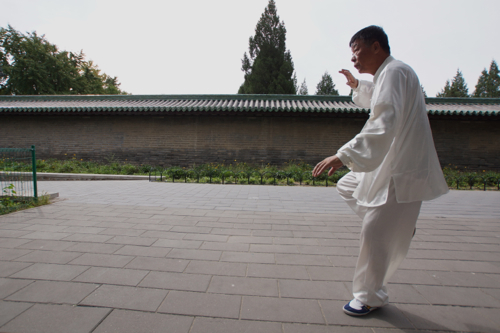
Here the local retirees do their morning exercises. This can vary from line dancing to hackie sack kicking with a variety of other activities in between. There is also mahjong and cards for the less active.

People are in groups or for the more solitary souls off on their own amongst the trees.

Many of these trees are very old, some dating back 400 years. We knew this by the plaques indicating their age.

The temple complex was constructed from 1406 to 1420 during the reign of the Yongle Emperor, who was also responsible for the construction of the Forbidden City.

This is where the Emperor came every year to pray for good weather and an abundant harvest.

Between visiting the Temple of Heaven and Tiananman Square we had tea, tasting five different varieties. According to our hostess every one of them had some amazing power to heal and revitalise the body.

Our next stop was the famous Tiananman Square, a vast open space dominated by public buildings on on either side, with Mao’s Mausoleum in the centre and the Forbidden City at one end.

This is a place that many Chinese wait their whole life to see and there were a lot fulfilling their dreams on the day we were there.

Other cities in China have a Forbidden City but the one in Beijing is far and away the largest and most impressive.

With 980 buildings covering 72 hectares, this is a vast complex, so it’s no wonder that it was declared a UNESCO World Heritage site in 1987.

Built from 1406 to 1420 it was the Chinese imperial palace from the Ming dynasty unti the end of the Qing dynasty. Built at the same time as the Temple of Heaven it has been the home of emperors and the centre of Chinese government for almost 500 years.

In the evening we visited the  Beijing Chaoyang Theatre, Acrobatics World. The theatre wasn’t full so our tickets were upgraded to VIP class. This gave us softer seats in the middle rows, close to the action.

Acrobatics have been a part of Chinese cultural life for over a thousand years, however this show was totally modern.

It was themed in an typical Chinese manner with umbrellas, pushbikes, hats and motorbikes. The motorbike act started with one bike speeding around inside a metal sphere, and ended with eight of them. At times it seemed totally chaotic, much like the Beijing traffic.

It was a relatively early start on day two and the haze was back. The temperature had also dropped a degree or two, which made climbing the Great Wall much more bearable.

On the way to the wall we had two obligatory factory visits, complete with shopping opportunities. One was to a jade workshop and the other an outlet that purported to make cloisonné (wire and enamel ware). It was really a front for a vast showroom.

We yet again resisted the urge to buy and moved on.

Once we reached the Badaling section of the Great Wall, at Lucy’s suggestion, we chose to walk on the south side. It was less crowded and more strenuous, but certainly worth the effort as we also got great views looking back to the north side. There were thousands clambering over the wall – the tourist invasion of 2014.

Not long into our walk the sky’s cleared and the sun made an appearance, improving the clarity of the snaps.

Forty two kilometers from the Beijing CBD, in the Changping District, is the Thirteen Tombs of the Ming Dynasty.

This area was also constructed by the Ming Dynasty emperor, Yongle (1402 – 1424). Based on the principles of feng shui, he chose to build his own mausoleum here.

Leading up to this necropolis is the sacred Road or ‘Spirit Way’ with statues of guardian animals and officials on either side, lining the way. The animals are all in pairs, with one pair sitting and the other standing.

We reached the Mausoleum of Emperor Chengdu late in the afternoon and the sun was low in the sky – the magic hour for photography.

The first hour of our last morning in Beijing was spent investigating if the Chinese Post Office could send my useless Sony lenses home.

It tuned out to be too hard to arrange as there was too much danger of them being broken. Not that they were of any value now.

We were then loaded onto a rickshaw for a ride through an old area of Beijing. These old areas are known as hutongs and are a tangle of narrow streets clogged with people and vehicles.

We then visited a ‘typical’ house of a hutong resident where the owner explained the way they live in this area. I have a feeling that this was more for show than authenticity. Still it was interesting to see how people live in the more traditional areas.

We had a separate guide for this trip into the hutong and Tony peddled along beside our rickshaw, narrating as we zigzagged in and out of the traffic.

Our last stop, before boarding the Bullet Train to Xian, was a quick visit to the Summer Palace.

This vast area, dominated by an artificial lake, was the summer resort of The ‘Dragon Lady’ Empress Dowager, Cixi. She diverted a fortune in silver, designated for the navy, to build this personal retreat.
There is only a bull and no bear in Shanghai. (September 2014)

Sunday, January 4th, 2015

DSC02360

Immediately we arrived in Shanghai we went to a Sony service centre. They believed it was the camera at fault but there wasn’t enough time to have it repaired. So it was then off to the Sony Store to see what replacements were available.

After two hours of trying different camera and lens combinations, testing my old lenses with demonstration cameras, and managing to break many of them, we decided to buy a new camera and telephoto lens.

We were only two weeks into our trip and the idea on not having a good camera was unimaginable.

It still wasn’t that straight forward as the store didn’t have the lens in stock, that had to come from the warehouse and in order to get a discount I had to buy the lens first, then the camera. We appreciated the chance to save a few Yen as the price of camera equipment in China is about 20% more than what you can buy online or in the States.

I had to wait a couple of days to get the new camera and lens so we were immediately back into the sightseeing.

The Bund was top of the agenda on our first morning.

This is a great introduction to Shanghai, as it highlights the paradoxes that make up this huge city of over 24 million people.

This is the city where east meets west and the Bund is a showcase for the city’s diversity of style and culture. This riverfront area runs along the Huangpu River facing the Pudong. On the Bund side are many old commercial buildings and banks that were built during the early part of last century. These overlook the Pudong, one of the newest areas in Shanghai, dominated by steel, glass  and neon monoliths.

From the Bund we went to Yu Garden, an excellent model of Chinese garden architecture. Built during the reign of Ming Emperor Jaijing in 1559 as a private garden for Pan Yuncuan, an administration commissioner.

The Jiangnan Silk Workshop was yet another ‘opportunity to buy’ we resisted and moved on to the Oriental Pearl Tower and History Museum. This is the Shanghai TV Tower and offers great views of the Bund from the Pudong area. There is a rather strange museum under the building that gives a censored history of Shanghai. This includes models of old motor vehicles, once seen in Shanghai, that have clearly been copied from the originals and scaled down.

In the evening of our first night we took the Metro back down to the Bund and wandered around.

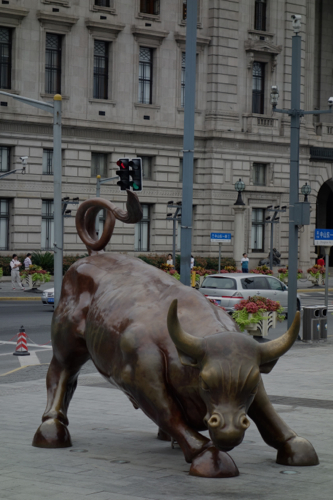
All the old buildings are illuminated, as are the skyscrapers in the Pudong, over the river. In the Bund there is a statue of a bull, no bear, that illustrates the Shanghaise and also the Chinese positive approach to business.

With the entire population of Australia living in the city, you get the feeling that your are not alone.

The Chinese have a  rather wonderful, self deprecating, humour when it comes to naming city sites. For instance the  clock on the customs house is called Big Chin (short for Chinglish or Chinese/English).

The rain put a dampener on activities for our second day and we were forced to pull out our umbrellas. The same ultra light umbrellas that were our souvenir of Japan.

We visited the Jade Buddha Temple, Xintiandi (also known as the French Concession Area), Nanjing Road and the Tianzifang arts and crafts area. All under the protection of our umbrellas.

The Jade Buddha Temple was founded in 1882 and, not surprisingly, contains two Buddhas carved from jade. These were made in Burma and then sent by sea to Shanghai.

The French Concession area is another link with Shanghai’s western past. The area was a foreign concession from 1849 to 1946 and still retains much of its original charm. There are a large number of European style residences as well as some excellent restaurants.

We returned that night to try one out.

On our last day we made the ninety minute car transfer to Suzhou. This is the city where Marco Polo arrived and not surprisingly named it the Venice of the East. Suzhou is in the Yangtze Delta and on the shores of lake Tai with many canals, stone bridges and beautiful gardens.

It’s a magnet for tourists, home to 11 million Chinese, the richest city in China and one of the fastest growing in the world.

The Grand Canal is the longest canal in the world, with the oldest parts dating back to the 5th century BC.

The Humble Administrator’s Garden is one of the main attractions and regarded by many as one of the finest gardens in China. It, along with other classical gardens in Suzhou, are UNESCO World Heritage Sites.

We also visited the Suzhou Museum, a contemporary building designed by the Chinese-American architect Leoh Ming Pei and completed in 2006. It houses a huge collection of ancient paintings, calligraphy, ceramics and crafts.

We finished our trip to Suzhou with a Grand Canal boat trip, complete with a serenade from the boatman.

Another nod to Venice.

Hangzhou, a philosopher’s view. (September 2014)

Monday, December 15th, 2014

A philosophers POV

Again shooting with the slightly malfunctioning Alpha 65 with the wide angle lens, and supported by the small RX100, we headed of to explore Hangzhou.

Our guide there was David. His mother is a philosopher and this was evident in his approach to life and the way in which he showed us around Hangzhou, his hometown.

As he explained to us, in questioning the meaning of existence, philosophers always look to the opposite side, never taking anything for granted. When things are good they look to see what bad things are just around the corner and then when things are bad they look to find the good.

David was a student of history, both ancient and modern. He was cynical about people’s motives throughout history and had many interesting stories to illustrate his cynicism.

From what we have seen so far, China is a prosperous, vibrant and ever expanding country. David didn’t share our optimism and believes that the country is on the verge of another revolution.

David explained to us that Hangzhou is the centre of software development in China. This isn’t writing original programs but rather hacking out vast amounts of code for software companies and even the big animation studios like Pixar.

Apparently there are tens of thousands of these ‘Digital Farmers’ working in the city. David was critical of this lack of originality and and the resulting exploitation.

On our first morning in Hangzhou we visited the Lingyin Temple, Six Harmonies Pagoda and the Dragon Well Tea Plantation.

The Lingyin Temple, originally founded in 328 AD, is a wealthy, large Buddhist temple with a variety of pagodas and grottos. The name Lingyin, roughly translates to mean ‘Temple of the Soul’s Retreat’.

The Six Harmonies Pagoda is on the edge of the Qiantang River and one of the most impressive in the city.

The temperature was still high and the humidity heavy but the walk to to top of the pagoda was worth the effort. The views were vast, even though there was a thick blanket of mist hanging over the river.

Or was it really smog?

From the pagoda is was a short car ride to the Dragon Well Tea Plantation. Tea farmers are amongst the richest citizens in Hangzhou. Their plantations are situated very close to the city centre and their tea is highly regarded in China.

The Dragon Well Plantation produces some of the best tea in the Hangzhou region and the water from the Dragon Well is said to possess magical powers.

We of course had a brew but to the surprise of our ‘Tea Lady’ didn’t buy any.

Hangzhou is a small city, of only 11 million people, and the geography is dominated by hillsides, covered in tea bushes and Westlake, a huge natural freshwater lake in the heart of the city.

In the afternoon we paid a visit to the Sony repair centre in Hangzhou. They were very helpful but weren’t able to work out what the problem was with the camera and lenses. They felt that the larger repair centre in Shanghai would be our best option.

David was amused by my two cameras, one large and the other small, he likened it to carrying a rifle and a revolver.

Overcoming equipment malfunctions seems to have become a pastime of ours.

We are lucky, in a way, that the internet is so poor that we haven’r been able to spend hours posting our blogs. Instead we have spent our time tracking down Sony repair centers or retail stores.

We then took an electric taxi back to the hotel. These ultra quiet, yellow boxes are becoming very popular in China, especially as the impact of pollution and the consequences of global warming becomes more evident.

Another very ‘green’ mode of transport in Hangzhou are the free bikes. There are over 3,000 bike stations throughout the city with 70,000 bikes.

Our hotel was situated on the edge of Westlake, so we had a long evening walk along part of the the east side of the lake.

We weren’t the only ones, as the banks were brimming with sunset strollers. The difference between them and us was that they had already eaten.

It appears most Chinese like to get the evening meal over early and the majority of local restaurants are shutting up by 8pm.

Westlake is the upmarket part of Hangzhou and commands prices to match. As David explained: “The closer you live to Westlake the more expensive it is, no matter if it’s a cup of tea or an apartment.” 

On our final day we had a boat ride on Westlake. This was in a craft that was built especially for Richard Nixon when he toured China in 1972.

Our next stop was a shop of traditional Chinese medicine. This is the second largest ‘pharmacy’ of its kind in China and was a potpourri of amazing aromas. There are countless staff concocting preparations from all varieties of animal, vegetable and mineral ingredients.

It was started by a very wealthy Hangzhou merchant who, when trying to get medicine for his ailing mother, was so disgusted by the lack of quality and service that he decided to DIY.

Or next stop was the former Residence of Hu Xueyan and the Yuyuan Garden. Hu Xueyan (1823-1885), was a leading businessman of China in the late Qing Dynasty.

The garden was built in 1559, during the reign of the Ming Emperor, Jailing. There are over two hectares of classical Chinese garden architecture with water features bridges, even an opera stage.

We were then taken down to the Hangzhou station to catch the Bullet train to Shanghai. We used the Bullet Train extensively Japan and I was interested to compare.

There was no comparison.

The art of queue jumping in China is a sly one.

Forty minutes before the train was due, people started to queue. Slowly, as the departure time got closer other passengers started to hover near the edges of the existing line and then subtly merge in. Then, with five minutes to go, those people who weren’t happy to be at the back of the queue, just move down to start a new queue of their own.

There is Yiddish word that beautifully describes this situation: shemozzle.

I had a feeling that we were going to be in many more shemozzles before this trip was over.

What price progress? (September 2014)

Thursday, December 4th, 2014

DSC06872

One hours flight from the calm of Guilin is the mega city of Chongqing, the starting point of our Yangtze Cruise.

Built on the banks of the Yangtze this regional capital is home to 34 million people.

It’s one of the fastest growing cities in China.

We were met at the airport by our new guide, Chris, and soon found ourselves in the midst of the Mid Autumn Festival celebrations, in Ciqikou, the old town area of Chongqing.

This area was a labyrinth of crowded, winding streets, full of vendors selling everything from grilled octopus on sticks to fortune telling on cards.

In the afternoon we visited the Three Gorges Museum. It’s dedicated to showcasing the history and culture of the local area. A history that goes back over two million years.

There is also a degree of political spin that justifies the building of the controversial Three Gorges Dam.

It was then down to the quay to board the Century Legend for our three day cruise of the Yangtze River.

As we slowly sailed north the scenery alternated between rural and urban. One constant was the development – China is very much a work in progress.

Late in the afternoon of our first day we ventured off the ship and visited the Shibaozhai Pagoda. The base of the pagoda was originally constructed in the Ming Dynasty (1364-1644) while the top tiers were built in 1956.

The Shibaozhai Pagoda has suffered from the rising Yangtze waters and now has a huge levee bank to stop it being reclaimed by the river.

The next day we had an early start, to visit the White Emperor City. It was originally built on a peninsula, now that peninsula is an island.

Another victim of the the Three Gorges Dam.

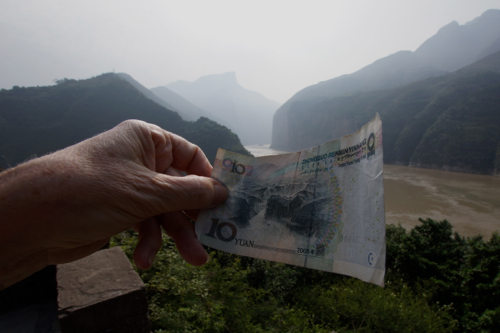
White Emperor City is also known as the City of Poems, as there are over 70 poems, carvings and cultural relics of the Sui, Yuan, Ming and Qing Dynasties at the site. So important is this part of the Yangtze that the view from the temple is featured on the Ten Yuan note.

Later we started to move through the first two of the three gorges, Qutang and Wu. The air was still hazy, a combination of smoke and fog.

Qutang is the shortest and regarded as the most spectacular of the three. Measuring only eight kilometers in length and 150 meters wide at its narrowest point, with mountains rising to 1,200 meters on either side.

The Wu Gorge, sometimes called the Great Gorge is formed by the Wu River and is 45 kilometers in length.

Late in the day we made a side trip up the Shennong Stream and it was here that I had a major camera malfunction. Both my 70-300mm and 18-55mm lenses stopped working.

Oh no, not déjà vu again.

A similar thing happened to me last year in Japan and I was forced to buy a new camera. It looked like I was up for more distressed purchases.

Our last night on board was a celebration of the Mid Autumn Festival and we were given a Chinese banquet with more strange cuts of meat. Cuts that, if we were home, would have be relegated to the abattoir floor.

Whatever we were served it was very tasty.

The highlight of the night was passing through the five locks of the Three Gorges Dam. It was excruciatingly slow, taking 3.5 hours to descend the 100 meters from the reservoir to the Yangtze River below.

Our final morning was another early start, as we were to make a trip to the dam wall.

The fog had closed in, which isn’t surprising considering that his area has at least 100 foggy days per year.

As we were due to fly to Hangzhou, early in the afternoon, we had to miss the Xiling Gorge, the last of the three. The Xiling was once regarded as the most dangerous, with whirlpools and strong rapids. However since the building of the dam the water level in some areas below the dam has increased from 3  meters to over 100 meters. This is the largest of the Three Gorges, taking up nearly half the length of the entire Three Gorges region.

The airport at Yichang is the smallest in China, and the quietest. We arrived far too early and had to wait for hours for our flight.

We could have seen the Xiling Gorge after all, that’s of course if it had been visible through the smog.

A land of shopkeepers.

Thursday, November 13th, 2014

A shopkeeper in Buhara

Uzbekistan and to a greater extent, all the former Soviet states along the Silk Road have a huge unemployment problem.

After the breakup of the USSR in 1990 the fabric of the socialist system started to disintegrate. The one thing the Socialists did was provide employment. The work may have been hard, mundane and poorly paid but it was work and it did put plov on the table.

Many of the indigenous inhabitants were nomads, who had been encouraged to come into the cities to work in the Russian and then Soviet factories. Once the factories closed they had no way of earning an income. They were untrained, all but illiterate and no longer had land or stock.

They turned to small business.

Many of the markets we visited are the main supplier of goods to these small family owned businesses.

If you have a table, a chair and something to sell you are in business. You don’t even need a table, as we saw one chap selling bottles of soft drink from a ground floor window.

Another enterprising woman had set her stall up, on one side of a pedestrian crossing, just across the road from a supermarket. She was selling cigarettes and her customers were those who had forgotten to buy their fags when they were shopping for groceries.

In Bukhara there’s a chap who rides the streets with a bike load of bread. He doesn’t make his money from selling the bread but from tourists who pay to take his photo.

On all the main roads leading in and out of cities and towns, vendors line the way. Close to the towns are the main markets with well presented stalls. The further you move out, the more you find the opportunists selling a lesser quality product at a cheaper price.

Then you have the black market money changers, buying foreign currency at a far better rate than you can get in the banks. Their profit comes from on-selling Dollars and Euros to the locals. They prefer to have their savings in a currency that’s not wildly fluctuating like their own.

You also have the Gypsies who make their living by holding their hand out. One of the pillars of Islam is giving to the poor, so they are always assured of a handout.

It was once said that Britain was a land of shopkeepers, I think that mantle has now move to Central Asia.

The tastes of Central Asia.

Thursday, October 30th, 2014

DSC01285

The food in this part of the world is unique, not just the recipes but also the ingredients.

The Silk Road was the melting pot of eastern and western cultures so it’s only to be expected that their cuisines also amalgamated to create something distinctive.

Lagma, a dish of noodles and meat, really begs the question as to where Spaghetti Bolognese came from and did pasta come from the east or west?

We ate dumplings that looked more like ravioli and Plov that’t somewhere between fried rice and Risotto.

The vegetables, herbs and spices combine to reward the palate in a way that I have not experienced before.

I am sure that this comes down to the fact that most of the food here, especially in the country areas, is unspoiled by herbicides, pesticides and other man made interventions.

We have been to countless markets and been overwhelmed by the aromas of the spice stalls and the faultless fruits and vegetables.

This perfect storm of taste and aesthetics results in meals that are both simple and remarkable in their delivery.

Their salads have been influenced by Chinese, Korean, Russian and European cuisines, yet they are nothing like you would find in Shanghai, Seoul, Moscow or Madrid.

The tomatoes are deep red and so full of flavor that all you need is a touch of salt and a drop of oil to create a mouth watering delight.

We were told by our guide in Khiva that it’s due to the high salt content of the soil that the Uzbek tomatoes are so sweet and flavorsome.

The herbs come fresh from the market, where they are expertly blended by the stall holders to your exact requirements.

Fruits, both fresh and dried, are in abundance.

Sultanas, apricots, raisins, melons, plums, figs, dates, pomegranates and berries are piled high in the market stalls. The vendors are very happy for you to try whatever you like and rarely pressure you to buy.

We were offered walnuts straight from the tree and strawberries fresh from the field.

The delightful result of this bountiful harvest ends up in the local restaurants, so you don’t just get to see and smell it in the markets, you get to taste it on your plate.

A fly on the wall.

Monday, October 27th, 2014

DSC01473

We are tourists and no matter how hard we try to integrate into a new culture or country we are still sitting in the audience – we are never on the stage.

We were in Uzbekistan for sixteen days and had been invited to at least five weddings.

Our guide in Samarkand told us that it was common for foreigners to be invited to join the celebrations.

It’s easy to understand why, as you are treated like a celebrity, wherever you go. This isn’t because you are, it’s just that the Uzbeks want to make you feel welcome.

Weddings play an enormous part in social life and are grand affairs. A small one might have 300 guests but it’s not uncommon to have more than a thousand. This is a huge expense, for all concerned, yet there is no hesitation in inviting a few more, especially if they’re Westerners.

Groups of school and university age kids want to be photographed with you and also want to take your snap.

The same groups are just as happy to spend time practicing their English.

Even when you approach older citizens they rarely refuse the opportunity to have their photo taken.

We can only sit on the sidelines and enjoy the view, but what a great and entertaining view it is.

On our last night in Samarkand we went to one of their best restaurants. This wasn’t full of tour groups but packed with locals, determined to have a great night out.

One of the by-products of the Russian, Soviet eras was the introduction of alcohol into a predominately Muslim society. On the whole they choose moderation over excessiveness, unlike their former colonial masters. The result is good humoured fun.

The venue was a huge palace with a large ground floor area full of party goers. The band was loud and the atmosphere vibrant.

There were no seats on the main floor so we went up to the first floor, where there were small rooms on a surrounding balcony.

The waiter thought that we wanted peace and quiet and insisted on shutting the door.

We opened the doors and had a wonderful Dress Circle view of the spectacle below.

At the end of the night we returned to our hotel and the locals went home.

The show was over for us but for the people of Samarkand, it was just another Friday night.

Adventurers not tourists.

Monday, October 20th, 2014

Alone but not lonely

In Bishkek, Kyrgyzstan we met two travellers who proved to me just how easily we do our touring.

One was at the Ala-Archa Gorge. He was a Spaniard, from Alicante, who was cycling, yes riding a bicycle, from South East Asia to Spain, via the Silk Road.

He had set up his tent and was settling down for the night, with a bottle of water and some food.

The temperature was dropping and we were heading back to our warm car that was taking us back to our warm hotel, where we would be able to get a cold beer.

We must have looked worried, because as we walked away he called after us:

“I am alone but I’m not lonely.”

The other was a Brit, who had just ridden a motorcycle from Bergen in Norway to Osh in Kyrgyzstan.

We met him at dinner and he was celebrating having a comfortable bed, a good meal and a cold beer.

Something we take for granted most nights.

He had left his bike in Osh with the intent of returning next year to continue his travels.

I am absolutely humbled by their spirit.

They are adventurers, we are just tourists.

Our trip so far. (October 2014)

Sunday, October 12th, 2014

I have written 14 blogs and taken over 3,000 snaps, but not been able to publish a thing.

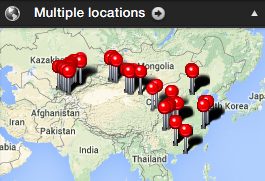
The internet has been so poor in Hong Kong, Guilin, Chongqing, Hangzhou, Beijing, Shanghai, Xi’an, Lanzhou, Jiayuguan, Yangshuo, Turpan, Urumqi, Almaty, Bishkek, Cholpon-Ata, Arslanbob, Osh, Fergana and now Tashkent, that I will have to resort to this map, from iPhoto, showing where we have been.

Hopefully we will get a good connection soon and I can start to post for real.

Our trip so far

You have to start somewhere. (September 2014)

Monday, September 29th, 2014

Our next big adventure is underway and the starting point was Hong Kong. After being on the road for over eight weeks, I now have enough bandwidth to publish a post, with photos.

After the hectic activity of packing our Melbourne life away, we needed a quiet start to what we hope will be six to nine months on the road.

The Big Buddha was the only thing we had planned for our one day in Honkers.

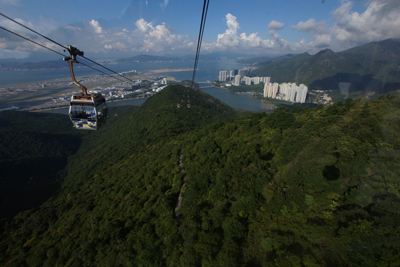
We took the train from near our hotel in Kowloon to Tung Chung, then the Ngong Ping Cable Car to  Ngong Ping Village.

The village is more a shopping mall than a cultural attraction with ‘opportunities to buy’ at every turn.

The central attraction is the Tian Tan Buddha or Big Buddha that was constructed in 1993. It is indeed big, standing 34 meters high and weighing 250 metric tonnes. It dominates the skyline on Lantau Island.

The cable car was a unique experience, as we opted to take the ‘Crystal’ cabins. These have glass bottoms, so you get an amazing view, both looking out and down, as you wend your way over the 5.7km journey from the Tung Chung terminal to the Ngong Ping terminal.

The highlight for me wasn’t the Buddha but the walk along the Wisdom Path, a winding track that runs behind the big fella.

The commercialism of the Ngong Ping Village had overtaken a small teahouse, that was at the start of the Wisdom Path. It had been abandoned and the the forrest was reclaiming the site.

Cow pads were everywhere but no sign of the bovines themselves. That was until later in the afternoon when we discovered the heard strung out along the track, eating their way towards the Big Buddha.

Hong Kong is a very commercial city and the Big Buddha is typical of that commercialism. I had a feeling that nature, and the cows were fighting back.

DSC06335