Archive for the ‘Travel’ Category

Nicaragua, right on the Pacific Ring or Fire.
(May 2015)

Thursday, June 11th, 2015

DSC05885

Managua.

After two short flights from Manuel Antonio, one in a 12 seater Cessna, we reached Managua, the capital of Nicaragua.

Nicaragua is the largest of the Central American countries with a relatively small population.

I think they all live in Managua.

It also has two of the largest fresh water lakes in Central America, predictably named, Lake Managua and Lake Nicaragua.

The tropical weather had set in and it was 35°C with high humidity.

Managua is divided into two distinct districts, the old part, which is north of the small volcanic lake, Laguna de Tiscapa, and the new part which is to the south.

It’s a sprawling city and we didn’t feel like trying to navigate around it in the heat.

So we hired a driver, come guide, to show us the highlights.

Eyner showed us the best of the old and new parts.

Managua suffered a devastating earthquake in 1972 that destroyed 90% of the downtown city area and killed over 19,000 people.

One of the buildings to suffer the most damage was the Catedral de Santiago. At the time it was deemed impossible to rebuild and at present just the shell remains.

It was designed by Pablo Dambach in 1920, then built and shipped from Belgium.

There is now talk of repairing it.

The new Cathedral of the Conception, that was completed in 1993 and replaced the ruined one, is a contemporary reinforced concrete construction, that really lacks the charm of the original church.

The locals believe it looks like a crate of eggs from the outside. This is due to the multitude of domes on the roof.

On the same square as the old cathedral is the National Palace, built in 1935, it currently houses the museum and library.

Like much of Central America, Nicaragua has had its share of heroes, violence and corruption.

There is a memorial and many statues to honour Augusto César Sandino (1895-1934)

He was a hero to the Nicaraguans and branded a bandit by the US.

He was assassinated in 1934.

In 2010 he was named by the nation’s congress as a ‘national hero’

A fascinating part of the rejuvenated city is the old port area on Lake Managua. This has been turned into a restaurant and picnic area.

Unfortunately there are no water sport activities as the lake is heavily polluted.

A rather bizarre addition to the street-scape are the giant, yellow, illuminated trees. These apparently are the brainchild of Rosario Murillo, wife of the president, Daniel Ortega. Inspired by Gustav Klimt, these symbolise the Tree of Life and are all over the city.

The locals believe that the money could have been better spent.

Our final stop on our Managua city tour was the food and craft market.

As Eyner pointed out, this market is the only one that’s safe enough for tourists.

We chose to stay at the more business oriented Holiday Inn Express.

This was for a reason.

One of our credit cards had been compromised and shut down so we had a new one sent by DHL courier to Managua.

We felt a business hotel would know how to handle a delivery.

They did and the new card was waiting for us when we arrived.

Because of the layout of the city there is no real tourist oriented hub where there are hotels with restaurants near by.

As it turned out our hotel selection was a good one, as the Galerías Santo Domingo was just up the road.

This is a shopping mall with a large and varied restaurant area in an enclosed courtyard.

The Holiday Inn even provided an hourly shuttle bus to the mall.

It’s a great solution for a city with a new growth area, that doesn’t have a traditional restaurant scene.

We returned to the Galerías Santo Domingo on our second night and the place was alive. There was even a band playing in a central courtyard.

The mall still had the ubiquitous fast food court, but this restaurant area was set apart and much more up-market.

A similar idea could breathe life into Southland and Chadstone malls that are traditionally lacking style, substance and good food.

Leon.

We hired a car in Managua and drove the 80km to Leon.

It was an easy drive in a rather abused Nissan Tilda.

The roads were mainly concrete and the surrounding country was more dry scrub than tropical.

Navigating is made much easier using the off-line features in Google Maps and Triposo.

Leon is one of the former capitals of Nicaragua, the other being Granada.

There was squabbling between the the two cities until Managua became a geographic and political compromise.

Leon was also the ecclesiastical centre and there is practically a church on every corner to prove it.

It’s a colonial city, the heart of which is Parque Central. There are many grand buildings, some in need of restoration and others already being restored.

The Cathedral is one that’s under renovation so the facade was a mess of scaffolding. However the interior was still open and very impressive.

The current church was built in 1747 in an American-Baroque style. The Stations of the Cross are vast murals, considered masterpieces in Central America, painted by Antonio Sarria.

On our first full day we went for a drive, firstly to the coast near Poneloya and Las Penitas then north to Chinandega.

The day was very hazy and not great for snaps.

We did drive on part of the Volcanic Route that took us past San Jacinto, Telica, Castila, San Cristobal and Chonco Volcanoes.

Both Telica and San Cristobal are still active.

Part of the road north from Chinandega is under repair, and for very good reason. The pot holes, I did’t manage to avoid, did nothing to improve the performance of the aging Nissan.

Once we were back in Leon we had our first encounter with the law.

Leon is full of one way streets, that aren’t always marked as such.

I stupidly followed one of the tricycle taxis (Tuc-Tuc) and found myself going against the traffic.

Obviously it was ok for him but not for me.

I turned around and went back, only to be confronted by a sour faced traffic policeman.

I acted dumb, not hard to do, and tried to explain that there were no signs.

He wanted to see my license, so I gave him my International one, even though it was out of date. I figured that if he wanted to use it as leverage, I still had my Victorian one.

Once he realised we were Australian he loosened up, gave me back my license and we were sent on our way, with instructions on how to find our hotel.

Our last day in Leon was a Sunday and coincidently Mother’s Day in Australia.

We had a leisurely lunch near Parque Central and then wandered around the city centre.

The days are getting hotter and more humid – the rains are on the way.

The eruption of the nearby Telica Volcano was a reminder that this whole area is sitting on what’s called the Pacific Ring of Fire.

Granada.

Driving from Leon to the outskirts of Granada was a breeze, then we encountered the one way streets again.

At many intersections there are no signs indicating that the street ahead is one way. I again found myself going the wrong way.

We eventually found the Hotel Dario and the bell boy jumped in the car and showed us how to get to the car park. This turned out to be just a street behind the hotel.

The Hotel Dario is a charming colonial building, right in the centre of the walking street and surrounded by bars and restaurants. It has an open court yard and wide breezy verandas.

Opposite the hotel was O’Shea’s Irish Pub. I am not usually one to visit Irish pubs, except in Ireland.

This was different – they served craft beer on tap.

I had a couple of glasses of Moropotente’s, 19 Días and it was very good.

I returned the next night to make sure that the 19 Días wasn’t an aberration, and ran into the owner, Tom O’Shea.

I questioned him about the brewer and the brew.

Tom had no idea. “It just comes in in big silver cylinders”

The luck of the Irish.

Granada is very different to the far lest developed and more modest Leon.

To start with it’s a UNESCO World Heritage Site. More of the buildings had been renovated and there was a greater tourist infrastructure in place.

This also means that everything is more expensive.

It was late in the day when we checked into the hotel and the afternoon thunderstorms were threatening. We walked around the city centre and then down to the edge of Lake Nicaragua. This is more an inland sea than a lake. In the haze the other side was barely visible.

Leon might have had a lot of churches but Granada wasn’t far behind. They were larger and in various states of repair.

After a morning of sites we headed into the mountains to La Catarina, a small tourist village that has a wonderful lookout over Laguna de Apoyo.

This is a volcanic crater lake with Granada just visible behind.

It was cooler and less humid with lots of locals also looking to escape the heat of Granada.

The next morning we took a tour of the isletas or islands near the coast of Lake Nicaragua. There are reportedly 365 tropical islands dotted around the lake, edge.

We stopped to visit Castillo San Pablo, a fort built by the Spanish in 1784 to protect Granada from pirate raids.

With 68% of Nicaraguans on the poverty line, life on the waterways is about survival. Fishing isn’t restricted so the locals fish to sell and feed their families.

They live side by side with the rich Nicaraguans and foreigners who build luxury housing on their own private islands.

The family who own Ron Flor du Caña, one of the worlds best rums, owns an island on the lake.

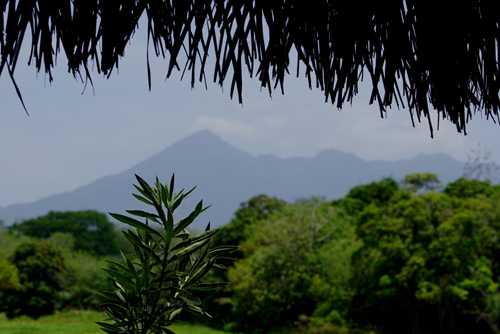
The Mombacho Volcano is a constant backdrop over Lake Nicaragua. In fact wherever you look there are the telltale silhouettes of volcanic peaks.

Spider Monkeys were introduced as a tourist attraction to one of the small islands. Aptly named Isla de los Monos or Monkey Island.

On the drive back from Granada to Managua we stopped off at the Masaya Volcano National Park.

As we pulled into the car park we were greeted by the smell of sulphur, as it wafted out of the Santiago Crater.

This is the most active volcano in Latin America and there are evacuation signs as we entered the park. I was particularly intrigued by the photo of a late model car with a rather large volcanic bolder imbedded in the bonnet.

I wasn’t particularly fond of the Nissan but I couldn’t see it subjected to that grizzly fate.

There’s even a warning to spend no more than five minutes at the crater’s edge, in case you are overcome by the fumes.

However there are flocks of parakeets that nest inside the crater and manage to survive.

We chose to do the rim walk around the extinct San Fernando Crater trail. This was a four kilometer, rocky, narrow and slippery track. Most of it running around the crater rim.

The highlight, apart from the views was discovering a flock of resting vultures.

These are truly ugly birds.

Then in total contrast we came across a white frangipani in bloom.

There were blossoming trees covering the crater floor.

Nature’s full of contrasts.
Panama, more than just the canal. (April 2015)

Thursday, June 4th, 2015

DSC04522

Our hotel in Panama City was pleasant enough but a little out of the way for our liking. It was neither in the new part nor the old part and we found that we had to do a lot of walking to get to the interesting places.

Reading the Lonely Planet we decided that the Casco Viejo, which is the old part of the city was just too dangerous – this was far from the truth.

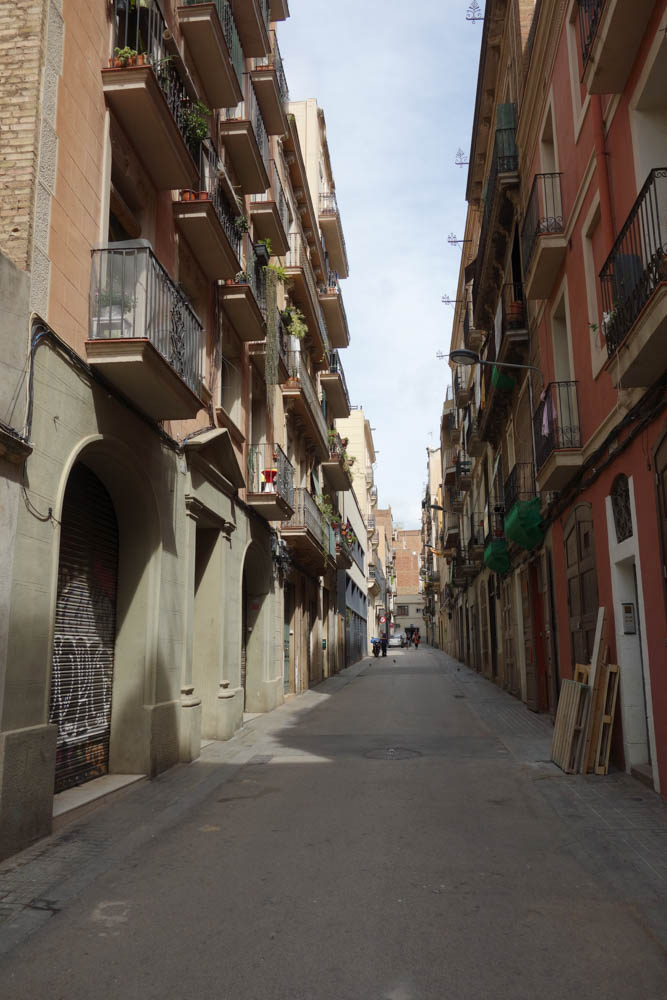
We should have learnt from our experience staying in Raval, Barcelona. These older parts are where the best restaurants and the real soul of the city can be found.

On our first day we found ourselves gravitating to Casco Viejo, where we found a lively rooftop bar that overlooked both the old and new parts of Panama City.

A common theme in Panama was: “It’s broken”

The lift and printer in our hotel and the WiFi at a cafe at Multicentro Mall.

Even on the Hop-On-Hop-Off-Bus, sometimes the PA system worked and sometimes it didn’t.

There were two sections to the bus tour, the canal tour and then the original old city or Panamá Viejo tour. There is nothing in Panamá Viejo but ruins, as it was reduced to rubble by the pirate Henry Morgan in 1671.

We walked around the newest part of the city, an area full of high rise apartments, office blocks  and luxury hotels.

It was here that we discovered the Hard Rock Hotel. Now call me uneducated but I have never set foot inside a Hard Rock Cafe, let alone a Hard Rock Hotel.

The foyer was a cross between a rock venue, a casino and a pop culture museum. There were instruments, photos and wardrobe belonging to famous rock stars from the past and present.

We looked to see what the price of a room is at the Panama City Hard Rock Hotel and were shocked.

These rock aficionados must be rolling in it.

If the number of German luxury sedans are anything to go by, then Panama has more wealth than we have seen so far in the Caribbean, Mexico and Central America.

We have also seen more people exercising and more sports stores. If another sign of wealth is self esteem, then Panama City is doing well.

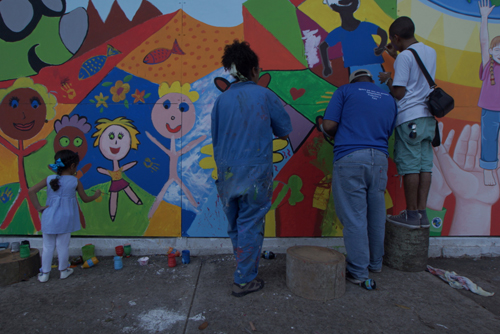
On Avenue Balboa we even discovered a community art project, which was a Mural for autism awareness. When communities can spend time and money on the needs of others, then there is a quality of life beyond survival.

Panama is all about ‘The Canal’ and no visit would be complete without a canal tour.

Our trip, on the Pacific Queen, started with a traffic jam and we nearly didn’t make it.

We asked reception at the hotel how long it would take to get to Isla Flamenco, where our boat was departing from.

Fifteen minutes, was his confident reply.

It took nearly 45 minutes, with Thea texting the tour organiser telling them we were on our way.

Apparently it takes that long every day.

Coming out of Panama City we passed two bridges, the first being the Bridge of the Americas, completed in 1962 and then the Centennial Bridge which is much newer, being completed in 2004.

The canal celebrated it’s centenary in 2014. It was built by the US, starting in 1904 and completed in 1914. Before the US the French attempted to build a canal in 1881. This failed due to engineering difficulties and the high mortality rate through tropical diseases.

The canal is 48 miles in length (77.1 km) and raises the ships by 85 feet (25.9 Meters) at each side of Lake Gatun. This is an artificial lake that provides water for the locks. The sea level is the same on both the Atlantic and Pacific sides. The reason for the locks is to cope with the tidal variations.

All the locks are gravity fed, there are no pumps. It only takes a relatively short time for 26,000,000 gallons to move from one lock to another.

In the morning large vessels travel northward, from the Pacific towards the Atlantic. They cross at Lake Gatun, where vessels that are coming from the Atlantic, pass to the Pacific in the afternoon.

Currently the canal can only take Panamax Class vessels. These are just smaller than the size of the locks – 110ft (33.528 Meters) wide and 1050ft (320.04 Meters) long, and 41ft (12.4968 Meters) deep.

There is a Panama Canal extension underway that will allow Mega Ships to pass through. It is estimated that this will double the income generated by the canal. The canal charges each vessel according to their size, so these larger ships will be able to generate greater income.

We were accompanied through the locks by a number of smaller vessels. One was first owned by J P Morgan, the American financier and then later acquired by the gangster Alfonse Capone.

I wonder how many of Big Al’s ‘colleagues’ ended up overboard.

After six and a quarter hours on the Pacific Queen we docked at Gamboa, on Lake Gatum.

We were then bused back to Isla Flamenco which only took 45 minutes.

The Panama Canal is not the fastest way to cross the Continental Divide, however it’s a lot faster than sailing around Cape Horn.

And I guess that was the point.

On Saturday we took a final walk into the old city – now we couldn’t stay away.

The waterfront isn’t that attractive when the tide’s out, with tidal mud flats, partly sunken boats and garbage.

We attempted to do the walking tour around Casco Viejo, that was suggested in the Hop-On-Hop-Off Bus brochure.

We did do it, but in reverse.

It was our last day and we had to get an early flight the following morning. Rather than do the walk and then eat, we did it the other way around.

We chose a restaurant that was near the end of the walk, so that’s where we started.

Casco Viejo is undergoing a major renovation. It was originally the top end of town then fell into a decline. It’s now starting to regain its former glory. Its here that the new city was established after Henry Morgan destroyed Panamá Viejo.

We met a friend from Australia who has just started a three months project in Panama. He is in the brewing industry and introduced us to La Rana Dorada. This is a Boutique Brewer who are making some rather nice beers.

Now the beauty of slow travel is that you have the time to re visit favourite spots.

La Rana Dorada definitely deserved a repeat visit.

Boquete.

We had another pleasant flight with Copa Airlines from Panama City to David, then hired a car and drove north to Boquete. This is a mountain area close to the Costa Rican border and known as the Valley of the Flowers.

The soil is rich and fertile with acres of flowers, fruit and coffee.

We had come for the coffee, as Boquete is regarded by many as the Nappa Valley of coffee and we planned to do a plantation tour.

It’s also home to a large expat community and the town has two distinctly different socioeconomic areas.

After we arrived we spent the afternoon driving around the surrounding hills. There are a number of loop roads that leave the town and then, inevitably, return.

As we were told It’s hard to get lost around Boquete.

The area has a decidedly non Panamanian feel about it. It’s more like the Swiss Alps in the tropics. The homes were large, many are timber with high pitched roofs and the pace was relaxed.

Admittedly it was Sunday when we arrived, but I had a feeling that Boquete never really built up a sweat.

Our experience at the Art Cafe on our first night was anything but inspiring.

We arrived in Boquete in late in the morning and this cafe seemed like a good place for a coffee.

The owner was a pleasant guy who showed us the menu and suggested that we return in the evening to have dinner.

Not knowing if the town, or the restaurants, were running on American or Panamanian time (Americans eat early, while Panamanians eat late) we turned up for dinner at 7pm.

Apart from one other diner, he was the only other customer than evening, the place was empty.

At 7:40 ‘mine host’ wished us good night and drove away. Immediately the staff started to pack up around us and finally, just before eight, the chef left.

We were still eating our main course, the restaurant was empty and the lights were out in the kitchen.

Then a strange thing happened, new customers started to turn up looking for a meal.

There were at least eight, many were locals and they all got turned away.

The owner, unfortunately I can’t remember his name, told us that he hoped to be able to sell the Art Cafe in a couple of years, for a good profit, and move on.

How sadly mistaken he is.

Another aspect of his business that I didn’t particularly like was that he only accepted ‘cash’ transactions. As we have seen in many places, this is a sure sign that he isn’t paying tax.

I am positive he would be the first to complain when the power went out or the roads needed repairing.

The next day we went looking to see the Cráter de Volcán Barú and then walk in the jungle.

We ended up having coffee.

The view of the volcano was constantly shrouded in heavy cloud. Then whenever we got near a walking track those clouds morphed into heavy tropical rain.

The drive was still spectacular with rich vegetation on all sides and steep, rocky escarpments rising out of the jungle.

The weather improved for our final day in Boquete.

We had booked a half day tour of a local coffee plantation. This was far less grand than the word ‘plantation’ indicates – it was more a hobby farm.

Finca Dos Jefes or The Farm With Two Bosses is only 7 acres and owned by an expat American, Rich Lipner. They are verified organic and very proud of the Arabica blend which has a tasting valuation of 91.

We were shown around the property by Gary Jackson, another American, and then given a rundown on how their coffee is grown, harvested, dried and blended. We were given an overview as to how it is tasted and what the tasters look for in a brew.

Cafés de la Luna is their brand and it has been described as having: “Undertones of dark chocolate, hints of walnuts and taints of vanilla”

It tasted like coffee to me.

If was explained to us that all coffee originally came from Ethiopia, a bit like the human race, and has spread around the world from there.

After roasting some coffee we then tasted two styles, one dark and the other a medium roast.

They were both very good.

These were served using a French Press, what we call a plunger.

Gary did also mention that espresso coffee has less caffeine than filtered or plunger coffee. This is plausible, considering the amount of coffee you have in an espresso is far smaller that in a regular coffee. Added to that is the fact that Robusta beans, used to make filtered coffee, have more caffeine than Arabica beans, which are used for an espresso.

The tour finished up with us all being offered a cold beer. Again this was good but I don’t understand why we were given a beer at a coffee tasting.

Like the Art Caffe, on our first night, Finca Dos Jefes only accepted cash and no receipt was given.

There seems to be a pattern here.

Boquete is also home to the world famous Geisha Coffee, which is the only coffee to have scored a perfect 100 from the international tasters. According to Gary, this coffee’s unique flavour comes from a combination of a perfect terroir and the jasmine bushes that were there before the Geisha Coffee trees were planted.

In the afternoon we went for a six kilometre walk to the Escondida Waterfall in the Volcano Baru National Park.

This is a beautiful rainforest area that has been unfortunately marred by the proliferation of water pipes, both steel and plastic, that remove mountain water from the waterfall and pipes it to the local farms and market gardens.

The actual waterfall was disappointing but the walk was very pleasant.

This area is also the home of the rare Quetzal, a strikingly coloured bird with red, green and gold plumage.

We thought we saw one, but we definitely did see the sign saying they were in the area.

Mexico City – take three. (April 2015)

Wednesday, June 3rd, 2015

DSC05355

We returned to Mexico City in preparation for our flight to Panama. We felt that we had done the touristy things and just wanted to walk around and look for the unusual.

It didn’t take long.

Throughout the main part of the city are organ grinders, without a monkey. These are guys, and they are all men, dressed in a khaki uniform, who expect to be paid for winding a handle. Many have an assistant who holds out the organ grinder’s hat for donations.

I guess they are in fact the monkey.

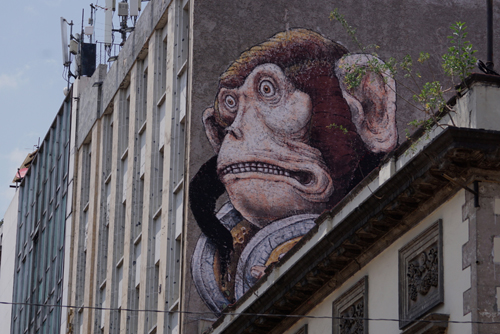
There are many murals painted on the city walls, one that took my fancy was funnily of a monkey. He was the only one we saw in Mexico City, apart from at the zoo that is.

The Museo Nacional de Arte is housed in a beautiful neoclassical building in the historic centre of the city. It was completely renovated in 2000 and has a large collection of Mexican art from the mid-sixteen to mid-twentieth century.

It was a Sunday and the museum was free, even for the Gringos.

As we left there was a Beatles cover band playing all the classics. They were rather good and a large crowd gathered around.

I wondered if any of the crowd had ever seen the Fab Four perform live.

Another delightful building is Palacio Postal or Main Post Office. It was built at the beginning of last century and renovated in the 1990s following the earthquake of 1985. It’s a mixture of many styles and can best be described as eclectic.

Casa de los Azulejos or House of Tiles is an18th century palace that was built by Count del Valle de Orizaba. It was taken over by the Sanborns brothers in1903 and is now their flagship restaurant.

Shooting had obviously finished on the new Bond movie so the Zócalo was free of barricades. We wandered around late in the evening. The buildings were tastefully illuminated, showing off each of the building’s classic features.

It’s no wonder that the Zócalo is regarded as one of the world’s most beautiful squares.

We had dinner at La Opera, an old world restaurant with high ceilings, waiters in white coats and an aging Mariachi band that wanted $7 to perform three songs.

Surprisingly they got a lot of gigs.

Mexico City Zoo is the proud owner of a number of Giant Pandas having developed a successful breeding program since 1980.

I am not a great fan of zoos and this one was reminiscent of the old style, with dingy enclosures and animals that look very much out of place.

Chapultepec Castle was started in 1775 and has the honour of being the only royal castle in North America that has actually been used by a sovereign.

The post Hispanic art of Mexico, that we have seen at both the Museo Nacional de Arte and Chapultepec Castle, appears to be more a record of history and story telling than decorative.

The Renaissance art of 16 century Europe told stories but only with pictures whereas in Mexico art is more like a graphic novel, combining words, story telling and decorative art.

Many of the painting and murals have an accompanying text. Some even have a legend with people and places.

Our last night in Mexico started off as drinks but turned into dinner. This was at the Gran Hotel Ciudad de México, which had an excellent roof top bar and restaurant that overlooks the Zócalo.

The building was originally the Mercantile Centre, built in 1899. It has a highly decorative Art Nouveau interior.

It was a fitting end to our third stay in Mexico City.

Copper Canyon, one of the world’s great train rides. (April 2015)

Tuesday, June 2nd, 2015

DSC04285

We flew from La Paz Airport, which was small, to Los Mochis, which was even smaller. This was with AeroCalafia, on a twin engined prop aircraft.

Having tried to self cater a Copper Canyon Railway tour and failing, we opted for a package trip. This was the first time we had done this since Iran.

It felt strange, not having to plan ahead.

We were picked up at the airport in Los Mochis and driven north to El Fuerte.

The railway line appeared occasionally on our left and right, as did the Rio Fuerte.

This area is much lusher than Baja, with trees, fields of corn and other agriculture. There were fewer cacti,  of a different variety. The Organ Pipe Cactus, as the name suggests, are more slender and straighter.

Eco Tourism is a growth industry worldwide. I am not sure what constitutes the eco side but if you paint your truck with zebra stripes or pictures of flora and fauna, then it seems to become an eco tour.

We took an eco tour and drove upstream, along the Rio Fuerte and then launched a dingy into the river and floated down.

After a while we went ashore and did a bird watching bush walk.

Our guide kept on pointing out birds that I could never see. We then went to see the Nahauti petroglyphs, where there were some reasonable examples of rock carvings, reportedly 2,500 years old. These are from an early period of the Nahauti Indians and depict serpents, sun gods and shamans.

At some point during the walk I got eaten alive by an undentifiable, small carnivoros insect. This was despite having applied liberal amounts of ‘Tropical Strength’ insect repellant.

It was into the boat again and we floated back to El Fuerte.

There was no outboard to power us, just the fast flowing river and the arms of our guide.

That was the real eco part.

El Fuerte was founded in 1563 by the Spanish conquistador Francisco de Ibarra. I wonder if he had a problem with black biting bugs?

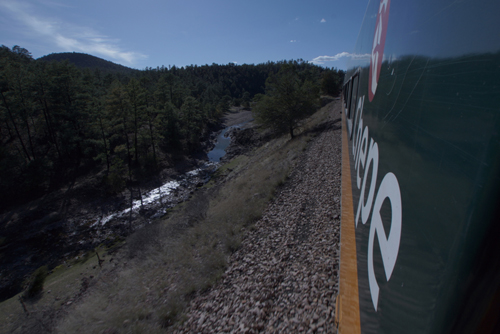
The following day was the real start of the Copper Canyon trip on El Chepe or Ferrocarril Barrancas de Cobre. We boarded the train just after 8am. The sun was still low in the sky but the temperature was warming up.

Our first day’s journey was from El Fuerte to Bahuchivo Station.

The carriages were old and a little worn, while the pace was slow. Even slower when there was a gradient.

This was certainly not a Bullet Train.

It was a spectacular ride, with lakes, rivers, tunnels, bridges and switchbacks.

What made it more enjoyable was that we weren’t confined to viewing the scenery from our seats. We could go to where the carriages were coupled and take snaps from there.

The top half of the carriage door was open so there was nothing stopping us leaning out to get a better shot and a face full of diesel fumes if we weren’t careful.

There were only three carriages – the restaurant car, first class and then second class.

The staff were all in traditional railroad uniforms and there was a heavily armed guard in the last carriage.

However come dinner time, around 6pm, they all congregate in the dining car for a feed.

An ideal time for the Bandidos to swoop on the Chepe.

Mario picked us up from Bahuchivo Station and drove us to our accommodation at San Isidro Lodge, which was a few kilometres out of Cerocauhui.

On the way he stopped to show us Yogi Bear Rock. It really does look like a more than average bear.

That afternoon we drove up to the Urique Rim. This is high up overlooking the Copper Canyon. The views were breathtaking, with rocky escarpments on either side and the river snaking its way from left to right.

There is even a purpose built cantilevered lookout hanging over the valley floor.

We then returned to San Isidro Lodge and walked to where there was another stunning valley view.

We just sat and enjoyed the moment.

The lodge is part of a working farm run by Mario and his three brothers and two sisters.

There were dogs, horses and an array of barnyard birds and one poor parrot. This Polly had unfortunately had its wings clipped.

I didn’t find that very eco.

The next morning, before rejoining the train, we visited the tiny village of Cerocauhui, with just 1,800 inhabitants.

Mario said that he knew all of the locals and they know him.

He therefore had to behave.

The area was fist visited by the Spaniards in 1679 and they immediately built a mission and church.

The Saint Francis Xavier Church has undergone many restorations, the last being in 1940, but has maintained much of the original interior.

Before the Spanish arrived to convert them, the Tarahumara Indians inhabited this area. We visited a local Catholic school that takes Indian girls in as boarders.

Mario, who was himself part Indian, said there were many Tarahumaras living in the area and surrounding hills. They are very religious and seem to have been able to combine Catholicism with their traditional Indian culture.

Much the same as the Mayans have done.

This next stage of the Copper Canyon trip was from Bahuchivo Station to Posada Barrancas Station.

The train was on time, which apparently is rare, and we were soon underway.

The surrounding area was alpine forests and farmland, interspersed with small villages.

The scenery wasn’t as dramatic as the previous day but it was still breathtaking.

It was only a short trip with a rather long hold up waiting for a goods train to pass.

The local Indian woman were very quick to seize the opportunity to sell their local handicrafts to the tourists.

No sooner had we arrived at Posada Barrancas Station than we were into a van and off to our hotel.

The Hotel Mansion Tarahumar ‘El Castillo’ is a rather large and sprawling, Disneyesque establishment that is managed, with an iron fist, by Maria Barriga. It was built by her brother, Jesus on 36 acres of steep hillside and was opened in 1993.

It’s made up of seventy cabanas or cabins, some have red conical turret towers.

The main dining area has a lofty timber ceiling with a huge open fire place.

Jesus told the contractors that he wanted to build a first class hotel – a palace.

They took him literally.

As soon as we arrived we were urged to have lunch and then check into our rooms later.

After lunch we were bundled into another van and taken on what seemed to be a very long ride up the hill. The main part of the hotel disappeared into the mist as we climbed ever higher.

Then the road ended and we had to climb even higher still.

By this time we were fearing the worst.

When we finally got to our rooms we realised that we had been given the best, if not the most remote, rooms in the hotel.

They were perched on the edge of the rim, overlooking the Copper Canyon.

The view was breathtaking.

Later in the afternoon we went on a walk around the rim to a small mountain settlement that is home to a group of the local Tarahumar Indians.

Apparently the hotel has a policy of promoting their culture and crafts.

We didn’t buy but we did leave a donation.

In the evening we sat on the balcony overlooking the town. The two bird feeders hanging there were constantly in use. Humming Birds and Woodpeckers were two species I recognised.

We were spending two nights at the Hotel Mansion Tarahumar, so the next day didn’t involve any rail travel.

The hotel had a tour that was included in our package, so we took that.

There was a choice of Zip Riding or the more conventional funicular to cross the gorge.

Now Zip Riding is like a flying fox on steroids. It’s a little less scary than Zip Lining but still involves great heights and high speed.

You are harnessed into a seat, which is attached to a very taught cable, which is launched across a ravine.

We chose the funicular.

Afterwards we visited various viewing platforms, that look out across the canyon, ending up at Divisadero. This is a small village that sits next to the rail line. There are any number of opportunities to both buy and eat, as the train makes a fifteen minute shop here.

Rather than take the bus back to the hotel we decided to walk.

It was only meant to be 5km and the weather was cool but pleasant.

We took a wrong turn and ended up at the funicular station.

In a moment of rashness we decided that the Zip Riding looked like fun, and we should try it.

We had to fill out an indemnity form, which didn’t help our apprehension.

As it turns out this is the longest Zip Ride in the world, travelling over a distance of 2,530 metres and reaching speeds of 125 kph.

The initial launch from the platform takes your breath away, as you plunge downwards at an ever increasing speed. It then it levels out and becomes quiet relaxing.

The hardest part is the 700 metre climb back up to the funicular, which then takes you back to the start.

After the exhilaration of the Zip Ride we continued our walk back to the hotel. We again took the wrong direction, making the walk even longer than the original 5km.

The next day we took the final leg of our rail trip to Chihuahua.

This was the longest stretch by far.

I had a feeling that the best photo opportunities were behind us.

That was until we discovered the back of the train.

Most trains have a guards van that brings up the rear, not the Chepe. We found we could go right to the back, where it was again open and overlook the tracks receding into the distance.

Our new vantage point in the vestibule was short lived as one of the staff booted us out. As it turned out we weren’t meant to be there after all.

This section of the journey took us to our highest point at 2,460 metres.

It was then downhill to Chihuahua.

Leaving the canyons and the mountains behind, we passed through pockets of farmland with gentler slopes in either side.

The more we descended the flatter the terrain became until we were finally travelling through acres of fallow wheat and corn fields.

We waited for a goods train that lumbered past. It was going so slowly that a group of ‘Rail Riders’ were able to jump on board.

It was dark by the time we reached Chihuahua – the end of line for our Copper Canyon adventure.

Baja California Sur and the Hotel California.
(April 2015)

Monday, June 1st, 2015

DSC03793

La Paz is in southern part of the of Baja California Peninsula. This is the second longest peninsula on earth, next to the Malay Peninsula, measuring 1,247km, from north to south with 4,000km of coastline.

It starts at the US border, with the Pacific Ocean on the west coast and the Gulf of California, or Sea of Cortéz, on the east.

The first day in La Paz was spent walking around the township. It was very quiet and most people seemed to be inside or eating at the many restaurants dotted along the Malecón. This seaside promenade is about 5km long with an array of aquatic themed sculptures.

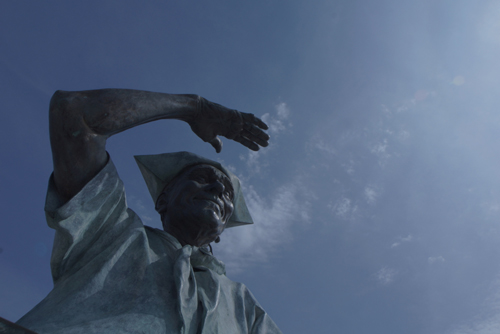
My favourite was of an old man in a paper boat, titled ‘El Viejo y el mar’ by Guillermo Gomez.

Our hotel was the Mediterrane and again in a great location. From our balcony we had a wonderful view, over the Malecón to the beach and marina.

There was a wedding in progress at Catedral de Nuestra Señora del Pilar de la Paz. Outside the church were the giant letters ‘A&J’. We can only assume that these were the couple’s initials.

Come Saturday night and La Paz had livened up. The streets were crowded, but no where near as busy as the main boulevard, which was bumper to bumper with cruising cars and pick-up trucks.

They were a diverse group, some with music blaring, through open windows, while others had their windows wound up tight, keeping cool in their air conditioned comfort.

The food in La Paz was very cosmopolitan with a slight Mexican influence.

The beers in Mérida and La Paz were outstanding. I awarded five stars to Patito Draught in Merida and Baja Blond in La Paz.

The craft brewing industry is growing in Mexico, as it appears to be wherever we go

We hired a car for a couple of days to get a feeling of the surrounding countryside. Our first trip was south on a Highway 1.

El Triunfo was the first mining centre of the peninsula. Silver was mined there in 1751 and the town flourished. Once the minerals dried up these mountain towns lost their importance and were reduced to a Main Street and not much more.

One legacy of the towns wealth is the Church of Nuestra Señora de Guadalupe de El Triunfo.

The country was rugged with many large cacti shooting up from the parched earth. The valleys were scarred with wide, dry riverbeds strewn with boulders.

After passing through the mountains we headed for the coast.

The mountain road twisted and turned, then suddenly we were looking at the Sea of Cortez. Due to the haze, it was only distinguishable as a slightly darker blue tone against the lighter blue sky.

Most of the  shoreline was occupied by private housing, that seems to go right to the water’s edge.

We did find Buenvista, a resort town that had some sort of urban centre.

I am sure that this coast is home to many small fishing villages. With all but the major roads being dirt, we weren’t willing to take the tiny Hyundai off-road. It’s no wonder the locals all have 4X4 pick-ups.

Our second day with the car we again headed out of La Paz, this time to the south west and the Pacific Ocean.

On Highway 16 is Todos Santos, which is close to the coast but not on it. It’s home to The Hotel California. Unfortunately this isn’t the hotel immortalised in the song by the Eagles. The song is just an allegory and there was no real hotel. However this doesn’t stop the management alluding to the fact that it’s the real McCoy.

Game fishing is a big tourist attraction in Baja California Sur. It’s also dwindling, as every fish caught means less fish to catch. I was interested to read an article in the local English language, and aptly named, ‘Gringo Gazette’ about a unique idea to solve the problem.

It’s called Plastic Taxidermy.

Rather than kill and stuff the catch, to become a trophy above some rich guys mantle piece, a plastic replica is made.

As the article pointed out, who would really know the difference – apart from the fish that is.

Just south of Todos Santos, at 23° 26′ 22″ N, is the Tropic of Cancer, it was here that we finally found the Pacific Ocean, at El Pescadero.

It wasn’t that spectacular but it was the Pacific, and we hadn’t seen it for some time.

Even this coastline is dominated by condominiums, hotels and private mansions. Again only reachable by dirt road.

Fortunately the little Hyundai managed it with ease.

The Yucatán Peninsula with Mayan Temples
and Gringo Condos. (March/April 2015)

Sunday, May 31st, 2015

DSC03554

We flew from Guanajuato to Cancún, the start of our tour of the Yucatán Peninsula.

Cancún. 

Rather than pay for a taxi we opted for the shuttle bus, this meant we were taken the long way to our hotel, through the Zona Hotelera. It was dark so we had no idea what was there.

Our hotel was in the residential part of Cancún, where there are only smaller hotels and not resorts. This area mainly caters to Mexican tourists.

We had a long walk from near the Ado Bus Station, via Mercado 23, and then down Avenue Tulúm to the Ibis Hotel.

Here we picked up a hire car, this would be our transport for the next week.

If was late in the afternoon so we drove around the Hotel Zone just to get a feeing of what it was like in daylight.

This is about 22.5km of hotels, condominiums and resorts. These are on a thin ribbon of land, with the Caribbean Sea on one side and the Laguna Nichupè on the other.

All the accommodation stretches along the Caribbean while the facilities face the lagoon.

In a way I was glad we were staying in the more authentic, Mexican, part of Cancún.

Tulúm.

Finding Tulúm was easy, finding our hotel wasn’t.

After roaming the streets and following the directions of both Google Maps and Triposo, we gave up and asked another hotel for directions.

When we did find it, our accommodation was more B&B than hotel and on the very edge of Tulúm. Almost surrounded by jungle there was a large variety of birds, but one stood out. It was the size of a wattle bird with a shinny black chest, a teal blue and back tail and some, I’m guessing the male, have a bright yellow beak.

Tulúm Ruins was originally a walled city of the Mayan culture and an important center of worship for the so-called ‘diving god’.

Built in post-Classic period, between 1200 and 1521 AD, the city was known as Zama or Dawn, as it faces east.

This is a small site set on the shores of Caribbean and witness to the rising sun.

We tried to get there reasonably early, but we weren’t early enough, as the tour buses had already arrived.

It was even more packed when we left, two hours later.

In the afternoon we drove out of the city to the Cenote dos Ojos. Cenotes are an underground system of flooded caves, this particular one extends for over 97km.

It’s a favourite spot for divers – we just had a swim.

We then drove south of Tulúm to Sian Ka’an, a long stretch of jungle with beaches and hotels.

At the end of the road we discovered a bridge, a favourite fishing spot for the locals with a sun baking area for the Crocodiles close by.

On the way from Tulúm to Piste we stopped to visit the Cobà Ruins.

These are quite old, being developed between 600 to 800 AD and reaching their peak in 1100AD.

They are in a jungle setting and everywhere you go you can see piles of rocks emerging from the undergrowth.

Nohoch Mul is by far the largest and the one everyone has to climb. Your efforts are rewarded with an excellent view of the jungle and the lake.

The Cobà Ruins are spread over a large area, about 70 square kilometres, much of which are yet to be unearthed. To see them you can hire a bike, take a chauffeur peddled tricycle or walk.

We walked, and after about 3.5 hours, each of the many sites became indistinguishable from the last.

It was time to move on to our next destination, which was Pisté, a small village very close to Chichén Itzá.

Piste and Chichén Itzá. 

We were at the gates at opening time for this World Heritage Site. Primarily to beat the heat but also the crowds and the touts.

It was a good move.

By the time we left it was hot and crowded.

Chichén Itzá was one of the largest and most culturally diverse of the Mayan cities, spanning a period between 800 and 1,200 AD.

It also has a great architectural variation, due to the span of time.

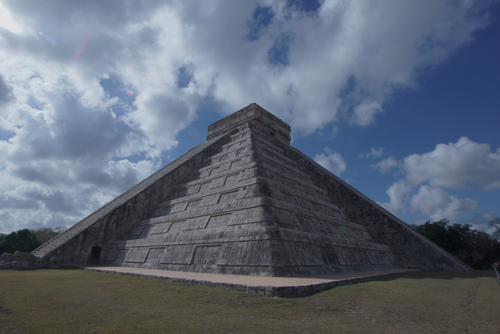
By far the most spectacular structure is El Castillo. This pyramid is primarily a 25 m high Mayan calendar of beautiful proportions.

The Mayans were a brutal race with human sacrifice their main form of entertainment.

The other site that intrigued me was Gran Juego de Pelota or the Great Ball Court. This is the largest ball court in Mexico and the place where the ‘big games’ were held.

A bit like the MCG.

The difference here is that the games often featured human sacrifice, usually the captain of the defeated side.

This would have been a real incentive not to lose.

The Ballgame in Mesoamerica dates back as far as 1,400BC. The ball was made of solid rubber and could weight up to 4kg. There were many variations to the rules but the players struck the ball with their hips, chests and arms and the objective was to keep it in the air.

The stone ball court and circular goal was a later addition.

After a number of hours wandering around the ruins in the heat we returned to our hotel.

We sat out in the rather pleasant garden, next to the pool, and enjoyed the shade of the mango trees. This proved to be rather dangerous, as the mangos would occasionally fall.

It was Easter and Mexico moved their clocks forward for Summer Time. This is the third time change we have had in the Yucatán Peninsula. The Cancún area operates on Central American time while the rest of Mexico has at least three other time zones.

Mérida.

This is the capital city of the state of Yucatán.

Approximately 60% of the population are of Mayan origins.

This is evident, not only in the people but in the craft and street performers. This is despite the fact that the Spaniards tried their darnedest to wipe them out.

We checked in to our hotel early in the afternoon and decided to head to the closest beach, Progreso, about 30 km north.

Mérida was very quiet, which is understandable, considering it was a Sunday. When we reached Progreso we realised why – they were all there, on the beach.

Our hotel in Mérida was in total contrast the one we had just left in Piste.

The Hotel Chichén Itzá, in Piste, was set in gardens with a pool and full of families. While the Gran Hotel in Mérida was more like a colonial museum. Built around a large internal court yard, there were three floors of timber, columns and tiled floors, all full of antique furniture.

It’s full name is El Legendario Gran Hotel. Built in 1901, I think it’s halcyon days were some years back.

Despite being a little frayed around the edges the hotel’s location couldn’t be faulted, being right on Calle 60 in the heart of the old city and facing the Parque de la Madre.

We drove a little way out of town to El Gran Museo del Mundo Maya de Mèrida. The museum building is a new complex, only completed in 2012, with contemporary architecture and state-of-the-art facilities.

The first part of the exhibition was about the Chicxulub crater, found in the Yucatán Peninsula. It is believed to be caused by the meteorite that resulted in the extinction of the dinosaurs during the Cretaceous Period.

The rest of the museum was dedicated to a celebration of the Mayans.

More than 3,000 years old the Mayan culture is still alive, if not a little changed by history. And with nearly six million Mayans in Mexico I think it will continue to survive.

Plaza Grande is the heart of Mérida with the the Mérida Cathedral, Catedral de San Ildefonso, dominating one end. Built between 1561 and 1598, with stone from a Mayan temple, it has an austere facade and daunting interior.

The public buildings around the Plaza Grande are like a living museum. They have a been restored and are now open to the public, for free.

We went to take the double-decker, Hop-on Hop-off bus that’s based in the square, but they didn’t have an English guide. So we walked a few blocks to Parque Santa Lucia and hopped on a bus that did.

This was in a converted 1972 Dodge, with open sides, slatted timber seats and the original shock absorbers.

The tour was excellent, if not a little hard on the backside.

Palacio de Gobierno is another of the free public buildings. It has a series of giant murals by Fernando Castro Pacheco (1918-2013), depicting the emancipation of the Mayan people.

The Mayan legacy and their integration into modern Mexican society is a constant theme that is everywhere in Mérida. They are a happy people and we were being constantly approached on the street. Yes, they wanted to sell their wares but they were equally interested in us and where we came from. They also go to great pains to tell their story.

The women, especially the older ones, still wear the traditional dress. This is white with colourful embroidery. The men wear western clothes, with many opting for the baseball cap rather than the Jipi or Panama hat, made from a palm-like fibre.

In contrast to the history of Mérida we took a day trip to Celestún to see the flamingos.

The town of Celestún, and the adjoining 600 square km, Parque Natural del Flamenco Mexicano, is west of Mérida.

The ecosystem is unique with salt water from the Gulf of Mexico and fresh water from the estuary.

There is an abundance of wildlife there, especially birds.

As the park’s name suggests, there were plenty of flamingos.

On the way to Celestún we stopped at the small town of Umán. They have a daily fruit, veg and meat market, complete with a resident DJ.

The local church, San Francisco de Assís is just over the road from the market. This, like so many others, was probably built over an existing Mayan temple. It was common practice to use the old materials as the basis for the new structure.

It’s a ancient strategy of newer regimes, wanting to exert influence and power over older cultures.

Our driver and guide was Mayan and he gave us a good insight into Mayan life.

Hammocks are sold on the streets by many vendors but we learnt that they are the preferred mode of sleeping for the Mayans.

The Ceiba tree, part of the kapok family, is known by the Mayans as the Tree of Life. The tree figures an important part in the mythologies of pre-Columbian Mesoamerican cultures.

Romance is an important part of the Mayan culture. This can be seen in their art, music, festivals and even Mérida’s street furniture.

‘Love chairs’ are dotted around public places, especially the parks.

On our last afternoon we just wandered around the old town and did some people watching and a little bit of sightseeing.

One was the Casa de Cultura Banamex Museo Casa Montejo.

This is a restored and decorated house of the Montejo family and another free activity, in the main square of Mérida. Within the house was also an exhibition of contemporary Mayan pottery, mixed with 14th century classical works.

The Banamex bank are sponsors. They are very good corporate citizens and support art and culture throughout Mexico. We had seen a similar exhibition in Mexico City.

There is also their commercial side with a gift shop and ATM on site.

We spent five night in Mérida, which wasn’t hard to do.

Life there is easy going and relaxing – we also needed time to do some forward planning.

You can see Guanajuato from above and below.
(March 2015)

Saturday, May 30th, 2015

DSC04510

It was a 5 hour 20 minute journey to Guanajuato, from Mexico City, on the ETN. This is one of the luxury coach services that operate throughout Mexico.

Air conditioned with reclining seats and a personalised audio and video system for each passenger.

This offers you more room and comfort than most airlines, if not a little slower.

Guanajuato was declared a World Heritage Site in 1988.

It has built its fame and fortune on mining, an industry that was well developed before the Spaniards found gold there in 1540.

In the 18th century it was one of the richest cities in the world and a great source of wealth for the Spanish crown.

The city is built in a mountainous area with coloured houses climbing up the hill from the old colonial area.

We arrived just in time for the Baile de las Flores or Dance of the Flowers. This festivals is held just prior to Easter and appears to be an excuse for the locals to let off steam. The streets around the historical centre, Jardín de la Unión, were crowded with family groups, teenagers and mariachi bands.

The next day we visited the Mummies of Guanajuato. The museum houses a number of naturally mummified bodies that were buried following a cholera outbreak around Guanajuato in 1833. There are also some more recently discovered bodies on display.

It’s a gruesome display which is made even more bizarre by the broken mirrors in every room.

Because of the steep terrain surrounding Guanajuato, flooding has always been a problem. In 1760 and 1780 floods nearly destroyed the city and as a result a series of tunnels and ditches were built. Today they have been converted into roads and footpaths, through which you can traverse the city like a subterranean mole.

That afternoon we returned to Jardín de la Unión and it was almost as crowded as the previous evening.

However there weren’t nearly as many mariachi bands – they must have been resting up for their night time performances.

We went to the tourist office just next to the gardens. Surprisingly the woman in the booth only spoke Spanish. This was rather strange considering that Guanajuato is one of the most popular destinations in Mexico, if not the world.

The lack of English was a theme that we continued to find in Guanajuato.

Our limited Spanish was put to the test.

Perched high above the city is a 28 metre tall statue of a local hero, Juan José de los Reyes Martínez Amaro (1782–1863) also known as El Píplia. On September 28, 1810 this brave miner strapped a long, flat stone to his back, to shield him from the Spanish muskets, and proceeded to burn down the door of the grain store in Guanajuato. This was at the very start of the Mexican War of Independence against Spain.

We took the funicular up to see El Píplia and walked down. The view from the top gives you a wonderful appreciation of the city layout and major attractions.

Don Quijote seems to be the unofficial patron saint of Guanajuato, as there are statues and memorials to him everywhere. This probably has something to do with the Cervantino Festival, held every October and named after the author, Miguel Cervantes.

In the evening we walked back into the main square to find some dinner. On the way we discovered a exhibition of local products, all displaying the Guanajuato GTO logo. This is an initiative to promote and sell quality good produced in the region.

Through the hotel, and at their suggestion, we had booked a day trip to San Miguel de Allende and Dolores Hidalgo.

The day started with a real kerfuffle.

We had been promised, on two occasions, that there would be an English speaking guide on the tour.

Once our guide started talking, he didn’t draw breath for ten minutes – all the time in Spanish.

It was then that we realised there was no English speaking guide.

After our pleading and a lot of debate between the staff and a frantic phone call, they found a guide to accompany us. This was going to be a long day visiting a number of different places and we didn’t want to spend it all in a communication black hole.

Jaimi turned up to be our guide and after some negotiations and the payment of an extra fee, we were on our way.

There were eleven ‘tourists’ and four staff all crammed into a Ford E350 Van. This of course included our personal guide, who sat in the back seat with us.

We very soon discovered that we were on a Mexican pilgrimage, visiting the places and remembering the people that the locals hold dear to their hearts. It’s no wonder there was no English guide.

The tour was mixed with liberal doses of ‘opportunities to buy’

Our first stop to shop was a silver jewelry showroom, where our hands stayed firmly in our pockets. Then it was on to the marmalade factory, Conservas Santa Rosa. Here they made all sorts of preserves even one from cactus.

Finally it was time for sight seeing.

José Alfredo Jimínez 1926-1973 was a very popular singer-songwriter who changed the Ranchera genre (traditional Mexican music). There is a grandiose memorial dedicated in his honour at the Dolores Hidalgo Cemetery.

Alfredo had no formal training, yet he wrote over 1,000 songs, many of which became hits and were covered by renowned artists, world wide.

Miguel Hidalgo y Costilla was the extraordinary priest who started the revolution, against Spanish domination, in 1810 at Dolores Hidalgo.

He was not only amazing for the way he fought for the rights of the indigenous population but for the way he openly flaunted the Catholic Church. Part of the museum, that’s dedicated to him, proudly displays his family tree. He was a father to his flock in more ways than one, having dalliances with at least two different women and creating a lineage that still survives today.

Next was the Jimínez Museum, that traced the rise to fame of the other of Dolores Hidalgo’s favourite sons.

We were bouncing between history and pop culture.

We then had yet another opportunity to buy, at a Lungar Ceramic Showroom, before driving to San Miguel de Allende.

This was our lunch break, at 4pm.

This is a Spanish colonial town and a UNESCO site. It’s also home to a large number North American and European retirees who have had the effect of inflating the property and restaurant prices.

It it however is a delightful town with yet another charming central square surrounded by classic post Columbian architecture.

Jaimi was prolific with Facebook and had images and videos up before the tour had ended. As he never ‘friended’ me I have no idea what he posted.

As we wandered around on our last morning I got the feeling that Guanajuato is more a tourist destination for Mexicans rather than broader travelling community.

That made it even more interesting.

Mexico City, monumental, statuesque and huge.
(March 2015)

Friday, May 29th, 2015

DSC04405

Paseo de la Reforma is the main boulevard of Mexico City. It was designed by Ferdinand von Rosensweig in the 1860s and modeled on the grand boulevards of Europe.

There are dozens of small statues of famous Mexicans, lining the Reforma, that’s apart from the major ones that are at every intersection.

La Reforma was originally full of stately homes but most of these have now been replaced by chrome and glass office towers.

There is a Starbucks on every corner and shoeshine stands every 50m. The Starbucks are particularly good for a cheap breakfast and free WiFi.

Unfortunately their coffee isn’t that great.

One Saturday a month and every Sunday La Reforma is turned over to the people. Our hotel was situated in a central position on this expansive boulevard, so this gave us great walking opportunities.

On our first afternoon we took the Hop-on Hop-off bus around the city. We were told that our ticket, a tag around our wrist, was valid for 24 hours, but when we turned up the next morning, that wasn’t the case.

This was Sunday so we walked, with what seemed like the rest of Mexico City, in a south westerly direction, passing many of the famous monuments along the way.

The Angel of Independence or El Ángel was built in 1910 to commemorate the centennial of Mexico’s War of Independence and is also a mausoleum for their most famous heroes. A couple of blocks away is the monument to Cuauhtémoc, the last of the Aztecs. He was the Mexica ruler of Teotihuacán from 1520 to 1521 and was executed in Honduras by Cortés in 1525.

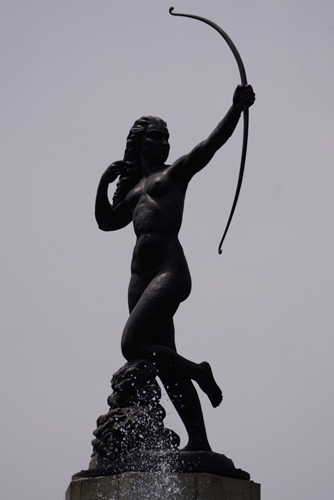
Another interesting monument is of The Northern Star Shooter or Diana the Huntress as she has become know. As part of a city beautification program in 1942, the statue was designed by the architect Vicente Mendiola and sculpted by Juan Olaguíbel.

The body of Diana leaves nothing to the imagination and there was a movement that felt she was just too provocative. Juan Olaguíbel was forced to weld bronze undies on, to hide her modesty. However he was forward thinking enough to only weld them in three spots, making them very easy to remove, when tastes became more liberal.

In the afternoon we spent a very pleasant few hours at the Anthropological Museum. This is probably one of the best museums I have ever visited. Beautiful wood carvings are used to demonstrate the change in human forms over the centuries and detailed dioramas add to the story.

Both archaeological and anthropological artifacts from the pre-Columbian heritage of Mexico are featured.

Designed in 1964 by Pedro Ramírez Vázquez, Jorge Campuzano and Rafael Mijares, it’s built as a large open square. The layout was intuitive with each area leading to the next in a seamless way. The interior blended with the garden to give the viewer an extra historical dimension.

The Teotihuacán exhibition gave us an insight into what we were going to visit later in our stay.

As with many cultures, Mexico City was built on the ruins of an older civilisation. The museum was once a Mexica or Aztec temple site.

We walked back to the hotel and Paseo de la Reforma was back to its congested self -the city was preparing for the start of a new week.

The next morning, again following the Paseo de la Reforma, we wended our way into the central part of Mexico City, passing yet more monuments. The Christopher Columbus Monument, erected in 1876, with Colón pointing the way, yet again. The Horse’s Head by Sebastian in front of the Torre del Caballito and the Triumphal Arch or Monument to the Revolution.

We wandered through the Juárez Gardens to the Benito Juárez Monument and then on to the Church of San Francisco.

Palacio de Bellas Artes was designed in 1904 but only completed in 1934 after years of stop start construction. This is a focal point in Mexico City, situated on the Alameda Central Park and overshadowed by the Torre Latinoamericana or Latin-American Tower. Built in 1956 it was the first skyscraper to be built on a major seismic fault line. It survived the devastating magnitude 8.0 Mexico City earthquake of 1985.

La Zócalo or Plaza Mayor is in the heart of the historic centre of Mexico City. La Zócalo which means plinth, was the main ceremonial center in the Aztec city of Tenochtitlan. It has been the heart of the city for over 700 years and is close to the place that the Aztecs regarded as the centre of the universe.

It’s also known as Constitution Square, but this name is  rarely used.

Close by is the Palace of Culture housing the Banco Nacional de México Exhibition. Which features a brief history of art since the 18th Century.

The ‘Metropolitan Cathedral of the Assumption of the Most Blessed Virgin Mary into Heaven’ (Try saying that after a few Coronas) is the largest cathedral in the Americas and again situated on the site of a former Aztec sacred site. It was built in sections from 1573 to 1813.

The twenty-fourth James Bond film, Spectre, was being shot in Mexico City. So, much to the dismay of some of the locals, La Zócalo was closed. There was also a constant beat of helicopter blades overhead, as some of the sequences were being shot.

I never did see Daniel Craig.

There are 24 million people and 15 million vehicles in Greater Mexico City. It’s a mega city with a severe pollution problem, however much has been and is being done to reduce the carbon monoxide levels.

Many of the houses are painted in bright colours. This isn’t so much for aesthetics but to indicate to the local authorities that the house has been built legally and taxes have been paid. Apparently there is a real problem with people building houses wherever they find a spare block – even if they don’t own it.

We decided to take an organised tour to Teotihuacán, a Pre-Columbian city that’s about 48km from Mexico City.

Firstly we went to Plaza de les Tres Culturas, an archeological site very near the centre of this city. This was discovered when excavating for the Metro in 1966 for the Olympic Games.

Santiago de Tlatelolco is the Catholic Church that is built over the site with stone from the Aztec ruins between 1604 and 1610.

From the city we droves for forty minutes out to Teotihuacán.

Then we had an ‘opportunity to buy’ that was disguised as an ‘open bar’ or opportunity to try the local tequila.

This was immediately followed by a lunch break.

By the time we had finished these pre-sightseeing diversions the clouds had rolled in and the good light was gone.

We climbed the Temple of the Moon first, then walked along the Road of the Dead to the Temple of the Sun.

The Moon Temple was 40m high and the Sun was 65m.

Strangely the Sun was easier to climb than the Moon.

From the the top of the Sun Temple we could see thunderstorms over Mexico City.

It was then back to the car park, but the bus was 25 minutes late in returning to collect is. Fortunately the rain started just after it arrived.

Our last stop for the day was to the Basilica of Our Lady of Guadalupe. As I have mentioned before this is a brilliant piece of 16th Century marketing and spin by the Spanish clergy.

In 1531 a Mexica native, Juan Diego, has a vision of the Virgin Mary, who asks him to build a church on the site where he was standing. Juan goes to the archbishop of Mexico City and tells him what has transpired. The archbishop wants more proof so he asks him to go back and ask ‘the lady’ for a miracle to prove her bona fides.

The resulting miracle is the image of the Virgin of Guadelupe on Juan’s tilma or cloak which now hangs in the basilica.

The tilma is Mexico’s most popular cultural symbol and the basilica is one of the most visited sacred sites in the world.

Call me cynical but what a clever way to involve the Aztecs Indians in the new faith of the Spanish, just 12 years after Hernán Cortés conquered them.

Our final day was devoted to two of Mexico’s most famous artists, Freda Kahlo and Diego Rivera, who were also married on several occasions.

Our first stop was the Museo Mural Diego Rivera. This houses the mural, ‘Sueño de una tarde dominical en la Alameda Central’ or Dream of a Sunday afternoon in the Alameda Central, which was commissioned for the Hotel del Prado in 1947. The hotel was destroyed by the earthquake of 1985, but the mural survived.

We then went to the Frida Kahlo Museum or La Casa Azul. This is, as the name suggests, more of a museum than an exhibition of her work. There are many personal items like clothing and a collection of Indian artifacts that are all set in a beautiful walled garden.

Frida Kahlo is revered in Mexico City and her work is seen everywhere, especially on souvenirs.

I would have liked to have seen more of her work, that wasn’t on ash trays, tea towels or T-shirts.

In Sayulita there’s Mexicans, surfers,
pelicans and dogs. (March 2015)

Wednesday, May 27th, 2015

DSC04028

We flew into Puerto Vallarta from Mexico City in the afternoon and were met by Ev and Steph.

At the airport we hired a car and drove the 25 km north to Sayulita, a small beach resort. It’s a hectic place full of Mexicans, Gringos (mainly from the US) and dogs. The place is also crowded with bars, restaurants and souvenir shops.

In the late in the afternoon, once we settled into our AirBnB, we went for a walk around the town.

Our bungalow was next to the Arroyo, a small river that runs down to the beach. The beach was as crowded as the town, again with bars, restaurants and dogs.

There is a reasonable beach break so the surfing and stand up paddle boarding culture is very strong in the area.

There was a stream of surfers, with their boards, continually filing past our house.

The area is situated on the Bay of Banderas, which in 1530 was named by Nuño Beltrán de Guzmán. This was because the local natives, the semi-nomadic Cuyuteco people, carried brightly coloured banners into battle.

The next day we drove further up the coast to San Francisco, a smaller seaside town. There were pelicans diving for fish along the shoreline. These are not the large white ones we have in Australia but much smaller and predominately brown and white.

We walked around town where there were lots of hippies and old Volkswagens.

This was a Mexican Ninbin or Byron Bay.

The image of Our lady of Guadalupe, the Mexican Virgin, is featured in the shopping street and on private houses. The story behind the miracles that created the legend of the native American, Juan Diego in 1531, is a curious one. It was instrumental in the conversion to Catholicism of the native Americans. It was also a rallying point for Mexicans against the rule of Spain in the 19th century.

Los de Marcos is a little further north and even quieter. Again the pelicans were there.

We had the hire car so went in search of a secluded beach. We found it at Litibu, which is south of Sayulita. It’s not really a town at all but few houses and some resort style accommodation. We spent a pleasant afternoon on the beach. Evan and I took some snaps while Thea and Steph just relaxed.

We then drove even further south to Punta de Mita for lunch. This is a series of beach side restaurants with more touts per square meter than I have ever seen.

They weren’t annoying but there was a constant stream coming through the restaurant. They were selling jewelry, bags, hats and even food. Which I felt was rather strange in a restaurant.

On our last day we took a trip to the Island of Las Marietas, a nature reserve just off the coast from Punta de Mita.

This the home and breeding ground of the endangered Blue-footed Booby. It’s also a UNESCO protected area so there was no walking around.

Our excursion of snorkelling and whale watching was on a small fibre glass boat with five others, all American women. Unfortunately the whale watching season was almost over so there were only a few Humpbacks around.

This is the breeding season for the whales so there were several cows with their calfs.

Our snorkelling was limited by the floatations device we were forced to wear.

We have been snorkelling in a number of places around the world and this was the most strictly controlled I have ever come across.

The fish were scarce but there was a good variety.

We are spoilt having the Great Barrier Reef on our doorstep.

What a fuck up. or When travelling goes
horribly wrong. (March 2015)

Friday, May 1st, 2015

Now I am not normally superstitious, but our problems did start on Friday the 13th of March, 2015.

On our last full day in Cuba we had to move from our Casa Particular to a hotel because our agent hadn’t made the correct booking and had us leaving a day earlier than we should have.

Then, the next day, the taxi we had pre-booked to take us to the airport didn’t turn up and we had to get another one.

At the airport the time came and went for our Air Cubana flight from Santiago de Cuba to Havana. This turned into a 6 hour delay, causing us to miss our connecting flight to Mexico City.

When we finally boarded we found that the call button on the Air Cubana flight was just there for show, and didn’t actually work – I guess that summed up customer service on Air Cubana.

Getting to Mexico was crucial, as we had accommodation booked there for two nights and were then due to fly to Puerto Vallarta, on the coast, to meet Ev and Steph.

Once we realised our dilemma, we started to make enquiries as to how to sort it out. We were sent from office to office, but no one seemed to want to help.

Finally we tracked down the Air Cubana supervisor, who said he would sort it all out, but this was a total lie.

He then clocked off, confidently telling us that he had organised everything with the new supervisor. She had no idea what to do and then sent us to a desk, one that we had already visited, and again they couldn’t help.

The biggest issue we were facing was that our connecting flight to Mexico wasn’t with Air Cubana but with Aero Mexico and the Air Cubana staff didn’t see it as their problem.

Everything was compounded by the fact that another Air Cubana flight, this one to Paris, was cancelled. It was a Jumbo and full of very angry French tourists.

Clearly a couple of more laid-back Aussies could wait.

We had been up since 5am and apart from the seventy minute flight from Santiago de Cuba had been hanging around at airports – it was now 9pm.

At this point all we wanted to do was leave Cuba ASAP.

At about 10pm we were finally helped out by an Air Cubana staff member who, realising we were desperate, took us to the office of CopaAirlines.

There we discovered that the next morning there was a flight to Panama with a connecting one, an hour later, to Mexico City.

We tried to book it then but were told that couldn’t be done until 4am the next morning, as they were shutting up for the night.

We had no choice but to stay at the airport as it was now 11pm.

Still carting our luggage around we found some vacant seats and tried to get a few hours sleep.

Without anyone around to keep the airport warm the air conditioning reduced the temperature down into the low teens and we were forced to pull jumpers and coats from our packs.

At 4am we went off to buy our tickets. Earlier we had been told we could pay by Visa but were then told that we now needed cash.

This meant finding an ATM that would, firstly, accept our cards and secondly, cough up enough money to buy the tickets – tickets that we so desperately needed.

By 5:20am we had the tickets and had to rush to get the plane as the gates were closing at 5:30.

What a nightmare 24 hours.

There was something positive that came out of this experience – Copa Airlines. They are based in Panama and have good aircraft, great service and wonderful, friendly staff.