Our last road trip was a combination of catching up with friends and trying to get into the minds of some of my creative heroes.
Wherever you travel in Europe someone famous was born there, raised there or lived there.
Trying to get closer to what inspired their work became my focus. Some encounters were planned and others just happened.
We travelled out of Barcelona to Lyon, another of those beautifully preserved French provincial cities.
In the Place des Terreaux is the Bartholdi Fountain.
It was originally created in 1857 for Bordeaux by the then 23 year old, Frédéric-Auguste Bartholdi, the designer of the Statue of Liberty.
Due to budget constraints it was never built there, and that was Lyon’s gain.
Four rampaging horses, the great rivers of France, complete with steaming nostrils, strain against their reins, under the control of an almost placid Paris, depicted as a female figure.
Paul Bocuse, the legendary French chef, is featured along with other heroes of Lyon on the painted facade of a riverside apartment building.
The Basilica of Notre-Dame de Fourviere, built between 1872 and 1884, sits high on the hill overlooking the city. It was undergoing serious internal renovations but beneath the scaffolding were a series of delicate, beautifully crafted, mosaics.
We overnighted at Chateau d’Etoges, in the Champagne region. This grande 17th century residence was once owned by the valet of King Louis XVI. He lost his head during the revolution, as a result of being a little too cosy with the monarchy.
Autumn was well advanced in the Champagne region around Epernay. The vineyards were a patchwork of browns, yellows, reds and greens.
We then headed north into Germany and weather turned even colder.
We picked up Hayden in Mannheim and then drove towards Heidelberg to catch up with our German friends in Bammental.
After an unexpectedly early snowfall the weather brightened up again and the sunflowers were soaking up the last of the Autumn warmth.
From there we travelled further north to Nieder Weisel, the hometown of a brave group of Germans who escaped from the troubles in Europe and took the long voyage to Australia in the 1850s’
Thea’s great, great grandmother was one of them and there’s a plaque near the church that commemorates their feat.
Next was Paderborn, a university town in Germany, where Hayden is spending 4 months as part of his PhD.
We visited, Schloß Neuhaus, just outside the town and situated on the Pader River, the shortest river in Germany. We also scoured Paderborn cathedral in search of the famous ‘Three Hare Window’, but it remained elusive.
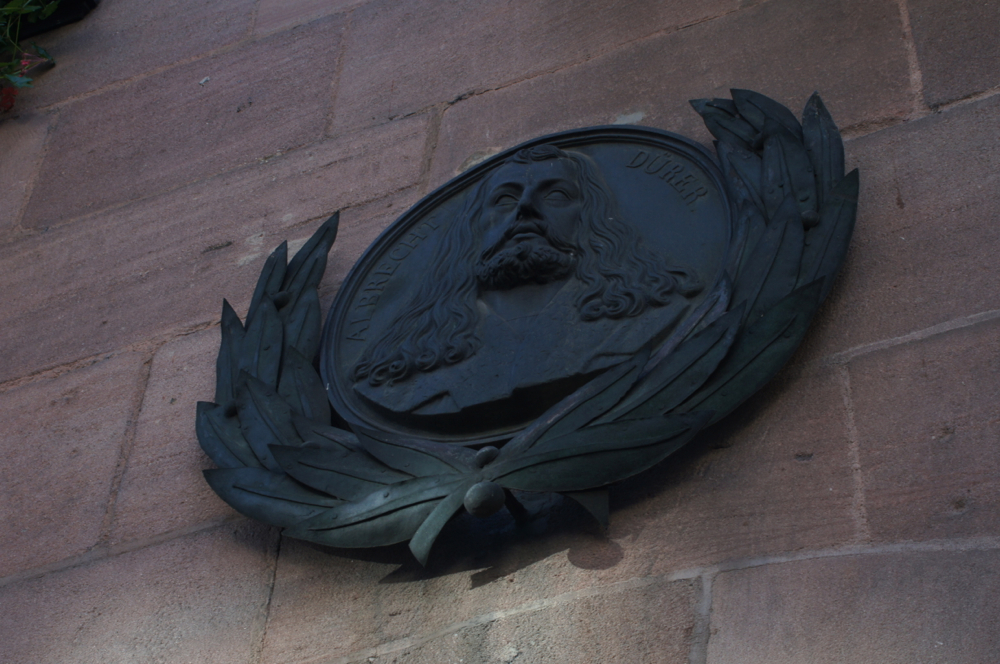
We left Hayden to his studies in Paderborn and drove to Nuremberg, home to Albrecht Dürer (1471-1528) Germany’s most famous graphic artist, painter and art theoretician.
There is no original work on display but it’s interesting to visit the house where much of his great art legacy was created.
Nuremberg was also home to the Nazi Party Rally Grounds, covering 11 square kilometers. There is also the Documentation Centre with a permanent exhibition ‘Fascination and Terror’ which provides graphic information about the causes, context and consequences of the National Socialist regime.
Adolf is definitely no hero of mine.
Just on the outskirts of Nuremberg, in Stein, is the factory and family residence of the famous stationery company, Faber-Castell.
I grew up very envious of those kids lucky enough to have a box of their pencils.
Next was Ulm, with the world’s tallest church steeple, and the birthplace of Albert Einstein.
Albert only lived for a short period in Ulm and according to him, it had no impact on his life.
The original house was destroyed in 1945.
The snow was still on the ground in Saint Gallen, Switzerland, and the skies were grey.
The cathedral has recently been restored and has elegant Renaissance frescos on the ceiling and 16 elaborate confessionals.
By my reckoning that gives the church the ability to forgive 32 sinners in a single sitting.
Next was Arnex-sur-Orbe, Switzerland, an idyllic village, where one of my oldest friends has lived, with his family, for nearly 30 years.
From there we visited the ‘Collection de l’Art Brut in Lausanne’ This is a gallery, created in 1976 by the French artist Jean Dubuffet.
He describes what Art Brut is below.
“Art Brut works are produced by self-taught creators firmly entrenched outside the mainstream, harboring a rebellious spirit and impervious to collective norms and values.
These include psychiatric hospital patients, prisoners, eccentrics. loners and outcasts…”
This exhibition was an eye opener with some of the most original and creative, of off-the-wall art, I have seen in years.
Aix-en-Provence and the world of Paul Cezanne was the next stage of our cultural adventure.
There are numerous tours you can do to try and get a insight into the mind of the father of modern painting, or as Picasso described, “the father of us all”
We decided to do just three.
The walk around Aix, with emphasis on where Cezanne lived and studied, Cezanne’s studio on the Lauves Hill and The Painters’ Ground, with spectacular views of Sainte-Victoire Mountain.
We also spent a day just circling around the Aix region, where Sainte-Victoire Mountain is ever present.
Even if you aren’t a student of art, the rugged escarpments of white rock, contrasting with the red earth, is spectacular.
It’s no wonder that Cezanne immortalized the region with his art.
The next leg took us from the sublime to the sometimes absurd, with a three day tour around the Dalí Triangle.
Salvador Dalí’s life embodied the ideals of Surrealism and you can gain a small understanding of this very strange man by visiting three of his most significant buildings.
The Dalí House at Port Lligat was the home that Dalí and his wife, Gala, built over a forty year period. It is a maze of odd shaped rooms on many levels, the result of Dalí buying up the surrounding fisherman’s cottaged and ingeniously combining them together.
You are greeted at the entrance by a giant stuffed polar bear – that sets the tone for the entire house.
Stuffed animals and bizarre objects are a vital ingredient in much of Dalí’s architectural decoration, however he was sane enough to include a BBQ in the back garden, near the pool.
Next was the Theatre Museu Dalí, at Figures, the largest Surrealist object in the world.
The exhibition is housed in what was the former Municipal Theatre, however it was extensively ‘renovated’ to suit the Dalí aesthetic.
Apart from a wide variety of sculptures, paintings and drawings by Dalí, there are also works by other artists.
Like most great artists Dalí studied the Masters and there’s even a reference to Albrecht Dürer’s Rhinoceros in one of Dalí’s etchings.
There is no doubt that this museum was built by Dalí as a homage to himself, as his tomb is in the crypt.
Dalí always fancied himself as the modern Renaissance Man, not confined to one medium or form of self expression. He used film, sculpture, painting, architecture and technology to convey his message.
However it’s his jewelry, in the Dalí-Joies collection, that best demonstrated how his talents could be expressed in alternative ways.
He used many of his reoccurring themes and turned them into beautifully crafted bracelets, broaches and necklaces.
The final part of the triangle was the Casa-Museu Castell Gala Dalí.
This is the 11th century Castle Púbol that Dalí purchased and then renovated as a gift to his wife, Gala. She accepted it on one condition, that Dalí could’t set foot inside the the castle unless he was given a written invitation.
The interior is less extravagant than the other two buildings we visited but still contains many examples of Dalí’s weird sense of humor.
There was no BBQ in the garden but there are some of Dalí’s strange elephant sculptures.
We spent a few hours in Girona on our way back to Barcelona.
Although it has a rich history and has been under siege 25 times, I could’t find any of my heroes in Girona.
*Isaac Newton

You get what you pay for. (January 2013)
Thursday, January 24th, 2013For our last adventure we booked a packaged deal through eDreams to Tenerife. The flights were with Ryanair, who’s positioning is ‘Low Cost’
It’s true that the initial airfare is cheap but that’s where cheap ends. If you want to reserve a seat, check-in luggage or have a drink of water, then it’s all an extra and expensive.
The weight of your suitcase is limited to 15kg and your hand luggage has a strict size and weight limit as well.
The airline staff police the line of waiting passengers, checking that they are within the limits. If you’re not then there’s a heavy price to pay.
Once you are on board the cabin staff are more anxious to sell you something than an African hawker on Barceloneta Beach in August. They try to flog you lottery tickets and to my amusement there were ads on the overhead lockers and the seat backs.
There are even ‘smokeless cigarettes’ for sale, so you aren’t forced to abstain or sneak off to the little room at the back of the plane for a quiet puff.
However the flight was on time and it was a very pleasant 3 hours journey to the Canary Islands.
Our hotel in Puerto de la Cruz was also part of the package and again relatively inexpensive.
On arrival we were told that because the hotel was full our room wasn’t that good, but if we wanted to we could change rooms in the morning.
We did change and got a much better room with a terrace and garden view, which was worthwhile considering that we were going to be there for seven days.
We were even offered a free meal in the restaurant as compensation for putting up with the dog box on the first night.
On our last night we took up the offer of the free meal and were happy that we hadn’t taken the ‘Full Board’ option. The bonus that night was an excellent bottle of wine that only cost us €6 (A$7.60).
Tenerife, with its sub tropical climate, is a destination favoured by Northern Europeans wanting to escape their bitterly cold winters.
They are there to get a tan, keep warm and drink beer.
The Canaries are Spanish and 100km to the west of Africa and the outermost region of the European Union. Tenerife is the largest island in the archipelago measuring 2,034.38 km².
We decided that we would replace ‘getting a tan’ with touring and went shopping for a hire car. We thought that a Citroen C3 was great value at €65 (A$82.40) for 3 days, that’s until we drove it.
This little car had had a tough life.
There were dints and scratches on all panels, no sun visor on the passenger side, the glove box had been screwed shut, the key was held together with gaffer tape and the warning lights on the dashboard had been blacked out.
Under the bonnet wasn’t much better.
The clutch had gone (where do clutches go?) and every time I changed down a gear the engine lost 1000+rpm. This became an issue on the climb to Mount Tiede, the highest mountain in Spain and the world’s third highest volcano.
Tiede and the Tiede National Park are a UNESCO World Heritage Site. Most of the park is formed by a caldera that was created when the original volcano walls collapsed into the sea about 160,000 to 220,000 years ago. This has resulted in the most spectacular moonscape appearance of towering escarpments, jagged rock formations and rubble strewn valley floor.
There is a cable car that runs to within a few hundred meters of the summit and you can then hike to the rim of the volcano, if you get permission first.
The Citroen managed the trip down the mountain with far greater ease.
On the second day we drove north east to Park Rural Anaga and enjoyed the ‘Path of the Senses’. This was through a beautifully preserved laurel woodland, one of the oldest on the planet.
Signs were placed along the walking track encouraging you to Touch, Listen, Smell and See the surrounding forest and spectacular views of the coastline.
From there we drove down to the capital, Santa Cruz de Tenerife. This is a port town, and there is no hiding it, as the harbor and container cranes dominate the coastline.
We wandered through Parque Garcia Sanabria, a large urban park in the centre of Santa Cruz with its amazing cactus garden. There you can see, close up, many of the succulents and cacti that are prevalent all over Tenerife.
Buoyed by the survival of the Citroen on the first two days, we became even more adventurous on our third and final day and travelled west. Our first stop was Icod de los Vinos, a quaint village overlooking the northern coast and home to one of the world’s oldest trees. Within the Parque del Drago, with its collection of Canarian flora, is the Millenary Drago which is believed to be over 1,000 years old.
The Drago or Dragon tree is shrouded in legends and mystery and get its name from the deep red sap, known as Dragon’s Blood, that it produces.
From Icod de los Vinos we drove around the coast to Buenavista del Norte then struggled over the mountains to Santiago del Tiede and finally reached the western coastline at Los Gigantes.
Then, to the whine of the failing wheel bearings, we drove back through Parque Nacional de Tiede to Puerto de La Cruz.
We travelled over 400km around Tenerife, had a great time, and to our surprise the Citroen kept going.
When we weren’t touring around the island we were exploring the streets of Puerto de la Cruz and the nearby village of Punta Brava.
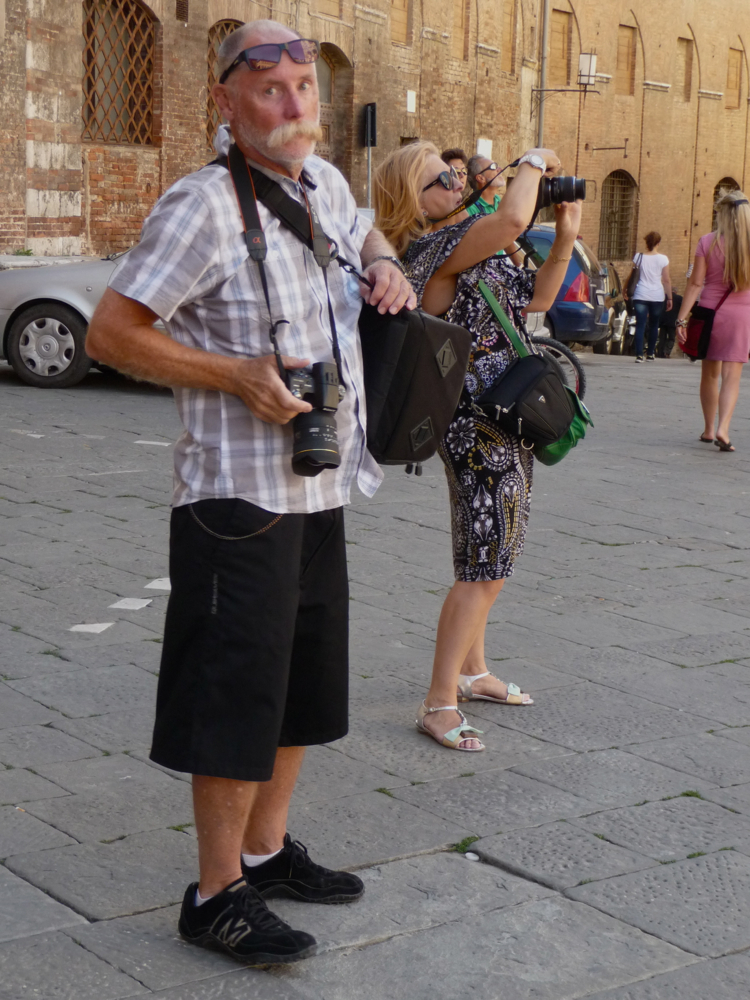
It’s a tourist town without a doubt but there are some quaint churches and interesting architecture, but for me, the tourists were the biggest attraction.
We chose to pay for reserved seats on the flight to and from Tenerife. A decision that paid for itself, if only from the looks on the faces of the other travellers. They watched in envy as we went to the front of the line, that’s after they had been standing there for at least an hour. Not only did we board the plane first but we had a row to ourselves and didn’t have to fight for overhead locker space.
This little extravagance cost us €20 (A$25) and was worth every Euro Cent.
I guess we got what we paid for.
Posted in Comment, Photography | No Comments »