Thursday March 12. Tunis, Tunisia to Casablanca, Morocco.
After a few hiccups with our airport transfer, we are now there and waiting for our Royal Air Moroc flight to Casablanca, Morocco.
Our flight path to Casablanca took us right over Granada. This was the closest we’ve been to the Spanish family for a while.
The announcements on Air Maroc were only in Arabic and French, so we had no idea what was was going on.
We were picked up at the airport by Mahdi, who was to be our driver for the trip.
He has a rather spacious black Mercedes van, which should be comfortable on our adventure around Morocco.
Another stuff-up of the day happened when we went to put my phone on and get the eSIM working, it wouldn’t.
Thea then spent over two hours on the phone, trying to sort it out and eventually got it going.
Where would I be without a techhead?
The hotel didn’t serve dinner and all that was available was from a large shopping plaza next door.
The only offering there was takeaway. McDonald’s, Pizza Hut, KFC, and all that sort of crap.
So we asked reception where could we go and they gave us a few choices.
One of them seemed reasonably good, so we went there. It turned out to be very, very posh.
What we chose was a French restaurant in Le Royal Mansour Hotel, which seemed rather fitting for Casablanca.
The food was excellent and very French.
I had Beef Tartar with French Fries, which were excellent, as they should be in a French restaurant.
However it probably cost more than we’ve spent, in total for dinners, over the last three or four nights.
Catching a taxi here is rather complicated, as there are three types of Taxis in Casablanca, two red ones, called a petite and a white one.
The Petite Taxi seems to be able to pick up people and drop them off along the way, even though you were the one that ordered it.
The one we caught back to our hotel was also a Petite Taxi, but we said we wanted the meter on and no extra passages. However he wanted to charge more, because he wasn’t picking up extra people.
I guess that’s fair.
This is not our first time in Morocco, in fact we were here in 1974.
We travelled in our VW Camper Van from Manchester, to the south of England then over the channel into Portugal and then onto Spain.
We then came down to Algeciras on the Spain coast and crossed into Morocco. We drove across the southern Mediterranean then to Fez.
It was a fabulous experience then, as it will be now.
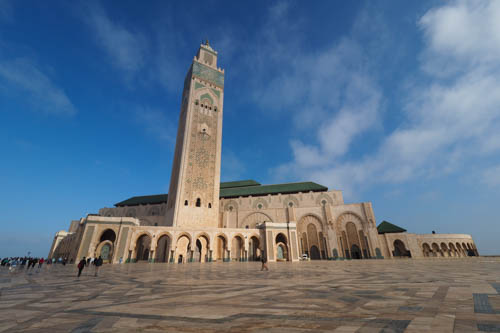
Hassan II Mosque (1993)
Friday March 13. Casablanca.
Breakfast was a limited choice but the Croissants were excellent and the coffee wasn’t that bad.
Even though it was from a machine.
Mahdi was our driver and as it turned out our guide (well sort of) for our first day.
The city of Casablanca seems well serviced with a freeway tunnel, beneath the city and a full tram system.
Our first stop was in the old part of town. This was built by the French in the 1930’s and has some wonderful Art Deco architecture.
There is also some Art Novo architecture around as well and that’s still evident in some of the more modern apartment blocks.
We then went to the Hassan II Mosque, the largest mosque in the country and one of the largest mosques in the world.
Here our entry fee included a group tour of the Mosque.
The tours were in many languages. Apart from English, there were German, French and Italian speaking guides.
Built entirely with Moroccan materials, except the chandeliers, which are Italian. It has heated floor and a sliding roof, weighing 550 tons on each side, so worshippers can pray under the sun, or the stars.
It can accommodate 25,000 men inside and 80,000 outside, plus 5,000 women on the balconies.
The associated Mosque Museum was included in the tour but not nearly as spectacular as the Mosque itself.
It was cold when we first got up in the morning and I thought I’d better put my coat on. By the time we came out of the mosque and had been into the museum, the weather had certainly warmed up.
As a result of ‘Dumb Donald‘s’ Middle Eastern war, petrol has risen around the world.
Here it was about A$1.90 a litre. Who knows how much it will be back home.
We then continued onto Ain Diab Corniche, which was along the waterfront. There we got a great view of the Mosque from a different perspective.
Our next stop was Mohammed V Square in the city centre. This is the home to thousands of pigeons.
It was spring, so they were getting rather excited.
We then drove to lunch, through the city centre and the Medina.
Lunch was at Rick’s Café.
The café, developed by Kathy Kriger, a former American diplomat in Morocco, was designed to recreate the bar made famous by Humphrey Bogart and Ingrid Bergman in the 1942 movie classic Casablanca.
This is the movie we watched on the flight coming over.
The food was excellent, but I got really excited when I looked at the menu and saw that they had craft beer.
Unfortunately, they’d run out.
The place was very popular, and I guess a lot of that popularity has risen from the fact that they actually serve booze.
After lunch, we thought we were heading back to the hotel but that wasn’t the case. In fact, we were taken down to the old part of the city, the Sukh, or market area, to have a wander around.
Then it was back to the hotel.
The streets were now crowded and the car horns were blowing.
Driving in Casablanca, as it was in Tunis, is a bit like a Formula One Grand Prix. Everyone goes as fast as they can and no one gives away to anybody. This even includes pedestrians, who have no safety whatsoever, even on pedestrian crossings.
Honking your horn is the way you either get right-of-way or ask someone to give you right-of-way.
However I have never worked out how honking your horn can ever move the traffic jammed up in front of you.
It’s still Ramadan here in Morocco and like Tunis no cafés are open anywhere in the city during the day. Even Dominos and KFC are shut.
The Moroccan flag is everywhere.
It’s red with a green star in the centre and nowhere near as unique as the Tunisian one. You know what they say about red and green should never be seen….
This is a very good case of not following that rule because, viewed at a distance the two colours merge and aren’t decipherable.
As we had a good lunch and the hotel doesn’t serve dinner, we are going next door to the Tachfine Centre, which is a rather large shopping Mall to buy a snack.
We headed into the mall at around 7:30pm, only to be turned away at the door and told it didn’t open until 8:00pm.
When we returned, we went straight into the Marjane Supermarket and it was huge. We grabbed a French Camembert and a small Baguette.
I also got three pairs of extra sox, as I just wasn’t able to get the ones I had washed and dried on a daily basis.
The bread and pastries have been great in Morocco. I guess that’s another leftover of the French colonisation.
It was the same in Tunisia.
I haven’t eaten so many Croissants in a long time.
Relax Hotel Casa Voyageurs, our hotel in Casablanca, has issues. They don’t serve an evening meal and there are very few places around that you can get a good dinner.
Our room had very few amenities and only had one bag of tea and no coffee. Also, there was a lot of noise from the floor above, both in the evening and during the night.
If you are forced to get take away, there is no crockery, cutlery or even napkins to make your dinner more pleasant and easier to consume.
It’s called the Relax Hotel, well ‘relax’ is about all you can do, as there is bugger all else to occupy you.
About its only saving grace was the shower, Thea gave it a nine out of ten.
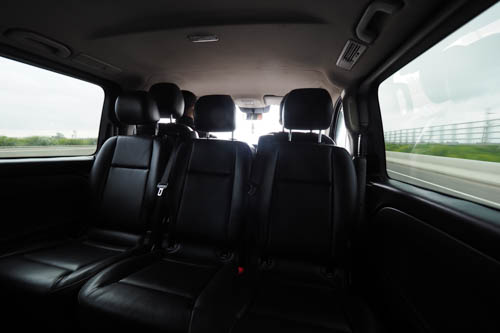
Our rather roomy Mercedes Van
Saturday March 14. Casablanca to Imlil.
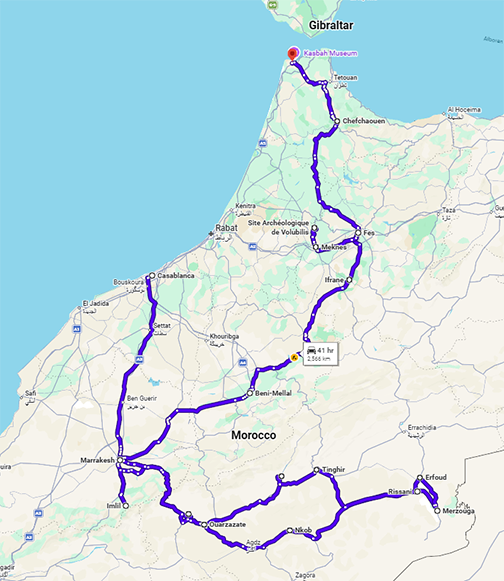
Today we start our road trip of Morocco and head south to Imlil.
It will be the first night of four consecutive ones on the road and a long day of driving, as the first leg is over 300km.
The first part of our journey, out of Casablanca, was on a very good freeway with 120 km speed limit. Even the footbridges over the freeways had disability ramps, as well as stairs.
The surrounding scenery was acres and acres of open pastures and farmland, with flocks of sheep and cattle grazing by the side of the road.
It was cloudy when we left Casablanca and then, as we passed through Marrakesh, it started to clear up but then hazed over again after leaving Marrakesh. As we climbed higher, the haze began to clear and the sky got bluer.
Imlil is Berber village, surrounded by the High Atlas Mountains. These are dominated by the Djebel Toubkal, the highest summit in North Africa at 4167m.
Berbers are the indigenous, and originally nomadic people of North Africa. They inhabited the area from Egypt, in the east, to Sahel, in the far west.
The word ‘Berber’ came from the Greek word ‘Barbaros’ and means ‘Barbarian’. The term was initially used to describe anyone who didn’t speak Greek.
In Imill we are staying at the Riad Oussagou Hotel, however it’s not what we expected. It’s more a guesthouse than a hotel and I’m not really sure they were expecting us.
However when we got to our rooms we were pleasantly surprised. They had everything you need and the hot water worked. There was even traditional Berber dressing gowns.
We are in a mountain village and surrounded by them.
After settling in we walked down to the village – that was the easy part – getting back up was a challenge.
On the way down we popped into a restaurant complex next to our hotel.
It was crammed with hikers, of all ages and accents.
We did have the option to do a hike in the mountains this afternoon, but declined.
I’m glad we did, as getting down and back up from the village was enough.
Back at the hotel we went up to the roof to get a bit of sun. There we met Alex and Russ a couple of Americans academics, who were here hiking.
We hit it off straight away, when we discovered that none of us thought much of Trump.
Dinner was up on the roof and we were accompanied by the two Americans, we met earlier, as well as two Belgian girls.
The conversation was lively but we did finish up having an early night.
Even though we had air-conditioning, it didn’t work that well and the room was very, very cold. The best place to be was in bed, rugged up as well as we possibly could.
We had a very civilised start today, departing at 9:00am, however tomorrow we are off at 7:00am.
Not looking forward to that.
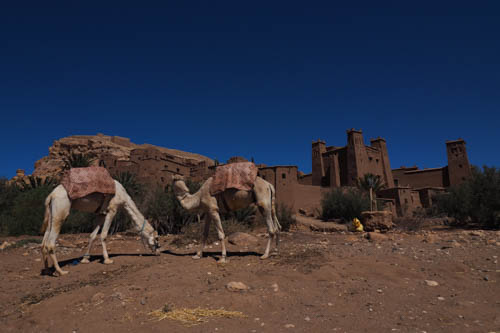
Crossing the River Asif Ounita
Sunday March 15. Imlil to Ait Ben Haddou and then Dades.
Starting the day at 7:00am, meant breakfast at 6:30am and then be ready to depart as soon as we were finished.
We were joined at the end of breakfast by Alex the American we met last night. She was anxious to find out about our travels, as she was a great traveller herself and was trying to talk her partner into doing more.
We ended up giving her links to our our websites so she could see what we’ve done over the last few years.
It was a long drive back down the mountain to the valleys below.
All along the way there were Berber villages perched precariously on the side of the mountains.
Our drive took us back into the outskirts of Marrakesh, then we turned east. All along the way there were acres and acres of housing estates, many of them fenced off. There was so much construction happening in all of these areas.
When we left the lower plains, we climbed back into the mountains again and they were very rugged. There was evidence, all along the way, of landslides over the road.
There were also many man-made channels around the rocks, diverting the water away from the cliffside. They were there to try and stop the erosion that was causing the landslides.
Café Restaurant Imouzar Tichka was our coffee stop. Here we had a Double Espresso each, it was ok.
Thea found a packet of Date Pillows to have with our coffee and they were great.
Then we stopped at Tizi Tishka for a panoramic view of the valley below. This was followed by our last climb to the summit of Tichka at 2,260 metres.
What has surprised us so far on this trip, is the bus loads of tourists, they are everywhere. Most of them are young and I think a lot of them are hiking around these mountains.
Next was the Argan Oil shop, where Thea got some oil for her hair.
Argan Oil is her favourite.
The shop, like everywhere else, was full of tourists.
The villages that are built into the mountain side are all the same colour as the mountain rock. I guess that’s what they’re made from. Plus the pottery in the stalls, that are also everywhere, all have the same colour as well.
Our first designated tourist stop was the Fortress of Ait Ben Haddou. The village is a great example of earthen clay architecture. It has been a UNESCO World Heritage Site since 1987.
Over time many movies have been shot here, such as The Man Who Knew Too Much (1956), Lawrence of Arabia (1962), Gladiator (2000) and even parts of the James Bond movie, Spectre (2015).
We had to cross the River Asif Ounita, on a rather unstable wooden foot bridge.
Then we climbed.
The history of the Kasbah was rather interesting, as it was built in a number of stages.
The fort at the top was built in the 9th century while the village below was started in the 11th century. It was inhabited by Jews in the 15th century and today there are only two remaining people.
However, there is still a Synagogue, as well as a Mosque.
Getting lunch with rather difficult as everyone wanted to serve us large buffets and of course charge for them as well.
We eventually did find a spot, the Restaurant Kasbah, which was à la carte and we got a couple of typical Moroccan salads, which was perfect.
I had an espresso after lunch and like this morning’s it was rather strong.
Still, it was a coffee and they are easier to get than a beer, especially during Ramadan.
The morning was freezing cold but after lunch, it had really warmed up, our jumpers and coats were off.
Our next stop is Dades, where we will spend the night.
The one thing we discovered today is that we actually don’t have a driver and a guide, we only have a driver.
We get a guide, that is paid for, when our driver feels we need one.
In a way, it’s a better system, as you don’t have someone, sitting in the front seat, on the long, long journeys doing absolutely nothing, except falling asleep, as we had experienced in Tunisia.
Cops with speed cameras are everywhere and the drivers warn each other that they are there, by flashing their headlights.
We arrived at the Xaluca Dades Hotel and were pleasantly surprised.
It was a luxury establishment with restaurants, bars and everything that you would need – including beer.
We hadn’t seen this in a number of days and were starting to think that all the hotels on our Moroccan trip were going to be rather boring and dry.
The interior design was fantastic and totally original. Everywhere there were sculptures on the walls in the halls.
Everything was very African.
After a great day of touring and sightseeing, I got a rather shock when I went to start my Olympus Camera and found that it wouldn’t work. I changed the batteries and did all sorts of things but it still wouldn’t work.
I’ve had a camera failures on another holidays – now it’s happened again.
Fortunately, I have my small Sony camera, so not all is lost.
The one benefit is, the small camera weighs nothing near what the big one does.
Once we’ve settled into our room, we decided to have a wander around the hotel. We found the rooftop bar and decided to have a drink.
We had a wonderful view of Dades and it was very relaxing.
We went in for dinner and it was a buffet. There was total pandemonium inside, as it was only 7:10 and everyone was just rushing to try and fill their plates.
And there were aliens again, even though we weren’t in Tunisia.
Half the fun of eating in a place like this is watching all the people and what they do, how they act, how they choose their meals and what they look like.
We also watch the staff and we were rather amazed how well trained they are.
The training they get could sometimes be used in Australia.
We were in the minority over dinner, with only a table for two. Everywhere else the tables had groups.
After the frantic rush by everyone to get dinner at 7 o’clock, come 8:20 and the place was almost empty.
So they were only really here for tea not dinner.
In Spain, the restaurants wouldn’t even be open yet.
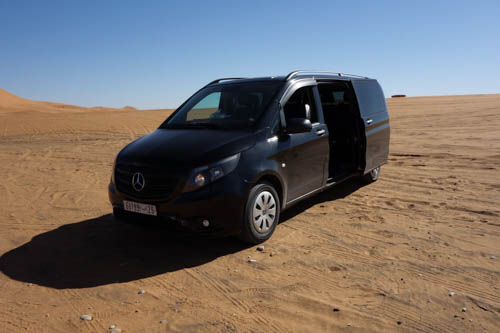
The Sahara Desert around Merzouga
Monday March 16. Dades to Tinghir then Rissani and Merzouga.
A civilised start to the day at 9:00am and then a quick breakfast from the buffet. Actually there wasn’t much to choose from, well at least breakfast things that we enjoy.
Then we were off to Merzouga for another night of ‘Glamping’. What a contrast from a Five Star Hotel to a tent.
But before that, we have a few stops, with the first on the outskirts of Tinghir.
There, from a viewpoint on the side of the road, we looked down part of a 40km oasis, which boasts one of the largest palm groves in the country.
It was huge and as we were driving out of town, it just kept on going.
The next stop is at the Toudgha Gorge, a 300m wall, carved deep into the High Atlas Mountains.
It was here that I first missed my wide angle lens.
There is a huge amount of urban development in Morocco. Outside many towns are acres and acres of homes being built. These housing estates, have hundreds of homes, all with a similar design and style.
Many of these villages seem rather well off.
There is good infrastructure, like schools, playgrounds and even bridges with a wide road and footpaths, with free standing lighting, on both sides.
After the Toudgha Gorge we headed east into the desert, which was surrounded by foothills and a landscape that was rather barren and very dry.
However, there was the odd oasis with filtered water and palm groves.
It was time to sit back and relax, as we had over a three hour journey to get to our destination.
We stopped for coffee somewhere on the N17, in the middle of nowhere. And would you believe it, they had an espresso machine and the coffee wasn’t too bad at all.
Two coffees and two bottles of water was only A$4.50.
Just near the espresso bar was a poster showing some of the local animals. One that stood out was an Oryx. Unfortunately there were none around. In fact we have seen no wildlife at all, apart from birds.
As far as I’m concerned cats, dogs, donkeys and camels don’t count.
The road we were travelling on wasn’t too bad, except when we passed areas where the water flowed over – then it got very rough.
We then had a stop at Rissani and were escorted around the Casbah. This was an ‘Opportunity to buy’ if ever we have had one. We were taken into store and shown a very fine array of carpets.
The shop was owned by a relative of our driver.
However we did learn something and that is that the camel is held in very high religious esteem by Muslims. Apparently it’s almost like Adam and descended from God.
The Casbah, built in the 17th Century, is occupied by a mixture Jewish, Arabic and Berber residents.
Our final stop was Merzouga, our ‘Glamping’ spot for tonight. We are staying in the Sahara Sky Luxury Desert Camp.
The entire area was set up for the tourist with quad bikes, dune buggies and camels.
At the end of the day, getting to new accommodation is always a stressful time. In most cases you just don’t know what’s waiting for you.
Today was even more so.
Our driver drove us out of Merzouga and dropped us at a car park. There waiting for us was a driver in his 4X4.
We drove out into the desert and the 4×4 was certainly getting a good workout over the sand dunes.
Suddenly we came across a herd of tourists on camels and the driver stopped. We got the feeling that they wanted us to ride a camel to the hotel. We weren’t about to do that, as we have ridden camels in the past, both in Egypt and Australia and we didn’t need to do it tonight.
Our driver then, reluctantly, took us to the camp. Where we waited for quite a while for someone to turn up and book us in.
At least we were offered tea and nibbles while we waited.
This is meant to be a luxury campsite, but it’s in no way a match to the one we had in Tunisia.
There were no glasses and only one power point in the room.
I get the feeling there aren’t many people here, so dinner will be a quiet affair.
Dinner isn’t until 7:30pm, so time to relax and enjoy the clear desert air.
The camp is set in an oasis of Date Palms and it’s very quiet. I was right, as there were only six people for dinner, including us.
Two were French and the other couple, one was Dutch and the other German and they lived in the Caribbean.
After dinner the staff put on a musical performance around an open fire.
We also had to participate by playing the drums and dancing round and round in circles.
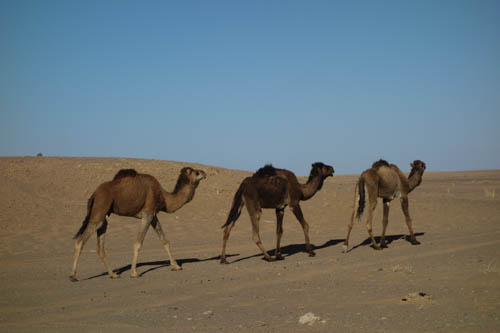
Camels on the loose
Tuesday March 17. Merzouga to Erfoud then Nekob and Ouarzazate.
It was an early start, well at least for us.
After breakfast we had to be driven from the camp, back to the car park, to meet up with our driver.
It was a 30 minute bounce across the desert.
Back on the main road we came across a column of eight Land Cruises, all with tourists on board. Over a matter of a few kilometres, we managed to pass them all.
We are now heading west and seem to be out of the desert area. There are lot more Date palm plantations now. However, these aren’t anywhere near as well cultivated as they were in Tunisia. It is similar, with the olive oil industry, both of them don’t seem to be as well developed as we have seen.
One of the big attractions along the way are stalls selling fossils.
We stopped for a coffee at Kiosque Slyat d alay, on the N17. This was where we had a coffee yesterday.
It’s surprising how many places have espresso machines. Just having an espresso coffee is sometimes the best way to go when you’re travelling, as trying to explain how you want your ‘Long Black’ is far too difficult.
Many of the men in this area wore traditional Muslim/Moroccan wardrobe, as do most of the women.
Later on, down the road, we were passed by thirteen bikers from Slovakia.
It does appear that the majority of vehicles on the road are carrying tourists.
We are suffering a bit from a driver who doesn’t have very good English. We also found that a number of destinations, that were listed on our itinerary, we’ve just not visited and we’re wondering why.
The scenery along the road was spectacular. We were surrounded by high mountains that were topped by dramatic, knife edged cliffs.
We stopped at Agdz café restaurant for lunch and just had a salad, which is much better than the huge meals we have been eating.
At the end of the meal I had another espresso and again It wasn’t too bad. All in all, it was a good choice and only cost A$11.20 for the meal and coffee.
Now we are back on the road to our final destination, Ouarzazate, where we will spend the night.
The road there took us back over of the Atlas Mountains.
When we arrived in Ouarzazate, we got a guide to take us around the Casbah and then the Old Town. This didn’t seem to be planned, but it was on our itinerary, so upon our insistence, our driver found a guide, and paid for him, who joined us at the car.
Ouarzazate, or in English ‘Quiet City’ has several areas. The Casbah, the Old Town and the New Town.
The Casbah is under renovation and unoccupied at the moment and was mainly where the Berbers lived. There was an 7.3 earthquake here in 2023 and a lot of damaged was done. The old town has Arab, Jewish and Berber people, all living together.
A tour of the Casbah took us through a number of houses, built for different size families. It was very interesting to see how the Berber families lived.
What was also very surprising, was how low the doors were. Our guide was constantly telling us to watch our heads, as did a guide in another tour group, that was in the house.
Banging your head must really be a problem.
We visited the old town, which I must admit was rather disappointing. There really weren’t many photo opportunities there. However one of the highlights was seeing storks on top of the various towers and minarets that were around.
After a long day, we finally got to our accommodation, the Dar Amoudou Hotel. It’s very quaint but certainly not a tourist hotel. Therefore no bar or booze, just a fridge full of soft drinks.
I am going to mention this fact to our tour operator, as we do like to have a drink at the end of a long day touring.
And we aren’t Muslim.
Over dinner, we met an English couple that were in Morocco and doing quite a similar trip to ours.
Inevitably, the conversation turned to Donald Trump and they, like us, thought very little of him.
However, what was also very interesting about this English couple, was what their son did for a job.
He’d recently been in Melbourne for the Grand Prix, as his job was to be a minder of Oscar Piastri, the Australian Formula One driver.
Dinner was much like we have become accustomed to. It consisted of Soup, a Chicken Casserole and a dessert and again, it didn’t have much flavour.
The Tunisian food was much tastier.
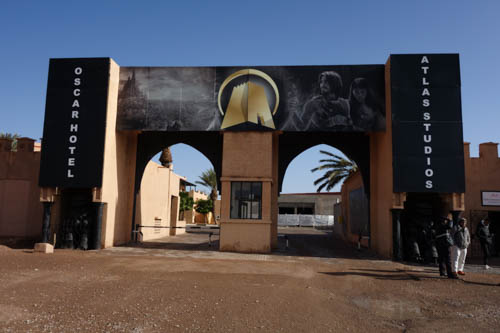
Atlas Film Studios
Wednesday March 18. Ouarzazatet to Marrakech.
Breakfast has always been a meal that I like to choose myself.
Whenever I travel I usually have the lunch and dinner that’s on offer and what’s local. For me, breakfast is something I like to be familiar with. However sometimes, like today, that doesn’t happen. We took what we were given and it was rather interesting.
But not something I want to repeat.
After breakfast we headed to the Atlas Film studios, where some of the most famous desert landscapes were and are still being filmed.
We were with a tour group, that was mainly Russians and we all travelled from set to set.
In one we were in Greece, another in Egypt and then we were suddenly in Italy.
This is an area totally devoted to fakes and facades. Everything is built with fibreglass and backed with timber frames.
One Russian woman was constantly seeking attention – it was all about Ben ‘Her’.
The studio was founded in 1983 by entrepreneur, Mohamed Belghmi and has continued to expand. This is due to the favourable climate and the introduction of guided tours, like we were experiencing.
The details on the sets, especially the Egyptian ones, were fantastic. They didn’t just paint the walls but actually used relief sculpture to highlight the outlines.
Many films were made here, or in the surrounding area, including Kingdom of Heaven (2005), Gladiator (2000), Jewel of the Nile (1985), The Mummy (1999) and Season 3 of Game of Thrones.
I get the feeling that both Tunisia and Morocco have benefit greatly from Hollywood.
If Donald knew that, I’m sure he would try to impose one of his taxes on them.
The big question remains, how long will places like this last, once AI takes over?
After the studios, it was then off on a three hour drive to Marrakesh. Again we were going across the Atlas Mountains. It was an amazing winding road, with many passing lanes. which was great.
We stopped for coffee at Café Nature Toufliht, that was back on the N9. Unfortunately we had to sit inside, as it was too cold out on the balcony.
But what a view we had.
Cops are everywhere, which is the same as as it was in Tunisia. Occasionally, we got pulled over, but they don’t do much, even when they did.
We are now on the rain shadow side of the Atlas Mountains and naturally they are much greener than they are on the other side.
Before we got to our hotel, we stopped at an area outside of Marrakesh called Menara, which is like a shopping centre. There Mahdi, our driver, took us into a tech shop to see if they could work out what was wrong with my Olympus camera.
Unfortunately, they couldn’t.
Then we headed to our accommodation for the next two nights, the Kech Boutique Hotel and Spa.
We were back into a tourist destination, complete with restaurant, lounge areas, pool, spa and a bar.
After we settled into the hotel, in the mid afternoon, we decided to go to a local mall, that was relatively close by.
The Almazar Centre Commercial was largish and also very busy.
I hadn’t brought enough hankies on the trip and thought it would be good to have a few more.
Hankies are hard to find at home and we had the same problem here.
No one uses ‘snot rags’ anymore.
We then just chilled in our room before going to the bar for a pre dinner beverage.
What a luxury.
Unfortunately the service was disappointing. There appears to be just one barman running the inside bar, pool bar and I think he is also doing room service, as he was constantly disappearing.
When I finally got a beer, it tasted very good. – it’s been a dry few days.
There seem to be very few guests in the hotel, as there has been over the last few nights in our other hotels.
As it turned out, the restaurant was closed and the only food that was available for dinner was tapas at the bar.
On the table next to us was Carlton, an American, who we got chatting with. He was a very interesting guy who was a birdwatcher, or, as we call it in Australia, a ‘Twitter’.
We got talking about all sorts of things, including politics and as it turned out, and not surprisingly, he was also anti Trump.
We ended the night on very good terms.
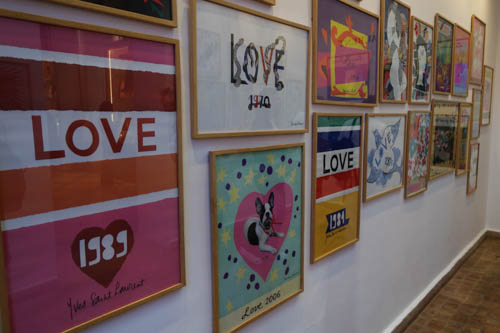
Yves Saint Laurent Love Gallery
Thursday March 19. Marrakech.
Unlike last night’s dinner, breakfast was a buffet and there was far too much food for the amount of people who turned up.
Fatima will be our guide today and take us around the sights of Marrakesh.
Our first stop was to the Kotoubia Mosque, built in the 11th Century. It’s the largest in Marrakech and one of the oldest in the world. It was completed under the reign of the Almohad Caliph Yaqub al-Mansur (1184 to 1199)
The Imam would ride a donkey to the top of the tower to call all to prayer. This was because it was too far for him to climb up the staircase five times a day.
On the top of all mosques are three balls which represent the three different religions in the world. Muslim, Judaism and Christianity.
This is an interpretation that’s very much open to opinion.
It was then to the exquisite Les Jardins Majorelle. An amazing display of bamboo, bougainvillea and cacti, formerly owned by Yves Saint-Laurent (1936-2008).
This French fashion designer was an icon of the industry and in 2002 was made a Grand Officer of the Legion of Honour.
Within the area was the Musée Berbére, featuring regional Berber costumes, jewellery and carpets that inspired his life and work.
Another exhibit was the Yves Saint Laurent Love Gallery, where posters were displayed, starting in the early days of his career.
Next was Yves Saint Laurent Museum, where no photos or even talking was allowed.
It was rather small, very crowded and quiet.
There was a film at the end that showed the history of Yves Saint Laurent.
It went through the start of his career, designing costumes for the theatre and then continued on to where he started designing women’s fashion and exhibiting it all around the world.
The number of tourists you have in an area can determine how things operate.
In our hotel, there are hardly any guests, so things aren’t like they should be. The restaurant doesn’t operate in the evening and the staff were minimal.
However, as soon as you get into tourist areas, that are overcrowded, you get the same old problem of too many people taking too many selfies.
They are constantly getting in the way of people taking real photos.
After the Yves Saint Laurent experience we then wandered around the Medina or old town.
This was followed by a visit to the Muslim school, or Médersa Ben Youssef, that was built in the 16th Century.
The school’s primary objective was to train young boys to become Imams.
The local kids went home at night, while those who lived out of Marrakech boarded there. Two were in each of the bedrooms, which were rather small. They were locked in at night and a guard had to unlock the door to let them out if they needed to go to the loo.
This school no longer exists and is now just a tourist site.
And there were plenty of them – tourists that is.
Next was another ‘opportunity to buy’ at the herb and oil shop, Herboriste La Sagesse.
The girl who served us was very well aware that Australians can’t take herbs and spices back into the country. So she wasn’t surprised when we didn’t buy a thing.
Lunch followed and was at Chez Sarghini, which was almost next door to the herb shop.
We kept it simple and shared a salad and a Tanjia. This is a typical Moroccan dish cooked in a clay pot in the coals of a fire.
Next was the Souq, or market and here we visited both the leather and metal areas.
Our final destination was Jemaa el Fna Square, or the central square, which is the hub of activity in Marrakesh. The square was next to the Kotoubia Mosque, where we started our tour.
So, by the end of the day we had done a complete circle around the old areas of Marrakesh.
They are obviously more guests in the hotel tonight because dinner is now being served in the bistro.
One benefit of more tourists.
However, not enough guests to have a full-time barman, as he still kept on disappearing.
At dinner, we met Carlton again, this time we sat and ate with him. He was telling us that he’s planning on doing a trip to Australia at the end of the year. He will be coming to Melbourne, so who knows, we might catch up with him again.
He seems to travel the world ‘Twittering’.
We have a long drive tomorrow to Fez, which means an early start.
Our driver wants us to meet him at seven, however breakfast doesn’t even start until then, so we have asked for one to be made and for us to eat it in the foyer area.
Who knows how that’ll work out.
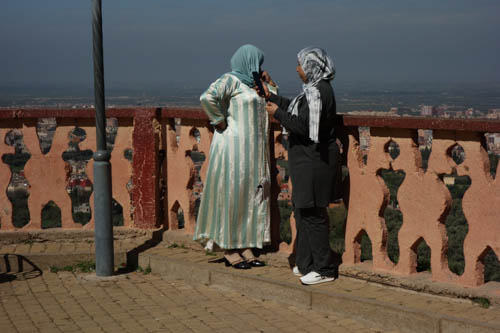
The lookout at Ain Asserdoun
Friday March 20. Marrakech to Beni Mellal then Ifrane and Fes.
With an early start to the day, we ate our breakfast in the room, as it came in a brown paper bag. Which wasn’t what we had asked for the previous night.
It will be a long day in the car as we’re driving to Fes.
Today Ramadan ends, so it will be interesting to see how things change. It’s also a public holiday in Morocco.
As we were driving along the N9, leaving the city, the streets were full of people in traditional outfits.
Even the kids were dressed up.
Apparently, everyone had just been to the mosque and were now going to feast. This is the celebration of Eid, the end of Ramadan.
We are heading into a couple of Alpine areas on our way through to Fez. The first is Beni Mellal and then Ifrane.
Nearly three hours into our drive we stopped for coffee at Café Agropole on the N8. It was a good strong coffee and helped to wake us up.
Even our diver, Mahdi, had one – well Ramadan is over.
As we were driving through Beni-Mellal, we noticed that all the coffee shops were now open, with most of them full of men and very few women in sight.
It was then up to the lookout at Ain Asserdoun, where we had a great view over the city of Beni-Mellal.
Even up here, at the Lookout, people were still wearing traditional clothes.
Along the road from Beni-Mellal, the area was very fertile. There were oranges, lemons, vegetables and strawberries all growing by the side of the road.
Plus, the ever present, olive groves.
Then it was on to Ifrane.
On the way we stopped at the Oum Er’rabi River View point. It was a pity about the power lines going straight through the middle of the view. This is a common problem in Morocco, as they are everywhere.
We stopped for a quick lunch at Rahou Rania in Khénifra. It wasn’t full but those who were there were certainly enjoying eating again.
Our driver was also having lunch, however he wasn’t sitting with us. He was getting stuck into a very large plate of chicken chips and rice and loving it.
Everyone else in the restaurant was also eating large meals and they all had a big smile on their faces.
I guess all the local restaurants are back to making money again.
We passed many small towns along the way that were beautifully laid out with wide streets, parks and gardens.
Ifrane is a town famous for its Alpine climate and European-style houses.
White houses, with high pitched terracotta roofs are everywhere. We could have been in France or Germany or even Switzerland.
It certainly didn’t feel, or look like, Morocco.
There is a statue of a lion near the centre of the town, which is regarded as being quite a mystery.
It seems to be very popular with both the tourists and the locals, everyone comes to get a selfie with the lion.
“The creator of the Ifrane Lion remains a mystery, with theories ranging from Italian and German prisoners to a French sculptor, Henri Jean Moreau. Despite various claims, research points to Moreau as the most likely sculptor, who worked on the lion around 1930.” (https://en.yabiladi.com)
The town sits at an altitude of 1665m and experiences snow during winter months with a cool climate during summer.
Ifrane is also the place where the lowest temperature was ever recorded in Africa, -24 °C in 1935.
Now we’re off, on the final leg of our very long journey, to Fez.
As usual, there was anxiety involved in finding the hotel and seeing what it was like. When we arrived at the one that was listed in our itinerary, we both freaked.
It looked empty and not very good.
After some questioning, we found that we’d been given the wrong name and the wrong hotel. Once that was sorted, we went and found the place we were meant to stay at.
It’s not great, but it certainly was better than the first one.
We were here for three nights and unfortunately it didn’t have a bar.
This means we’ll have to go to an international hotel to have dinner, with a drink.
But even that wasn’t easy.
The first hotel we went to was Ramada by Wyndham Fes and there bar was closed.
We then went to Hôtel L’Escale and they were serving alcohol with the meals but they had no beer.
Bugger.
Also to add to our traumas, it was raining.
The dinner was pretty good. Thea had à la carte and I had a choice from the buffet.
The staff were fantastic. Thea managed to splash some of her Tagine onto her jumper and they were there, in an instant, with hot water, to mop it up.
However at the end of the night they would only accept cash.
Apparently their card reader “wasn’t working” – now that’s one of the oldest tricks in the book.
Over dinner we met a Romanian couple, Dan and Elizabeth.
Dan only spoke French while Elizabeth had very good English – better than she thought.
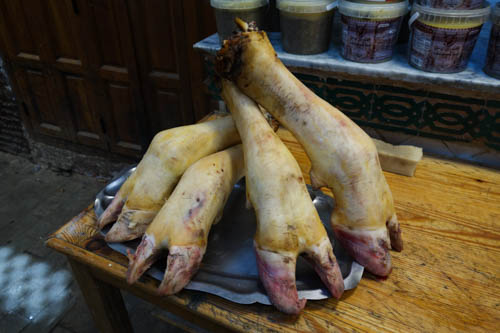
Medina
Saturday March 21. Fes.
It was a 10:00am start today, a big contrast to yesterday’s 7:00am.
Our first priority is getting the laundry done. After that was sorted, we got to breakfast at about nine and almost everything had gone. And what was there, was pretty pathetic anyway.
Today we have a guide to explore Fez.
It is the oldest of Morocco’s 4 imperial capitals and the most complete medieval city in the Islamic world.
Fez means Axe, but why the city is named after that I have no idea.
Our guide was Fahed, a well educated Moroccan, who speaks many languages.
The gate of the palace was our first stop, then the Jewish Quarter, both old and new.
We then drove up to Borj Sud. This is a viewpoint over the city, attached to a 16th Century fortress.
The Fes Medina is the biggest in the world. It has over forty mosques and more than 9,000 streets.
A lot of the Medina stalls were closed, as it’s a public holiday for the end of Ramadan. This is really a shopping area for the locals, as there was not much for the tourists.
I was hoping to buy a T-shirt, as a memento of Morocco, but didn’t see one in the whole Medina.
We then visited the Art D’Argil, an art school.
Art D’Argile is a family owned ceramics and pottery workshop that has been around for four generations. Everything is hand made and a lot is available to buy.
The Medina is divided into two halves by a river, that is now under the road. Tunisian architecture is on one side and Spanish on the other.
Lunch was at Ryad Nejjarine, which was set in an amazing house that’s been converted into the restaurant.
It was huge and extended over at least four levels and was rather expensive.
After lunch we wandered around the Al Attarine Madrasa, which is one of the most important spiritual centres in Fez and also one of the most visited landmarks.
Within the the Madrassa is the 9th Century Karaouine Mosque, which claims, along with the Al Azhar in Cairo, to be the oldest continually functioning university in the world.
Unfortunately it was prayer time and we could not get in.
Next was an opportunity to buy in a converted Carravanserie and then the Tannery, another opportunity to buy. Well this is how many guides make extra money.
After a failed attempt to find somewhere different have dinner tonight, we finished up going back to the same hotel L’Escale, in its Restaurant Panoramique.
Tonight I did get to the bottom of why they didn’t have any beer last night and still don’t have any tonight.
Apparently, beer production was stopped for Ramadan and it hasn’t started being delivered again. There is currently a four day holiday and nothing happens during that time, so the beer won’t be delivered until after the holiday is over, which is next Tuesday.
Again, we caught up with the Romanian couple. This was their last night in Fes and again we had another good, but limited, chat.
Elizabeth had a great sense of humour and could find a joke in any situation.
They decided that if we were having a bottle of wine for dinner, they could as well, so they also got one.
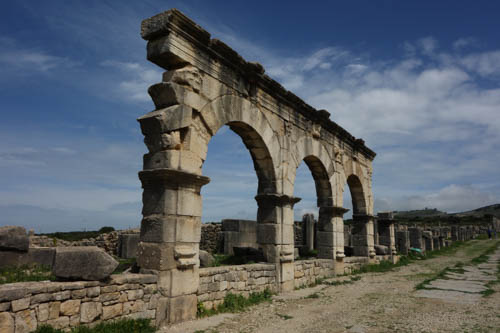
The Roman ruins at Volubilis
Sunday March 22. Fes to Volubilis then to Meknes and back to Fez.
We had another late start this morning but lost an hour overnight due to a time change.
This was yet another outcome of Ramadan.
Today we are travelling into the countryside to see a few of the surrounding towns.
First we head to Volubilis, to see the Roman ruins. This is regarded as one of the furthest outposts of the Roman empire and now a very well preserved UNESCO World Heritage site.
Then we drove to Meknes a large regional town.
We thought we would be having guides in both of these stopovers, however we only had them for the Roman ruins in Volubilis.
Stork nests are everywhere. Communication towers, mosque minarets, light posts, anywhere that’s up high you’ll find a nest, with chicks. Only very occasionally will you see them in a tree.
On the drive to Volubilis, we were pulled over by the cops, yet again.
I have no idea what they wanted this time. However, I do believe our driver may have been picked up for speeding.
We stopped at the viewpoint, overlooking Lake Sidi Chahede, for a photo opportunity.
There was also a number of stalls, a café and a very, very rudimentary toilet at the viewpoint.
We had another un-scheduled stop, which I think it was a delaying tactic, because the guide hadn’t turned up at Volubilis.
When we arrived Mohammed, our guide, was waiting for us.
The city is named after the flower Morning Glory, that opens at sunrise and closes at sunset.
The Romans came here mainly for the olive oil.
Archaeologist have been coming to the site since 1915 and they’re still coming to this day.
It was a good tour, of just over an hour and we saw a lot.
The site here must have covered many years of Roman history, as there were Doric, Ionic and Corinthian columns.
Our guide showed us a leaf that is believed to be the inspiration for Corinthian Columns.
It is known as the Acanthus.
The Acanthus is one of the most common plant forms used for making ornamental decoration and emanated from both the Greek and Roman cultures.
Lunch was at the restaurant, Roman City, that was just outside the ruins – which was very fitting.
Then it was off to Meknes.
Meknes was the capital of Morocco under the reign of Moulay Ismail (1672–1727), before it was relocated to Marrakech.
It was originally founded as a military city in the 11th Century.
As parking was an issue outside, we were dropped at the gate and let go.
We wondered around really not knowing what to see but did visit a fair bit of the centre of the town.
Coffee shops are everywhere in Morocco, even coffee vans. And now that Ramadan is over, they’re all open and full.
We have noticed over the last couple of days there’s been a gradual leak in our hotel bathroom, under the sink. It’s actually got worse and this morning I went and reported it to reception.
We came back tonight and water was still everywhere, it hadn’t been repaired.
I went down to reception and reported it, yet again, and they said they were going to send a technician up to fix it.
Who knows if that will happen.
After failing to find somewhere different to have dinner last night, we decided to just repeat that tonight and returned to Hotel L’Escale.
We are becoming regulars there.
When we arrived and ordered our wine, we were surprised to find an English couple at a nearby table, who didn’t even know they served wine here.
And they were staying here.
Compared to the last two nights, the place was empty an obvious sign that there’s not that many guests here.
It also means that the buffet wasn’t on, so it’s all à la Carte.
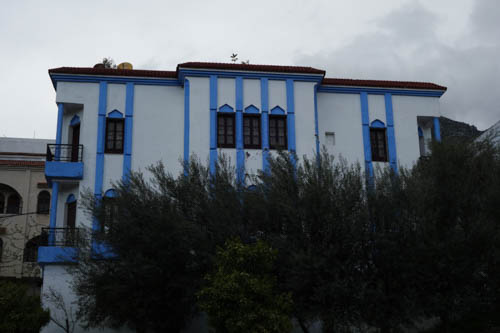
Around Chefchaouen, the blue and white town
Monday March 23. Fes to Chefchaouen.
This morning we both woke up with stiff backs, a result of the very rough roads we encountered yesterday.
On our drive north this morning, the roads were rather bad again, so it certainly won’t help our backs. And it won’t help the suspension of the van either, which is already shot.
Nothing happened about fixing the leak under the sink in the bathroom, so we reported it yet again.
The guy looked blankly me and said he will get it repaired. I said fine but believe me you will not get a good review for this hotel.
Again, he looked blankly at me and then my words sank in and then he looked worried.
It’s just under four hours to Chefchaouen and I don’t think we’re doing anything on the way there, except to get a coffee at a roadside van.
We think we love our coffee in Australia, well the Moroccans are just as mad about it.
They can’t drink alcohol, but they can certainly drink coffee.
Even though we got our coffees from a coffee van, they did give it to us in real cups, not paper ones.
We stopped for a photo opportunity on the N 13. There was even a small waterfall there, which was rather lovely.
We had two more photo opportunities on the way to Chefchaouen, one was the gate of the town and the other, a view over the town, which is very blue and white.
I counted seven ‘cop stops’ on our way up north. Fortunately Mahdi didn’t get booked along the way, as he did yesterday.
We got into the town and after a bit of research decided that very few restaurants, if any, serve alcohol.
So we went in search of a store that might sell it, we even drew a blank there.
It looks like a dry couple of days.
We are staying at the Puerta Azul Hotel.
It looks ok on the surface but it’s a bit shabby when you look closer and it’s also located in rather poor part of town.
Chefchaouen, is known as the ‘Blue Pearl’ of Morocco. This due to its striking blue and white Medina.
The town was founded in 1471 by Ali Ben Rashid, as a small Kasbah. This was to defend against a Portugese invasion of northern Morocco.
After the fall of Granada in 1492, many Muslims were expelled by King Philip III of Spain and immigrated to Chefchaouen.
After we checked into the hotel, we went for a wander around the town.
It was very hilly.
We didn’t do too much, as we have an excursion tomorrow morning, with a guide – we think.
Blue and white is everywhere, including the street lamps which are blue and also have a blue light on top.
Even the taxis are blue and white.
Dinner was at the Blue Escape, which was just around the corner from our hotel. With a restaurant name like that, I guess we’re keeping with the theme of the town.
We chose to eat downstairs, rather than in the Restaurant area upstairs on the roof.
It was just too cold up there.
Downstairs we could barely hear ourselves think. What with the sound of the TV blasting out football and the kitchen staff squabbling amongst themselves.
We’ve never been served by a waitress in Morocco. I guess it is in keeping with their very Islamic culture, where the man dominates everything.
Another interesting fact is you rarely see girls and boys together. It’s normally only just boys on their own or girls on their own.
For dinner, we shared a pizza and a salad and it wasn’t too bad.
The amazing thing was it only cost about AU$16.
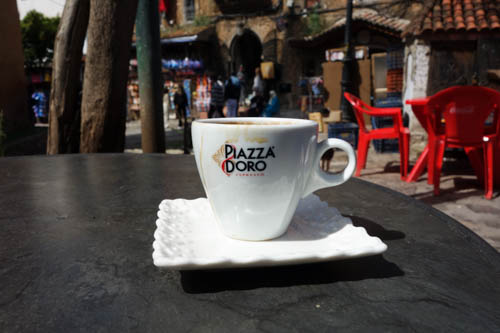
Second coffee of the day
Tuesday March 24. Chefchaouen.
Breakfast was a strange affair.
Firstly it was a kind of buffet but they insisted of serving us.
It was limited to bread, pancakes and croissants, chocolate ones.
Yuk.
You could have eggs if desired.
And, to top it all off, the coffee was not espresso but brewed and sitting in a pot, stewing.
Yuk again.
The positive thing is there are plenty of espresso coffee shops around town, so we won’t be caught short getting one.
This morning we thought that we had a guide to take us around the city.
This wasn’t the case, as we were just picked up from the hotel, taken to the central part of town and dropped off, then told we had two hours to wander around.
So the first thing was to find a coffee.
This wasn’t as easy as we thought. We were in the tourist area and just kept on getting hassled by people offering services.
We were coaxed into a coffee shop in one of the main squares and all they had on offer was Nescafe. Not wanting to have a bar of that, we wandered off and went into the more local area and sure enough, found a coffee shop with an espresso machine and got one there.
And it was good.
We then went walking around town, which is very interesting and in a spectacular location.
Just near the coffee shop was the Kasbah Chefchaouen, built by Moulay Ali Ben Rashid. It had a number of areas built around a beautiful garden.
There was a museum, a tower and even a small gallery, with an exhibition of painted umbrellas.
After that we wondered around town again. Up hills, down hills, around through shopping areas and everything was quite amazing.
This part of the city is much more interesting, compared to where we are staying. It’s a pity that the Moroccan agent didn’t book us into somewhere like here.
Everywhere we’ve been in the market areas of Morocco, I’ve been welcomed with the greeting of “Hey Moustache”
I’ve actually got quite used to it.
On our wanderings we only found one shop that’s sold Tees. Unfortunately all he had was white ones, or extra large and small in black.
However, Thea did buy a traditional dress for Aida and surprisingly, the guy accepted a card for the payment.
We stopped at the Ali Baba Restaurant for lunch, which was in one of the main squares. Which is quite ironic, as my hairdresser, in Hampton, has exactly the same name.
Chefchaouen reminds us so much of Granada, which is not surprising considering that Granada was so influenced by this area.
After lunch, we returned to the coffee shop we went to this morning and I had another coffee.
It was so good and probably the best Double Espresso we’ve had so far.
We had the afternoon off, so by the time we finished lunch and the coffee, it was time to go back to the hotel.
Tonight we will probably return to the Blue Escape, the same place as last night.
After our lunch, we won’t need much and they were friendly people who made us feel very welcome.
Tonight we decided to eat upstairs, on the terrace, and what a view there was.
But it was chilly, well we are in the Rif Mountains.
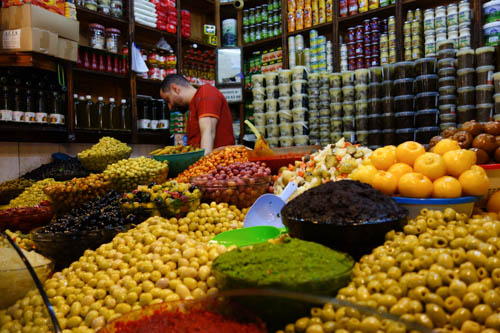
The Tangier Market
Wednesday March 25. Chefchaouen to Tangier.
As the breakfast coffee was so poor at the hotel, that we went to a cafe, that was just over the road, and had one there.
The coffee at Les Féres wasn’t bad but we were spoilt by our double experience from yesterday.
As we’ve been touring Morocco, over the last two weeks, we have realised just how much more Muslim the society is, especially compared to Tunisia.
Not only are the women treated more strictly but the men are also more conservative.
Today we are driving north to Tangier, on the Mediterranean, for our last few days in Morocco.
We stopped to get a view of Lake Martil, which in fact is a dam.
As we approached Tangier, we noticed that there were many wind farms on the hills surrounding the city.
The only renewable energy we’ve seen so far were solar panels.
We arrived at the hotel, but were a couple of hours early to check in. So we went for a walk down to the Medina.
I was still in need of a Tee, so we went wandering around and then I found one.
The store owner was great and we chatted for quite some time. We told each other the stories of our lives.
Then we went in search of a small lunch and found the Gran Café Central, on the Petit Socco.
We shared a Seafood Salad and had one of our favourite drinks a Citron, which basically is a bitter lemon.
I ended my meal with an Espresso and it was rather good.
Will be back in this area tomorrow, hopefully with a guide, so we didn’t want to do too much more now.
So we meandered back to our accommodation but did come across the old market area on the way.
We are staying in the centrally located Rembrandt Hotel.
Why a Moroccan hotel is named after a 17th Century Dutch painter, I have no idea.
Before dinner, we went for a drink in the bar, yes, they have a bar and the bar has alcohol.
This will be my first beer in five days.
However there were negatives.
They didn’t serve wine by the glass, only in bottles. Their menu said they had draft beer, but they didn’t and the menu also said that they had small bottles of white wine, but, again, they didn’t.
Also, the beer I had was a Casablanca, which I’ve had many times before. However, this one was only in a 25cl bottle, when they have always been in 33cl.
It’s barely a sip – but it did taste good.
The Rembrandt Hotel, so far, has proved to be below standard. We couldn’t even charge our meal or our drinks to the room.
Who knows what breakfast holds.
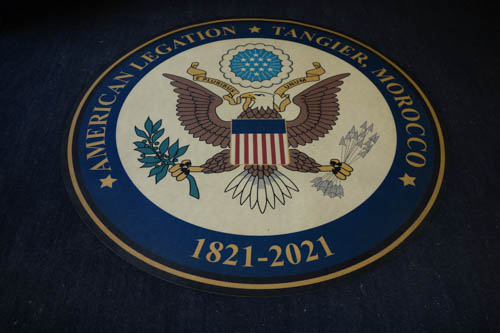
The Tangier American Legation
Thursday March 26. Tangier.
Breakfast wasn’t too bad, there was fresh fruit and real Croissants, not ‘Americano Croissants’.
The ones with chocolate that is.
Today we’re off, with our driver and hopefully a guide, to explore Tangier.
The sun is shining, which is great, because this is our last day in Morocco.
So much of the hotels technology is old and doesn’t work. The lift is ancient, the air-conditioning just didn’t go warm and the toilet didn’t flush and the water doesn’t get away in the shower.
The list goes on.
I think I know now why they call it the Rembrandt Hotel, because it’s actually from the 17th century.
Our guide is Mostafa, yes we had one and he was waiting with our driver outside the hotel.
We visited everything around the city and it was all seen on foot.
First was the French Quarter.
The French have had so much influence in Morocco and you can see it here in Tangier. It’s evident in architecture, street names and especially in the cafes and food.
Bakeries are also everywhere.
Then it was the market again, followed by the Tangier American Legation.
The legation was established in 1821, following decades of good relations between Morocco and the United States. Also Morocco was one of the first counties to recognise US independence from Great Britain in 1777.
The legation building was gifted to the US by the Sultan Mohammed ben Abdallah. It remained a US diplomatic post for 140 years.
After the legation visit we returned to the Petit Socco or Small Market, where we were yesterday and went back to Gran Café Central in the Petit Socco for a coffee.
We continued on towards the Kasbar, but then came across the summer residence of Barbara Hutton, the famous American actress.
Next was the Kasbar Museum, which is housed in a 17th Century Palace. The museum covered Neanderthal through Bronze Age to Roman artefacts and up to the Islamic era. It also featured work from the Portuguese occupation.
It was a very small museum, but it spanned a great deal of time.
We passed through the Spanish quarter, where the influence of their settlement can be seen in the architecture.
We returned to the Big Market Square, after three and a half hours of excellent sightseeing.
When we look back on what we’ve seen, we realise that our hotel was in a very good location.
We did cover a fair bit of it yesterday but it was great to do it with a guide and have everything explained to us.
Mostafa was a good guide, who explained it all very well. He also took his time, so it was a slow pace as we wandered around town.
Also he didn’t race ahead, like so many guides do.
After dropping Mostafa off, we drove to Cape Spartel, the meeting point of the Mediterranean Sea and the Atlantic Ocean.
This is a real tourist destination, a place of many selfies.
Then we drove a bit further on down the Atlantic coast and found Hercules Cave. This was nothing spectacular, so we didn’t stay long.
However we did stay long enough to have an ice cream and that turned out to be our lunch.
After that we drove back to the hotel. It was the end of our time here in Tangier.
We had walked about 5 km around the town centre.
Our driver, Mahdi, had borrowed 500 Dirham from us earlier in the trip, as his card wouldn’t work in Chefchaouen. Now he wanted to return back to the hotel, in an hour, to pay us off.
We had decided that this money could be his tip, so told him not to bother about returning.
He was very grateful.
We have a very, very, early start in the morning at 3:30 am. Therefore we’ll try and get everything sorted out and packed up tonight, before we go out for dinner.
Tomorrow we fly from Tangier to Malaga in Spain, then we get a bus to Granada.
We did go down for dinner early and the restaurant was absolutely empty. I ordered a beer and asked if they had anything bigger than 25cl.
The answer was no.
Friday March 27. Tangier to Malaga, Spain.
It was a 3:30 am when we jumped into the van and headed to the airport.
We said goodbye to our driver, Mahdi and then checked the time. It was then about a three hour wait before our departure.
I think we could have got up later.
It was only a 30 minute flight to Malaga and I think I slept through the entire time.
We had breakfast at the Malaga airport and waited for our bus.
It was then over two hours to get to Granada.
We have spent many hours sitting today. Sitting, waiting for the plane, sitting on the plane. Then sitting waiting for the bus and then sitting in the bus to Granada.
I’ve never been a fan of Ryanair and today was just another example of how cheap they really are.
The seats on the bus to Granada and the bus itself, was far more comfortable and in better condition than the aircraft.
We are now settled into our room at the Hotel Gala Placida 1923, in Granada and have been upgraded to the suite on the roof. It has a lovely balcony and seats in the sun.
And, so ends our North African adventure.
It’s been a wonderful four weeks of culture and experiences.
Also, having our trip during Ramadan, was both restrictive and also very interesting.
However, one fact stood out, in both Tunisia and Morocco. The people there believe there is a great relationship between cultures and religions. Muslims, Jews and Christians could all get on together and they did.
We had spent over 40 hours sitting in the van and covered over 2,500km.
What an adventure.


