Bruce Stainsby's Blog: Muttering from the mo

The Great Wall really is great. (September 2014)

January 17th, 2015

DSC07887

We arrived into Jiayuguan on the overnight train from Lanzhou, after another sleep deprived night.

We had been put on the slow train that stopped at every station. We later discovered that there was a train that left half an hour later than ours and arrived two and a half hours earlier.

Vickie, our guide, was there to meet us and after another quick breakfast of beef and noodles we were back into the site seeing.

Our first stop was the Jiayuguan Pass, or Fort, and the Great Wall Museum.

The weather was warmer and the tourists fewer.

There was a choice as to how you could see the fort, one was by ultralight – we chose to walk.

The fort is located at the western end of the Great Wall and is historically one of the main passes through the wall. It was built during the early Ming dynasty, sometime around the year 1372.

This part of Western China is in the Gobi Desert and has been designated as an expansion area. Soil has been moved here in order to grow trees along the roadsides. The water comes from natural springs that have their origins in the nearby mountain range of Qing.

For millennia Chinese dynasties have been trying to tame this harsh environment. When this particular part of the Great Wall was constructed soldier/farmers were brought here both to defend the frontier and feed the growing population.

With the protection that the Great Wall offered, the Silk Road expanded and the area around Jiayuguan became a melting pot of multiculturalism.

Not only goods were traded but so were ideas.

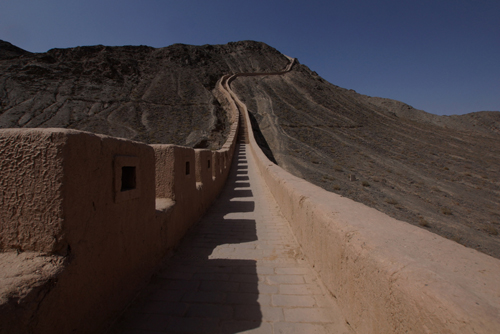
From the fort it was a short drive to the Overhanging Great Wall. This is another part of the wall that has been renovated and gives you a good idea just what an enormous feat of construction the Great Wall was.

As we discovered in the museum, there is more than one wall that makes up the Great Wall complex. Successive Chinese dynasties have added to it according to their defensive needs.

The Great Wall, stretching from Dunhuang in the west to beyond Beijing in the east, was built over thousands of years and is estimated to have been 21,196 km in length. Considering that the circumference of the equator is 40,075 km, it really is great.

In the afternoon we made the long drive to Dunhuang and really got a feeling for the surrounding desert environment. There were patches of fertile farmland interspersed amongst a flat barren landscape. Ever present were the high tension power lines stretching as far as we could see.

We also passed two of the largest wind farms I have ever seen. There weren’t hundreds of turbines, there were thousands.

The Chinese don’t do anything on a small scale. Even the toilet block at one of the motorway rest stations had more urinals and cubicles than you would find on the entire Hume Highway.

Strangely the car park was empty so I guess they are looking to the future.

Dunhuang is an oasis in the Gobi Desert producing fruit, vegetables and grapes. Like the rest of China, it’s a work in progress, with cranes dominating the skyline and construction at every turn.

The next morning we were off to the Dunhuang Yardang National Geopark, which is about 180km from Dunhuang.

The rock formations in the park were formed by water and wind erosion over a 700,000 year period. This is the largest park of its kind in China.

The temperature was warm but the air was still hazy, a byproduct of China’s industrialisation, even this far west.

We them went to another outcrop of the Great Wall. This one was made of straw and mud, yet was still standing after 2,000 years.

The day was to be spent driving around the Gobi Desert and, as we discovered from Vicky, there are many colours of the Gobi. These depend on the makeup of the soil, there’s black, white, yellow and red. And when it rains and the grass grows, there’s even a Green Gobi, however this doesn’t happen very often, as the average rainfall is only 24mm.

A visit to Yumen Pass and Yangguan Pass completed a long, warm and dusty day in the desert.

Both these passes were important gateways on the Silk Road, joining Central Asia with China.

Day three started with a visit to the Mogoa Caves, made a UNESCO World Heritage site in 1987. Before we went to the actual caves we had an introduction in the ‘Digital Caves’. This was a high-tech, audio video explanation of the cave’s origins.

There were two video presentations, one explaining the geological origins of the caves and the other showing the caves in detail. The last video was in a 360 degree theatre with high resolution graphics that recreated some of the main imagery contained within the caves.

The Mogoa Caves are also known as the Caves of the Thousand Buddhas and contain 492 temples carved out of the sides of a steep river bank.

It has documented over a thousand years of Buddhist history in art, painting and sculpture.

Situated close to Dunhuang, the Mogoa Caves were of religious and cultural significance to the Silk Road travellers. They were abandoned in the eleventh century, a result of the spring feeding the river drying up.

In 1907 a Hungarian-British archeologist, Sir Marc Aurel Stein, discovered the ‘Library Cave’. This cave contained a wealth of religious and historical documents.

In the tradition of archeologists before him, he cheated the locals and plundered the treasure.

More treasure hunters came from France, Russia, the US and Japan. Resulting in most of the library now being held in foreign capitals.

Our last stop for the afternoon was the Singing Sand Mountains and Crescent Spring.

Here giant sand dunes dwarf the natural crescent shaped oasis. There is a pagoda next to the spring that was built in the 1990s. It replaced an old Buddhist temple that was destroyed by the Red Guard during the Cultural Revolution.

The facilities at all of the tourist sites we have visited have been amazing. They aren’t there for Westerners but for the Chinese, who are avid travellers.

Another long day was coming to an end, so it was back into the van for a two hour bumpy ride to Liuyuan to catch an overnight train to Turpan.

Our travelling companions on this trip were Alfred and Annamaria from Switzerland.

Alfred, discovering we were Australian and believed that sharing a cold beer wouldn’t be out of the question.

We did manage to convince the catering staff to sell us two cans of local ale, unfortunately they were warm.

Warm beer seems to be the norm as we moved west in China.

Tibet or not Tibet. (September 2014)

January 15th, 2015

DSC07823

We took the overnight train from Xi’an to Lanzhou. This is a city with a history dating back 2,000 years and was a major stopping point on the Silk Road.

We arrived in Lanzhou at 6.30am and were met by Adreana. After a quick breakfast of beef, noodles and vegetables, we set off to see the sites of the city.

We were meant to do this on our second day in Lanzhou however the road rules had changed and our driver, having a vehicle with even number plates, wasn’t permitted into the city area on the day we arrived.

This is a very small city, by Chinese standards, only having 3.4 million people, yet there is enough congestion to warrant a subway system. It’s construction was now causing more disruption hence the banning of vehicles from the CBD on certain days.

Our first stop was to visit the White Pagoda Mountain.

After crossing over the Lanzhou Iron Bridge we had a steep climb up the mountain to the pagoda. Unfortunately the pagoda was being renovated, as Lanzhou was the host city for the forthcoming Golden Rooster and Hundred Flowers Film Festivals, so its famed ‘whiteness’ was in no shape to be photographed.

The views of the Yellow River from the top were worth the climb – a climb that was welcome exercise after a night confined to the train.

The Yellow River is indeed yellow, well a clay colored muddy yellow. It is regarded by many Chinese as the ‘Mother River’ because its yellow colour matches their skin.

On a siding next to the river, and harnessing its power, are the Lanzhou Water Wheels. These are two giant timber wheels that currently divert water to a mill-house, via an elevated aqueduct. They were originally used to irrigate farmland in the area. The waterwheel was originally invented by Duan Xu in the Ming Dynasty (1368-1644).

Until 1952 about 252 waterwheels stood along the Yellow River at Lanzhou.

Adjacent to the waterwheels were a group of river rafts, that use inflated sheep skins as the means of flotation. They are a popular attraction with the Chinese during the tourist season.

There was even an onsite puncture repair centre.

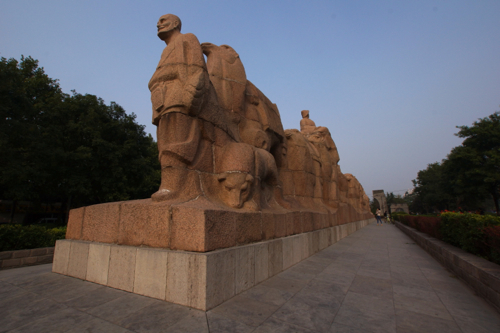
The Mother Statue of the Yellow River, constructed in 1986, was just down the road. It was over run by Chinese tourists having their photo taken in front of it.

The statue is of a mother and baby. It’s believed that the baby’s gender is hidden, so the viewer can chose what sex they want it to be, when they make a wish for the good fortune of their own children.

It was then into the car and off for a four hour drive to Xiahe. This drive would normally take a lot less time but it was raining, slowing the traffic down considerably.

Xiahe County is in the Gannan Tibetan Autonomous Prefecture and is part of what was formally known as Tibet, but is now well and truly in China.

After arriving in Xiahe and checking into our hotel we were off to meet a Tibetan family on the Sangke Grassland.

These semi nomadic Tibetan herdsmen have three locations to graze their cattle and move from place to place, according to the seasons.

It was the beginning of autumn and most of the herd had already moved to the winter grasslands.

The next morning we visited the Labrang Monastery. This is a huge complex with over 1,000 monks living and learning there. It’s not only a monastery but a university that has a number of faculties including medicine, philosophy and of course Buddhism.

Apparently there are over 108 monasteries in Tibet, Labrang being the largest. From the amount of cash, received from offerings, I saw the monks counting, it may well be Tibet’s primary industry.

It was interesting to note that most of the Tibetans use iPhones and not the more common Chinese Android devices. This is because Apple have cleverly included Tibetan in their language selection.

Something the Chinese refuse to do.

In the afternoon we had a long walk around Xiahe and another great coffee at Cafe Norden. The coffee was an unexpected highlight, given where we were.

Tibet, like most of China, is modernising and new buildings are popping up at a rapid rate. The small town of Xiahe was no exception, with indoor shopping malls being built adjacent to the main street. From what I could see these were very underused, with most shopkeepers preferring to remain on the main thoroughfare.

It was then back into the car for another long, wet drive back to Lanzhou.

When we arrived the traffic was chaotic. Again it was the turn of vehicles with even number plates and our driver only had permission to drop us off at the railway station for our trip to Jiayuguan.

I would hate to imagine what it would be like with both odds and evens on the road.

The Silk Road starts here. (September 2014)

January 13th, 2015

DSC07759

Our introduction to Xi’an, the start of the famed Silk Road was summed up by this quote from our guide Maggie.

“To see tens of years of history visit Shanghai. To see hundreds of years of history visit Beijing. To see thousands of years of history visit Xi’an.” 

Naturally our first stop in Xi’an was the Terracotta Warriors.

Over 7,000 have been unearthed in the area around Emperor Qin Shihuang’s tomb. It is believed that here are many more still buried there.

They were discovered by a local farmer, Mr Yen, in 1974. Since that time he has gone on to become a celebrity. He even has his own store at the site, where he signs books, postcards or whatever else you might care to buy.

Even taking a snap of Mr Yen will cost you.

The bodies of the warriors were made in casts while the hands and heads were crafted individually, making each solder unique.

Emperor Qin Shihuang had a vision for China and fulfilled it in a brutal and bloody manner. He united the Chinese, through a series of wars lasting 16 years. He wasn’t all bad as he introduced a unified system of weights and measures plus a common currency.

The Emperor, like so many ancient and modern leaders, wanted his power to last forever. To this end he built his tomb on such a grand scale that he included an army to help him keep his power in the afterlife.

The Terracotta Warriors are that army.

The average size of a flesh and blood warrior in those days was 1.5m, his warriors were made to be 2m tall. Emperor Qin Shihuang wanted to make sure he would never be beaten, living or dead.

In the afternoon we hired bikes for a ride around the 14.5 km of the ancient city wall.  It was very flat but with the cobblestones, a bit like the Paris to Roubaix.

At Maggie’s insistence we bought an evening entertainment package that consisted of a dumpling dinner and cultural show.

The dumplings were shaped according to what was inside. We had piglets, fish, lotus flowers and tomatoes. There were some with no real shape, so I was a bit sceptical about their filling.

My favourite act of the cultural show was a percussion group, playing a variety of drums, cymbals and bells.

The next day we visited the Big Wild Goose Pagoda and the Shannxi History Museum. The Big Wild Goose Pagoda is made from stone and was originally constructed in 652, during the Tang Dynasty. Today it has a very distinctive lean that was caused by an earthquake in 1556.

The Shannxi History Museum, like all Chinese tourist attractions, was crowded. Here the locals were taking snaps of everything in museums – what do they do with all those photos?

We wanted to get a shot to celebrate the start of our Silk Road adventure, so after much searching Maggie and the driver found the the Silk Road Monument that Thea discovered existed just outside the city walls. It was a large sandstone sculpture depicting a camel train, heading west, just like us.

In the afternoon of our second day we visited Muslim Street and the Great Mosque of Xian.

Muslim Street, as the name suggested is the area where most of Xi’an’s Muslim community live. It’s a very crowded street full of food, goods of all variety and souvenirs for the tourists.

There were dozens of food stalls and fast service restaurants.

We had a quick meal in one of them before heading off to catch the train to Lanzhou.

I ordered food from the front counter and the service was so fast that the food was already on the table by the time I got back to my seat.

Within the Muslim Street precinct is the Great Mosque, which bares little resemblance to other mosques we have visited. It’s designed totally in a Chinese style with pagodas, gates, relief sculpture and calligraphy. Representational art is rare in Arabic mosques, with the only decoration consisting of quotes from the Koran.

The overnight train to Lanzhou was an experience.

We had a ‘soft sleeper’ which was a cabin with four bunks, which we shared with a Chinese couple.

The bed was comfortable enough however the train ride was full of bumps, rattles, jerks and frequent stopping. I have know idea how many carriages were hitched and unhitched during the night.

Music and a constant babble in Chinese was piped into our cabin until 11pm and then resumed again at 5.30am.

Forbidden cities and great walls. (September 2014)

January 11th, 2015

DSC07412

Beijing is China’s capital and after Shanghai, the second largest city in China. It’s also regarded as the political, educational and cultural centre.

From what we have seen the Chinese love to be tourists in their own country, Beijing was no different.

Our guide in Beijing was Lucy and as she explained, a member of the Han community.

There are 56 different cultural groups in China with the Han making up 90%. The other 55 ethnic groups make up the remaining 10%.

I think that all the ethic groups love to travel as we found a huge diversity in the tourist mix.

We arrived late on a Sunday and the air was clear and the sky blue. The next day the haze was back but not as thick as we had seen.

Our first stop was the Temple of Heaven, one of Beijing’s largest temples and situated in a huge parkland area, not far from our hotel.

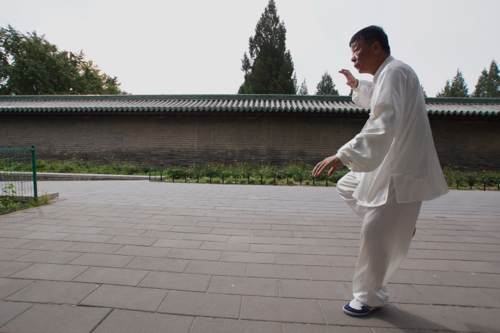
Here the local retirees do their morning exercises. This can vary from line dancing to hackie sack kicking with a variety of other activities in between. There is also mahjong and cards for the less active.

People are in groups or for the more solitary souls off on their own amongst the trees.

Many of these trees are very old, some dating back 400 years. We knew this by the plaques indicating their age.

The temple complex was constructed from 1406 to 1420 during the reign of the Yongle Emperor, who was also responsible for the construction of the Forbidden City.

This is where the Emperor came every year to pray for good weather and an abundant harvest.

Between visiting the Temple of Heaven and Tiananman Square we had tea, tasting five different varieties. According to our hostess every one of them had some amazing power to heal and revitalise the body.

Our next stop was the famous Tiananman Square, a vast open space dominated by public buildings on on either side, with Mao’s Mausoleum in the centre and the Forbidden City at one end.

This is a place that many Chinese wait their whole life to see and there were a lot fulfilling their dreams on the day we were there.

Other cities in China have a Forbidden City but the one in Beijing is far and away the largest and most impressive.

With 980 buildings covering 72 hectares, this is a vast complex, so it’s no wonder that it was declared a UNESCO World Heritage site in 1987.

Built from 1406 to 1420 it was the Chinese imperial palace from the Ming dynasty unti the end of the Qing dynasty. Built at the same time as the Temple of Heaven it has been the home of emperors and the centre of Chinese government for almost 500 years.

In the evening we visited the  Beijing Chaoyang Theatre, Acrobatics World. The theatre wasn’t full so our tickets were upgraded to VIP class. This gave us softer seats in the middle rows, close to the action.

Acrobatics have been a part of Chinese cultural life for over a thousand years, however this show was totally modern.

It was themed in an typical Chinese manner with umbrellas, pushbikes, hats and motorbikes. The motorbike act started with one bike speeding around inside a metal sphere, and ended with eight of them. At times it seemed totally chaotic, much like the Beijing traffic.

It was a relatively early start on day two and the haze was back. The temperature had also dropped a degree or two, which made climbing the Great Wall much more bearable.

On the way to the wall we had two obligatory factory visits, complete with shopping opportunities. One was to a jade workshop and the other an outlet that purported to make cloisonné (wire and enamel ware). It was really a front for a vast showroom.

We yet again resisted the urge to buy and moved on.

Once we reached the Badaling section of the Great Wall, at Lucy’s suggestion, we chose to walk on the south side. It was less crowded and more strenuous, but certainly worth the effort as we also got great views looking back to the north side. There were thousands clambering over the wall – the tourist invasion of 2014.

Not long into our walk the sky’s cleared and the sun made an appearance, improving the clarity of the snaps.

Forty two kilometers from the Beijing CBD, in the Changping District, is the Thirteen Tombs of the Ming Dynasty.

This area was also constructed by the Ming Dynasty emperor, Yongle (1402 – 1424). Based on the principles of feng shui, he chose to build his own mausoleum here.

Leading up to this necropolis is the sacred Road or ‘Spirit Way’ with statues of guardian animals and officials on either side, lining the way. The animals are all in pairs, with one pair sitting and the other standing.

We reached the Mausoleum of Emperor Chengdu late in the afternoon and the sun was low in the sky – the magic hour for photography.

The first hour of our last morning in Beijing was spent investigating if the Chinese Post Office could send my useless Sony lenses home.

It tuned out to be too hard to arrange as there was too much danger of them being broken. Not that they were of any value now.

We were then loaded onto a rickshaw for a ride through an old area of Beijing. These old areas are known as hutongs and are a tangle of narrow streets clogged with people and vehicles.

We then visited a ‘typical’ house of a hutong resident where the owner explained the way they live in this area. I have a feeling that this was more for show than authenticity. Still it was interesting to see how people live in the more traditional areas.

We had a separate guide for this trip into the hutong and Tony peddled along beside our rickshaw, narrating as we zigzagged in and out of the traffic.

Our last stop, before boarding the Bullet Train to Xian, was a quick visit to the Summer Palace.

This vast area, dominated by an artificial lake, was the summer resort of The ‘Dragon Lady’ Empress Dowager, Cixi. She diverted a fortune in silver, designated for the navy, to build this personal retreat.

There is only a bull and no bear in Shanghai. (September 2014)

January 4th, 2015

DSC02360

Immediately we arrived in Shanghai we went to a Sony service centre. They believed it was the camera at fault but there wasn’t enough time to have it repaired. So it was then off to the Sony Store to see what replacements were available.

After two hours of trying different camera and lens combinations, testing my old lenses with demonstration cameras, and managing to break many of them, we decided to buy a new camera and telephoto lens.

We were only two weeks into our trip and the idea on not having a good camera was unimaginable.

It still wasn’t that straight forward as the store didn’t have the lens in stock, that had to come from the warehouse and in order to get a discount I had to buy the lens first, then the camera. We appreciated the chance to save a few Yen as the price of camera equipment in China is about 20% more than what you can buy online or in the States.

I had to wait a couple of days to get the new camera and lens so we were immediately back into the sightseeing.

The Bund was top of the agenda on our first morning.

This is a great introduction to Shanghai, as it highlights the paradoxes that make up this huge city of over 24 million people.

This is the city where east meets west and the Bund is a showcase for the city’s diversity of style and culture. This riverfront area runs along the Huangpu River facing the Pudong. On the Bund side are many old commercial buildings and banks that were built during the early part of last century. These overlook the Pudong, one of the newest areas in Shanghai, dominated by steel, glass  and neon monoliths.

From the Bund we went to Yu Garden, an excellent model of Chinese garden architecture. Built during the reign of Ming Emperor Jaijing in 1559 as a private garden for Pan Yuncuan, an administration commissioner.

The Jiangnan Silk Workshop was yet another ‘opportunity to buy’ we resisted and moved on to the Oriental Pearl Tower and History Museum. This is the Shanghai TV Tower and offers great views of the Bund from the Pudong area. There is a rather strange museum under the building that gives a censored history of Shanghai. This includes models of old motor vehicles, once seen in Shanghai, that have clearly been copied from the originals and scaled down.

In the evening of our first night we took the Metro back down to the Bund and wandered around.

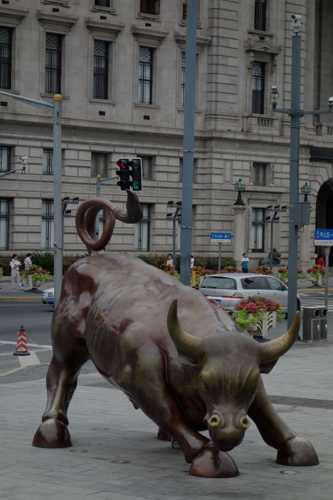
All the old buildings are illuminated, as are the skyscrapers in the Pudong, over the river. In the Bund there is a statue of a bull, no bear, that illustrates the Shanghaise and also the Chinese positive approach to business.

With the entire population of Australia living in the city, you get the feeling that your are not alone.

The Chinese have a  rather wonderful, self deprecating, humour when it comes to naming city sites. For instance the  clock on the customs house is called Big Chin (short for Chinglish or Chinese/English).

The rain put a dampener on activities for our second day and we were forced to pull out our umbrellas. The same ultra light umbrellas that were our souvenir of Japan.

We visited the Jade Buddha Temple, Xintiandi (also known as the French Concession Area), Nanjing Road and the Tianzifang arts and crafts area. All under the protection of our umbrellas.

The Jade Buddha Temple was founded in 1882 and, not surprisingly, contains two Buddhas carved from jade. These were made in Burma and then sent by sea to Shanghai.

The French Concession area is another link with Shanghai’s western past. The area was a foreign concession from 1849 to 1946 and still retains much of its original charm. There are a large number of European style residences as well as some excellent restaurants.

We returned that night to try one out.

On our last day we made the ninety minute car transfer to Suzhou. This is the city where Marco Polo arrived and not surprisingly named it the Venice of the East. Suzhou is in the Yangtze Delta and on the shores of lake Tai with many canals, stone bridges and beautiful gardens.

It’s a magnet for tourists, home to 11 million Chinese, the richest city in China and one of the fastest growing in the world.

The Grand Canal is the longest canal in the world, with the oldest parts dating back to the 5th century BC.

The Humble Administrator’s Garden is one of the main attractions and regarded by many as one of the finest gardens in China. It, along with other classical gardens in Suzhou, are UNESCO World Heritage Sites.

We also visited the Suzhou Museum, a contemporary building designed by the Chinese-American architect Leoh Ming Pei and completed in 2006. It houses a huge collection of ancient paintings, calligraphy, ceramics and crafts.

We finished our trip to Suzhou with a Grand Canal boat trip, complete with a serenade from the boatman.

Another nod to Venice.

Hangzhou, a philosopher’s view. (September 2014)

December 15th, 2014

A philosophers POV

Again shooting with the slightly malfunctioning Alpha 65 with the wide angle lens, and supported by the small RX100, we headed of to explore Hangzhou.

Our guide there was David. His mother is a philosopher and this was evident in his approach to life and the way in which he showed us around Hangzhou, his hometown.

As he explained to us, in questioning the meaning of existence, philosophers always look to the opposite side, never taking anything for granted. When things are good they look to see what bad things are just around the corner and then when things are bad they look to find the good.

David was a student of history, both ancient and modern. He was cynical about people’s motives throughout history and had many interesting stories to illustrate his cynicism.

From what we have seen so far, China is a prosperous, vibrant and ever expanding country. David didn’t share our optimism and believes that the country is on the verge of another revolution.

David explained to us that Hangzhou is the centre of software development in China. This isn’t writing original programs but rather hacking out vast amounts of code for software companies and even the big animation studios like Pixar.

Apparently there are tens of thousands of these ‘Digital Farmers’ working in the city. David was critical of this lack of originality and and the resulting exploitation.

On our first morning in Hangzhou we visited the Lingyin Temple, Six Harmonies Pagoda and the Dragon Well Tea Plantation.

The Lingyin Temple, originally founded in 328 AD, is a wealthy, large Buddhist temple with a variety of pagodas and grottos. The name Lingyin, roughly translates to mean ‘Temple of the Soul’s Retreat’.

The Six Harmonies Pagoda is on the edge of the Qiantang River and one of the most impressive in the city.

The temperature was still high and the humidity heavy but the walk to to top of the pagoda was worth the effort. The views were vast, even though there was a thick blanket of mist hanging over the river.

Or was it really smog?

From the pagoda is was a short car ride to the Dragon Well Tea Plantation. Tea farmers are amongst the richest citizens in Hangzhou. Their plantations are situated very close to the city centre and their tea is highly regarded in China.

The Dragon Well Plantation produces some of the best tea in the Hangzhou region and the water from the Dragon Well is said to possess magical powers.

We of course had a brew but to the surprise of our ‘Tea Lady’ didn’t buy any.

Hangzhou is a small city, of only 11 million people, and the geography is dominated by hillsides, covered in tea bushes and Westlake, a huge natural freshwater lake in the heart of the city.

In the afternoon we paid a visit to the Sony repair centre in Hangzhou. They were very helpful but weren’t able to work out what the problem was with the camera and lenses. They felt that the larger repair centre in Shanghai would be our best option.

David was amused by my two cameras, one large and the other small, he likened it to carrying a rifle and a revolver.

Overcoming equipment malfunctions seems to have become a pastime of ours.

We are lucky, in a way, that the internet is so poor that we haven’r been able to spend hours posting our blogs. Instead we have spent our time tracking down Sony repair centers or retail stores.

We then took an electric taxi back to the hotel. These ultra quiet, yellow boxes are becoming very popular in China, especially as the impact of pollution and the consequences of global warming becomes more evident.

Another very ‘green’ mode of transport in Hangzhou are the free bikes. There are over 3,000 bike stations throughout the city with 70,000 bikes.

Our hotel was situated on the edge of Westlake, so we had a long evening walk along part of the the east side of the lake.

We weren’t the only ones, as the banks were brimming with sunset strollers. The difference between them and us was that they had already eaten.

It appears most Chinese like to get the evening meal over early and the majority of local restaurants are shutting up by 8pm.

Westlake is the upmarket part of Hangzhou and commands prices to match. As David explained: “The closer you live to Westlake the more expensive it is, no matter if it’s a cup of tea or an apartment.” 

On our final day we had a boat ride on Westlake. This was in a craft that was built especially for Richard Nixon when he toured China in 1972.

Our next stop was a shop of traditional Chinese medicine. This is the second largest ‘pharmacy’ of its kind in China and was a potpourri of amazing aromas. There are countless staff concocting preparations from all varieties of animal, vegetable and mineral ingredients.

It was started by a very wealthy Hangzhou merchant who, when trying to get medicine for his ailing mother, was so disgusted by the lack of quality and service that he decided to DIY.

Or next stop was the former Residence of Hu Xueyan and the Yuyuan Garden. Hu Xueyan (1823-1885), was a leading businessman of China in the late Qing Dynasty.

The garden was built in 1559, during the reign of the Ming Emperor, Jailing. There are over two hectares of classical Chinese garden architecture with water features bridges, even an opera stage.

We were then taken down to the Hangzhou station to catch the Bullet train to Shanghai. We used the Bullet Train extensively Japan and I was interested to compare.

There was no comparison.

The art of queue jumping in China is a sly one.

Forty minutes before the train was due, people started to queue. Slowly, as the departure time got closer other passengers started to hover near the edges of the existing line and then subtly merge in. Then, with five minutes to go, those people who weren’t happy to be at the back of the queue, just move down to start a new queue of their own.

There is Yiddish word that beautifully describes this situation: shemozzle.

I had a feeling that we were going to be in many more shemozzles before this trip was over.

There is a Doctor in the house. 

December 12th, 2014

Dr. Stainsby

Last night Hayden defended his PhD thesis to an adjudication panel at the Autonomous University of Barcelona.

His paper was titled, ‘Triangular Basis of Integral Closures’ 

I didn’t understand a word, however the panel seemed to, and now Hayden has a Doctorate in Mathematics.

Needless to say we are very proud of him.

What price progress? (September 2014)

December 4th, 2014

DSC06872

One hours flight from the calm of Guilin is the mega city of Chongqing, the starting point of our Yangtze Cruise.

Built on the banks of the Yangtze this regional capital is home to 34 million people.

It’s one of the fastest growing cities in China.

We were met at the airport by our new guide, Chris, and soon found ourselves in the midst of the Mid Autumn Festival celebrations, in Ciqikou, the old town area of Chongqing.

This area was a labyrinth of crowded, winding streets, full of vendors selling everything from grilled octopus on sticks to fortune telling on cards.

In the afternoon we visited the Three Gorges Museum. It’s dedicated to showcasing the history and culture of the local area. A history that goes back over two million years.

There is also a degree of political spin that justifies the building of the controversial Three Gorges Dam.

It was then down to the quay to board the Century Legend for our three day cruise of the Yangtze River.

As we slowly sailed north the scenery alternated between rural and urban. One constant was the development – China is very much a work in progress.

Late in the afternoon of our first day we ventured off the ship and visited the Shibaozhai Pagoda. The base of the pagoda was originally constructed in the Ming Dynasty (1364-1644) while the top tiers were built in 1956.

The Shibaozhai Pagoda has suffered from the rising Yangtze waters and now has a huge levee bank to stop it being reclaimed by the river.

The next day we had an early start, to visit the White Emperor City. It was originally built on a peninsula, now that peninsula is an island.

Another victim of the the Three Gorges Dam.

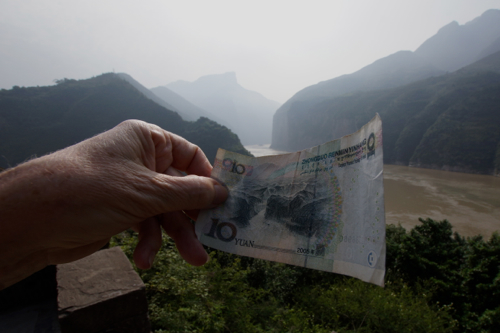
White Emperor City is also known as the City of Poems, as there are over 70 poems, carvings and cultural relics of the Sui, Yuan, Ming and Qing Dynasties at the site. So important is this part of the Yangtze that the view from the temple is featured on the Ten Yuan note.

Later we started to move through the first two of the three gorges, Qutang and Wu. The air was still hazy, a combination of smoke and fog.

Qutang is the shortest and regarded as the most spectacular of the three. Measuring only eight kilometers in length and 150 meters wide at its narrowest point, with mountains rising to 1,200 meters on either side.

The Wu Gorge, sometimes called the Great Gorge is formed by the Wu River and is 45 kilometers in length.

Late in the day we made a side trip up the Shennong Stream and it was here that I had a major camera malfunction. Both my 70-300mm and 18-55mm lenses stopped working.

Oh no, not déjà vu again.

A similar thing happened to me last year in Japan and I was forced to buy a new camera. It looked like I was up for more distressed purchases.

Our last night on board was a celebration of the Mid Autumn Festival and we were given a Chinese banquet with more strange cuts of meat. Cuts that, if we were home, would have be relegated to the abattoir floor.

Whatever we were served it was very tasty.

The highlight of the night was passing through the five locks of the Three Gorges Dam. It was excruciatingly slow, taking 3.5 hours to descend the 100 meters from the reservoir to the Yangtze River below.

Our final morning was another early start, as we were to make a trip to the dam wall.

The fog had closed in, which isn’t surprising considering that his area has at least 100 foggy days per year.

As we were due to fly to Hangzhou, early in the afternoon, we had to miss the Xiling Gorge, the last of the three. The Xiling was once regarded as the most dangerous, with whirlpools and strong rapids. However since the building of the dam the water level in some areas below the dam has increased from 3  meters to over 100 meters. This is the largest of the Three Gorges, taking up nearly half the length of the entire Three Gorges region.

The airport at Yichang is the smallest in China, and the quietest. We arrived far too early and had to wait for hours for our flight.

We could have seen the Xiling Gorge after all, that’s of course if it had been visible through the smog.

Rivers, lakes and mountains. (September 2014)

November 27th, 2014

DSC06560

Surrounded by spectacular Karst mountains and spread over two rivers and four lakes, Guilin certainly made an attractive start to our Chinese adventure.

The rivers and lakes are joined by a series of canals. Some of these were started over a thousand years ago during the Han Dynasty.

In fact Guilin has a history dating back to 300 BC.

With so much water it’s not surprising that bridges are a big feature of the cityscape.

Guilin was all but destroyed by the Japanese during WWII and there has a been a lot of reconstruction since then. The bridges were originally planned to be Chinese in design but that was regarded as impractical, as they are too steep for contemporary vehicles.

The answer was to design each bridge as a copy of fa amous bridge around the world. There is Neoclassical Roman, Classical Venetian, San Francisco’s Golden Gate and London Bridge. There’s even a bridge that goes nowhere, that’s not even based on a bridge at all but a replica of the Arc de Triomphe in Paris.

During the day the space beneath many of the bridges becomes impromptu rehearsal rooms for the local Guilin musicians and singers. The spounds of flute and Chinese opera can often be heard as you walk along the river banks.

The other unique feature of the Guilin landscape is the surrounding Karst mountains. These geological formations are so important that UNESCO have set up a centre for Karst research in Guilin. Building regulations in Guilin prohibits the construction of tall buildings, within the city centre, so as not to interfere with the views of these, all important, tourist attractions.

So important are the karst mountains, and the unique landscape that they create, that heavy industry has been moved out of Guilin. The result is a green, pollution free city that relies on tourism for its survival.

We very quickly discovered from our tour guide John, that due of the sheer size of the population, everything in China is a measured in millions. For example, Catholics make up a tiny minority of all religions, yet there are over 10 million of them. We also discovered that there are four million farmers living in the mountains outside of Guilin.

This is a very rural area and homes are built three stories high to accommodate three generations of one family.

The old people live on the ground floor because they can’t climb the stairs. The middle generation live on level two and their kids live on the top floor. That way they have to go past their parents if they want to leave the house.

John took us on a city tour of Guilin, however it was more a tour of natural sites close to the city than a tour of the city itself. That we did the day and evening before, walking around the lakes, rivers and canals.

Our first stop on the City Tour was the Reed Fute Caves. These are enormous limestone caves, set in a karst mountain, with stalagmites and stalagtites so thin that they are reminiscent of flute reeds. In fact we found that imagination, in interpreting shapes, was part of the game tourist are asked to play in this area. John was constantly asking us to see an owl here or a flower there in the limestone formations.

The cave tour concluded with a rather amazing sound and light show. Projections onto the ceiling of the cave were used to visualise its geological history.

Elephant Trunk Cave was our next stop, again we were asked to imagine an elephant drinking from the river.

This wasn’t hard as the similarity was very obvious.

Our final activity for the day was to climb to the top of Fubo Hill to get a good view of Guilin. It was a good view and a hard climb, especially in the 30 degree heat with 80 percent humidity.

Electric scooters are the main mode of transport for the Guilin locals. They are so quiet that you can’t hear them coming, so we very quickly learnt that traffic drives on the right in China. Well that’s the plan, most of the time they drive on whatever side they like.

The next day we took the Li River Cruise to Yangshuo. The river winds its way through a spectacular karst mountain landscape, the sort depicted on the 20 Yuen note.

The skies were typically hazy but this just added to the atmosphere of the area.

As soon as we arrived in Yangshuo John hired three bikes so we could go cycling around the countryside. Without hesitation we were launched into the middle of the Yangshuo traffic. This was light compared to what we had experienced in Guilin and nothing compared to what we had been told about in Beijing.

We very quickly escaped the the urban area and found ourselves in rural China. We visited an old farmhouse and a lake where the locals go punting on bamboo rafts.

Many of the tourist activites are run by the local farmers. They are the only group who own land. The plots are so small they can’t support the family, so they supplement the farm income with other ventures.

After two hours in 30 degree heat we were exhausted – and thirsty. We found a quiet bar that served cold beer and rested our tired legs and numb bums.

In the evening we were taken to see a local performance. ‘Impressions of Sanjie Liu’ is a spectacular open air live show, set against the backdrop of the Li River and surrounding kasrst mountains.

Six hundred local children and farmers perform on this picturesque outdoor stage. It’s reminiscent of an Olympic games opening ceremony. This isn’t surprising considering the director of this production also created the opening extravaganza for the Beijing games.

Thus spake Zarathustra.

November 19th, 2014

DSC02968

Zarathustra, or Zoroaster, whether real or mythical, was the founder of the faith that preceded Islam in Central Asia and Iran.

He possibly lived sometime between 1000 BC and 1500 BC but no one really knows.

Zoroastrianism was the first faith to propose the concept of an invisible, omnipotent god.

It is also known as a fire worshipping faith, as the followers were asked to pray towards the direction of light.

Fire was a light that they could control, more than the sun or moon, so their temples always contained continually burning fires.

We have seen many examples of Zoroastrianism throughout our travels in Uzbekistan, Turkmenistan and Iran and we have heard many interesting ideas about its origins.

This faith is still practiced covertly in Iran and more openly in India.

Many Zoroastrian temples and buildings are adorned with a base-relief carving of a winged figure known as Fravashi or Guardian Spirit. He was regarded as the spirit who reached their deity Ahura Mazda.

Zoroastrianism is also known as Mazdaism and as Magism from the name of their ancient priests, the Magi.

The Three Wise Men were thought to be Zoroastrian and to come from Kashan, south of Tehran.

Zoroastrianism is said to have influenced Judaism, Christianity and Islam.

I find it amazing that all these religions appear to be at odds with each other, yet they have so much in common.