Archive for the ‘Photography’ Category

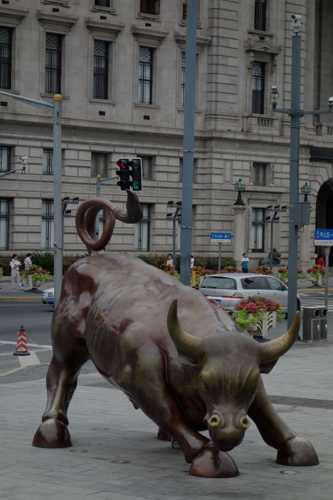
There is only a bull and no bear in Shanghai. (September 2014)

Sunday, January 4th, 2015

DSC02360

Immediately we arrived in Shanghai we went to a Sony service centre. They believed it was the camera at fault but there wasn’t enough time to have it repaired. So it was then off to the Sony Store to see what replacements were available.

After two hours of trying different camera and lens combinations, testing my old lenses with demonstration cameras, and managing to break many of them, we decided to buy a new camera and telephoto lens.

We were only two weeks into our trip and the idea on not having a good camera was unimaginable.

It still wasn’t that straight forward as the store didn’t have the lens in stock, that had to come from the warehouse and in order to get a discount I had to buy the lens first, then the camera. We appreciated the chance to save a few Yen as the price of camera equipment in China is about 20% more than what you can buy online or in the States.

I had to wait a couple of days to get the new camera and lens so we were immediately back into the sightseeing.

The Bund was top of the agenda on our first morning.

This is a great introduction to Shanghai, as it highlights the paradoxes that make up this huge city of over 24 million people.

This is the city where east meets west and the Bund is a showcase for the city’s diversity of style and culture. This riverfront area runs along the Huangpu River facing the Pudong. On the Bund side are many old commercial buildings and banks that were built during the early part of last century. These overlook the Pudong, one of the newest areas in Shanghai, dominated by steel, glass  and neon monoliths.

From the Bund we went to Yu Garden, an excellent model of Chinese garden architecture. Built during the reign of Ming Emperor Jaijing in 1559 as a private garden for Pan Yuncuan, an administration commissioner.

The Jiangnan Silk Workshop was yet another ‘opportunity to buy’ we resisted and moved on to the Oriental Pearl Tower and History Museum. This is the Shanghai TV Tower and offers great views of the Bund from the Pudong area. There is a rather strange museum under the building that gives a censored history of Shanghai. This includes models of old motor vehicles, once seen in Shanghai, that have clearly been copied from the originals and scaled down.

In the evening of our first night we took the Metro back down to the Bund and wandered around.

All the old buildings are illuminated, as are the skyscrapers in the Pudong, over the river. In the Bund there is a statue of a bull, no bear, that illustrates the Shanghaise and also the Chinese positive approach to business.

With the entire population of Australia living in the city, you get the feeling that your are not alone.

The Chinese have a  rather wonderful, self deprecating, humour when it comes to naming city sites. For instance the  clock on the customs house is called Big Chin (short for Chinglish or Chinese/English).

The rain put a dampener on activities for our second day and we were forced to pull out our umbrellas. The same ultra light umbrellas that were our souvenir of Japan.

We visited the Jade Buddha Temple, Xintiandi (also known as the French Concession Area), Nanjing Road and the Tianzifang arts and crafts area. All under the protection of our umbrellas.

The Jade Buddha Temple was founded in 1882 and, not surprisingly, contains two Buddhas carved from jade. These were made in Burma and then sent by sea to Shanghai.

The French Concession area is another link with Shanghai’s western past. The area was a foreign concession from 1849 to 1946 and still retains much of its original charm. There are a large number of European style residences as well as some excellent restaurants.

We returned that night to try one out.

On our last day we made the ninety minute car transfer to Suzhou. This is the city where Marco Polo arrived and not surprisingly named it the Venice of the East. Suzhou is in the Yangtze Delta and on the shores of lake Tai with many canals, stone bridges and beautiful gardens.

It’s a magnet for tourists, home to 11 million Chinese, the richest city in China and one of the fastest growing in the world.

The Grand Canal is the longest canal in the world, with the oldest parts dating back to the 5th century BC.

The Humble Administrator’s Garden is one of the main attractions and regarded by many as one of the finest gardens in China. It, along with other classical gardens in Suzhou, are UNESCO World Heritage Sites.

We also visited the Suzhou Museum, a contemporary building designed by the Chinese-American architect Leoh Ming Pei and completed in 2006. It houses a huge collection of ancient paintings, calligraphy, ceramics and crafts.

We finished our trip to Suzhou with a Grand Canal boat trip, complete with a serenade from the boatman.

Another nod to Venice.

Hangzhou, a philosopher’s view. (September 2014)

Monday, December 15th, 2014

A philosophers POV

Again shooting with the slightly malfunctioning Alpha 65 with the wide angle lens, and supported by the small RX100, we headed of to explore Hangzhou.

Our guide there was David. His mother is a philosopher and this was evident in his approach to life and the way in which he showed us around Hangzhou, his hometown.

As he explained to us, in questioning the meaning of existence, philosophers always look to the opposite side, never taking anything for granted. When things are good they look to see what bad things are just around the corner and then when things are bad they look to find the good.

David was a student of history, both ancient and modern. He was cynical about people’s motives throughout history and had many interesting stories to illustrate his cynicism.

From what we have seen so far, China is a prosperous, vibrant and ever expanding country. David didn’t share our optimism and believes that the country is on the verge of another revolution.

David explained to us that Hangzhou is the centre of software development in China. This isn’t writing original programs but rather hacking out vast amounts of code for software companies and even the big animation studios like Pixar.

Apparently there are tens of thousands of these ‘Digital Farmers’ working in the city. David was critical of this lack of originality and and the resulting exploitation.

On our first morning in Hangzhou we visited the Lingyin Temple, Six Harmonies Pagoda and the Dragon Well Tea Plantation.

The Lingyin Temple, originally founded in 328 AD, is a wealthy, large Buddhist temple with a variety of pagodas and grottos. The name Lingyin, roughly translates to mean ‘Temple of the Soul’s Retreat’.

The Six Harmonies Pagoda is on the edge of the Qiantang River and one of the most impressive in the city.

The temperature was still high and the humidity heavy but the walk to to top of the pagoda was worth the effort. The views were vast, even though there was a thick blanket of mist hanging over the river.

Or was it really smog?

From the pagoda is was a short car ride to the Dragon Well Tea Plantation. Tea farmers are amongst the richest citizens in Hangzhou. Their plantations are situated very close to the city centre and their tea is highly regarded in China.

The Dragon Well Plantation produces some of the best tea in the Hangzhou region and the water from the Dragon Well is said to possess magical powers.

We of course had a brew but to the surprise of our ‘Tea Lady’ didn’t buy any.

Hangzhou is a small city, of only 11 million people, and the geography is dominated by hillsides, covered in tea bushes and Westlake, a huge natural freshwater lake in the heart of the city.

In the afternoon we paid a visit to the Sony repair centre in Hangzhou. They were very helpful but weren’t able to work out what the problem was with the camera and lenses. They felt that the larger repair centre in Shanghai would be our best option.

David was amused by my two cameras, one large and the other small, he likened it to carrying a rifle and a revolver.

Overcoming equipment malfunctions seems to have become a pastime of ours.

We are lucky, in a way, that the internet is so poor that we haven’r been able to spend hours posting our blogs. Instead we have spent our time tracking down Sony repair centers or retail stores.

We then took an electric taxi back to the hotel. These ultra quiet, yellow boxes are becoming very popular in China, especially as the impact of pollution and the consequences of global warming becomes more evident.

Another very ‘green’ mode of transport in Hangzhou are the free bikes. There are over 3,000 bike stations throughout the city with 70,000 bikes.

Our hotel was situated on the edge of Westlake, so we had a long evening walk along part of the the east side of the lake.

We weren’t the only ones, as the banks were brimming with sunset strollers. The difference between them and us was that they had already eaten.

It appears most Chinese like to get the evening meal over early and the majority of local restaurants are shutting up by 8pm.

Westlake is the upmarket part of Hangzhou and commands prices to match. As David explained: “The closer you live to Westlake the more expensive it is, no matter if it’s a cup of tea or an apartment.” 

On our final day we had a boat ride on Westlake. This was in a craft that was built especially for Richard Nixon when he toured China in 1972.

Our next stop was a shop of traditional Chinese medicine. This is the second largest ‘pharmacy’ of its kind in China and was a potpourri of amazing aromas. There are countless staff concocting preparations from all varieties of animal, vegetable and mineral ingredients.

It was started by a very wealthy Hangzhou merchant who, when trying to get medicine for his ailing mother, was so disgusted by the lack of quality and service that he decided to DIY.

Or next stop was the former Residence of Hu Xueyan and the Yuyuan Garden. Hu Xueyan (1823-1885), was a leading businessman of China in the late Qing Dynasty.

The garden was built in 1559, during the reign of the Ming Emperor, Jailing. There are over two hectares of classical Chinese garden architecture with water features bridges, even an opera stage.

We were then taken down to the Hangzhou station to catch the Bullet train to Shanghai. We used the Bullet Train extensively Japan and I was interested to compare.

There was no comparison.

The art of queue jumping in China is a sly one.

Forty minutes before the train was due, people started to queue. Slowly, as the departure time got closer other passengers started to hover near the edges of the existing line and then subtly merge in. Then, with five minutes to go, those people who weren’t happy to be at the back of the queue, just move down to start a new queue of their own.

There is Yiddish word that beautifully describes this situation: shemozzle.

I had a feeling that we were going to be in many more shemozzles before this trip was over.

What price progress? (September 2014)

Thursday, December 4th, 2014

DSC06872

One hours flight from the calm of Guilin is the mega city of Chongqing, the starting point of our Yangtze Cruise.

Built on the banks of the Yangtze this regional capital is home to 34 million people.

It’s one of the fastest growing cities in China.

We were met at the airport by our new guide, Chris, and soon found ourselves in the midst of the Mid Autumn Festival celebrations, in Ciqikou, the old town area of Chongqing.

This area was a labyrinth of crowded, winding streets, full of vendors selling everything from grilled octopus on sticks to fortune telling on cards.

In the afternoon we visited the Three Gorges Museum. It’s dedicated to showcasing the history and culture of the local area. A history that goes back over two million years.

There is also a degree of political spin that justifies the building of the controversial Three Gorges Dam.

It was then down to the quay to board the Century Legend for our three day cruise of the Yangtze River.

As we slowly sailed north the scenery alternated between rural and urban. One constant was the development – China is very much a work in progress.

Late in the afternoon of our first day we ventured off the ship and visited the Shibaozhai Pagoda. The base of the pagoda was originally constructed in the Ming Dynasty (1364-1644) while the top tiers were built in 1956.

The Shibaozhai Pagoda has suffered from the rising Yangtze waters and now has a huge levee bank to stop it being reclaimed by the river.

The next day we had an early start, to visit the White Emperor City. It was originally built on a peninsula, now that peninsula is an island.

Another victim of the the Three Gorges Dam.

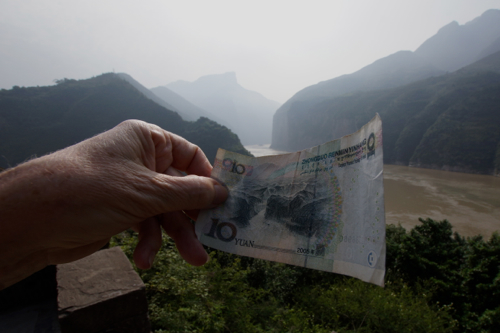
White Emperor City is also known as the City of Poems, as there are over 70 poems, carvings and cultural relics of the Sui, Yuan, Ming and Qing Dynasties at the site. So important is this part of the Yangtze that the view from the temple is featured on the Ten Yuan note.

Later we started to move through the first two of the three gorges, Qutang and Wu. The air was still hazy, a combination of smoke and fog.

Qutang is the shortest and regarded as the most spectacular of the three. Measuring only eight kilometers in length and 150 meters wide at its narrowest point, with mountains rising to 1,200 meters on either side.

The Wu Gorge, sometimes called the Great Gorge is formed by the Wu River and is 45 kilometers in length.

Late in the day we made a side trip up the Shennong Stream and it was here that I had a major camera malfunction. Both my 70-300mm and 18-55mm lenses stopped working.

Oh no, not déjà vu again.

A similar thing happened to me last year in Japan and I was forced to buy a new camera. It looked like I was up for more distressed purchases.

Our last night on board was a celebration of the Mid Autumn Festival and we were given a Chinese banquet with more strange cuts of meat. Cuts that, if we were home, would have be relegated to the abattoir floor.

Whatever we were served it was very tasty.

The highlight of the night was passing through the five locks of the Three Gorges Dam. It was excruciatingly slow, taking 3.5 hours to descend the 100 meters from the reservoir to the Yangtze River below.

Our final morning was another early start, as we were to make a trip to the dam wall.

The fog had closed in, which isn’t surprising considering that his area has at least 100 foggy days per year.

As we were due to fly to Hangzhou, early in the afternoon, we had to miss the Xiling Gorge, the last of the three. The Xiling was once regarded as the most dangerous, with whirlpools and strong rapids. However since the building of the dam the water level in some areas below the dam has increased from 3  meters to over 100 meters. This is the largest of the Three Gorges, taking up nearly half the length of the entire Three Gorges region.

The airport at Yichang is the smallest in China, and the quietest. We arrived far too early and had to wait for hours for our flight.

We could have seen the Xiling Gorge after all, that’s of course if it had been visible through the smog.

Rivers, lakes and mountains. (September 2014)

Thursday, November 27th, 2014

DSC06560

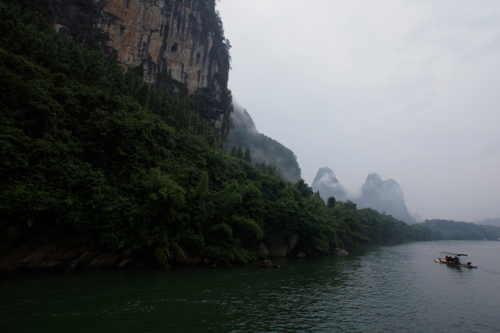
Surrounded by spectacular Karst mountains and spread over two rivers and four lakes, Guilin certainly made an attractive start to our Chinese adventure.

The rivers and lakes are joined by a series of canals. Some of these were started over a thousand years ago during the Han Dynasty.

In fact Guilin has a history dating back to 300 BC.

With so much water it’s not surprising that bridges are a big feature of the cityscape.

Guilin was all but destroyed by the Japanese during WWII and there has a been a lot of reconstruction since then. The bridges were originally planned to be Chinese in design but that was regarded as impractical, as they are too steep for contemporary vehicles.

The answer was to design each bridge as a copy of fa amous bridge around the world. There is Neoclassical Roman, Classical Venetian, San Francisco’s Golden Gate and London Bridge. There’s even a bridge that goes nowhere, that’s not even based on a bridge at all but a replica of the Arc de Triomphe in Paris.

During the day the space beneath many of the bridges becomes impromptu rehearsal rooms for the local Guilin musicians and singers. The spounds of flute and Chinese opera can often be heard as you walk along the river banks.

The other unique feature of the Guilin landscape is the surrounding Karst mountains. These geological formations are so important that UNESCO have set up a centre for Karst research in Guilin. Building regulations in Guilin prohibits the construction of tall buildings, within the city centre, so as not to interfere with the views of these, all important, tourist attractions.

So important are the karst mountains, and the unique landscape that they create, that heavy industry has been moved out of Guilin. The result is a green, pollution free city that relies on tourism for its survival.

We very quickly discovered from our tour guide John, that due of the sheer size of the population, everything in China is a measured in millions. For example, Catholics make up a tiny minority of all religions, yet there are over 10 million of them. We also discovered that there are four million farmers living in the mountains outside of Guilin.

This is a very rural area and homes are built three stories high to accommodate three generations of one family.

The old people live on the ground floor because they can’t climb the stairs. The middle generation live on level two and their kids live on the top floor. That way they have to go past their parents if they want to leave the house.

John took us on a city tour of Guilin, however it was more a tour of natural sites close to the city than a tour of the city itself. That we did the day and evening before, walking around the lakes, rivers and canals.

Our first stop on the City Tour was the Reed Fute Caves. These are enormous limestone caves, set in a karst mountain, with stalagmites and stalagtites so thin that they are reminiscent of flute reeds. In fact we found that imagination, in interpreting shapes, was part of the game tourist are asked to play in this area. John was constantly asking us to see an owl here or a flower there in the limestone formations.

The cave tour concluded with a rather amazing sound and light show. Projections onto the ceiling of the cave were used to visualise its geological history.

Elephant Trunk Cave was our next stop, again we were asked to imagine an elephant drinking from the river.

This wasn’t hard as the similarity was very obvious.

Our final activity for the day was to climb to the top of Fubo Hill to get a good view of Guilin. It was a good view and a hard climb, especially in the 30 degree heat with 80 percent humidity.

Electric scooters are the main mode of transport for the Guilin locals. They are so quiet that you can’t hear them coming, so we very quickly learnt that traffic drives on the right in China. Well that’s the plan, most of the time they drive on whatever side they like.

The next day we took the Li River Cruise to Yangshuo. The river winds its way through a spectacular karst mountain landscape, the sort depicted on the 20 Yuen note.

The skies were typically hazy but this just added to the atmosphere of the area.

As soon as we arrived in Yangshuo John hired three bikes so we could go cycling around the countryside. Without hesitation we were launched into the middle of the Yangshuo traffic. This was light compared to what we had experienced in Guilin and nothing compared to what we had been told about in Beijing.

We very quickly escaped the the urban area and found ourselves in rural China. We visited an old farmhouse and a lake where the locals go punting on bamboo rafts.

Many of the tourist activites are run by the local farmers. They are the only group who own land. The plots are so small they can’t support the family, so they supplement the farm income with other ventures.

After two hours in 30 degree heat we were exhausted – and thirsty. We found a quiet bar that served cold beer and rested our tired legs and numb bums.

In the evening we were taken to see a local performance. ‘Impressions of Sanjie Liu’ is a spectacular open air live show, set against the backdrop of the Li River and surrounding kasrst mountains.

Six hundred local children and farmers perform on this picturesque outdoor stage. It’s reminiscent of an Olympic games opening ceremony. This isn’t surprising considering the director of this production also created the opening extravaganza for the Beijing games.

You have to start somewhere. (September 2014)

Monday, September 29th, 2014

Our next big adventure is underway and the starting point was Hong Kong. After being on the road for over eight weeks, I now have enough bandwidth to publish a post, with photos.

After the hectic activity of packing our Melbourne life away, we needed a quiet start to what we hope will be six to nine months on the road.

The Big Buddha was the only thing we had planned for our one day in Honkers.

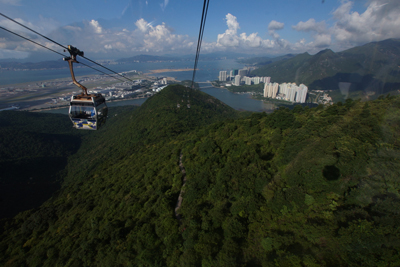
We took the train from near our hotel in Kowloon to Tung Chung, then the Ngong Ping Cable Car to  Ngong Ping Village.

The village is more a shopping mall than a cultural attraction with ‘opportunities to buy’ at every turn.

The central attraction is the Tian Tan Buddha or Big Buddha that was constructed in 1993. It is indeed big, standing 34 meters high and weighing 250 metric tonnes. It dominates the skyline on Lantau Island.

The cable car was a unique experience, as we opted to take the ‘Crystal’ cabins. These have glass bottoms, so you get an amazing view, both looking out and down, as you wend your way over the 5.7km journey from the Tung Chung terminal to the Ngong Ping terminal.

The highlight for me wasn’t the Buddha but the walk along the Wisdom Path, a winding track that runs behind the big fella.

The commercialism of the Ngong Ping Village had overtaken a small teahouse, that was at the start of the Wisdom Path. It had been abandoned and the the forrest was reclaiming the site.

Cow pads were everywhere but no sign of the bovines themselves. That was until later in the afternoon when we discovered the heard strung out along the track, eating their way towards the Big Buddha.

Hong Kong is a very commercial city and the Big Buddha is typical of that commercialism. I had a feeling that nature, and the cows were fighting back.

DSC06335

Peace and not so quiet on Fafa Island. (May 2014)

Saturday, June 7th, 2014

The sounds of domestic animals was now replaced with the more melodic chirping of birds, and waves gently lapping on the beach outside our fale on Fafa Island.

Fale is the Samoan word for house, however it is widely used in other parts of Polynesia.

The fales all have names and ours was called Niu, which means coconut in Tongan.

It was set in a secluded tropical garden surrounded by palms. We had our own private beach with two sun lounges. There were also more sun lounges in the garden and on the veranda, and a large hammock, hanging in the shade.

There was certainly no shortage of places to do absolutely nothing – which is what we did for most of the time.

The quiet was broken briefly on Saturday morning when a boat load of Chinese tourists arrived from the mainland for a day trip.

The Kingdom of Tonga has 176 Islands scattered over an area of 700,000 square kilometers of the South Pacific.

Only 52 islands are inhabited and Fafa is one.

This idyllic Robinson Crusoe style island is only 17 acres in size and dotted with coconut palms and surrounded by sandy beaches and coral reefs.

Fafa was developed in 1982 by Rainer Urtel, a German hippy, who fell in love with the Island.

Now in his 70s he still comes every year, for two months, to manage the property. For the rest of the year two other couples take over. Heidi and Martin, from Austria, were currently in charge. Heidi has been working on Fafa for the last ten years and other members of staff had been there that long as well.

She told us that she had tried to escape the island a few years ago but its magnetic charms drew her back.

At low tide you can circumnavigate Fafa. It only takes about 30 minutes and that’s with plenty of time to take some snaps.

When the tide is high there is a bush trail that runs through the eastern part. This section of Fafa is uninhabited and again only takes a short time to explore.

Bird life is everywhere and come dawn the squeak, squawk and screeching of the locals is deafening.

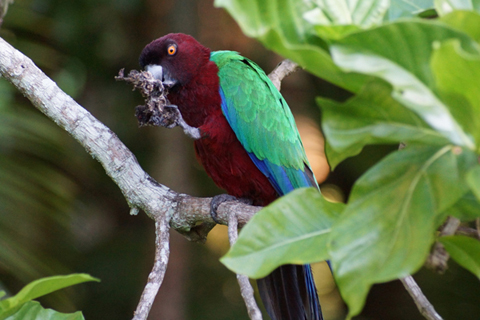
There are even some rather rare Fijian parrots, that were originally brought to Tonga for their feathers but now roam freely around the island.

One afternoon we spent a pleasant couple of hours snorkelling on a reef that was closer to the main island. The coral wasn’t great but there was a good variety of fish.

Our boatman, Moses, had great fun getting the some members of the group back into the boat, after the snorkelling.

He claimed that the boat’s ladder had been stolen, but I think he enjoyed the entertainment too much.

On our last day, the usual morning chorus was interrupted by a sudden downpour. It didn’t last long, however the weather had changed and it was a lot cooler.

This didn’t stop us having another snorkel, this time off the beach, in front of our fale. There were fewer fish but the coral was much better.

Fafa was made a Marine Preserve in 2013. This has already helped to protect the coral reef from over fishing and return it to a more natural state.

DSC06205

The sounds of Nuku’alofa, Tonga. (May 2014)

Wednesday, May 28th, 2014

Pigs squealing, dogs barking and roosters crowing.
These were the sounds of our first night at the Little Italy Hotel in Nuku’alofa.
The most predominant sound however, was of the rain pouring down, as the weather was stormy and the sky grey.
On our first day we headed into town to visit the Talamuhu Market. This is the main market on the island of Tongatapu, where all the local farmers bring their produce to trade.
Everything is available.
Fresh fruit and vegetables, handy crafts and a huge variety of clothes, both local and imported. Plus Father’s Day cakes, that were either in chocolate or banana and covered in a thick icing, then decorated with sprinkles and candles.
Father’s Day should be September but it has been decided to move it closer to Mother’s Day, just to make sure that the dads aren’t forgotten.
Mother’s Day was last Sunday.
The market isn’t restricted to the city centre but extends along the Vuna Road towards the port. Here the produce is cheaper and the customers stop by the roadside to haggle for the best price before buying.
On our second full day the rain gave way to wind and we ventured out on to the deserted streets of Nuku’alofa. It was Sunday and everything was shut except the churches and they were alive with gospel singing combined with choruses of amens and hallelujahs.
We joined the service at the Centennial Church, built in 1983 but looking centuries older. It’s the site of the main basilica of Nuku’alofa that was founded in 1885 by King George Tupou and originally the Free Wesleyan Church.
This is a grand but crumbling edifice, greatly in need of repair, much like at lot of what we have seen in the capital.
We were welcomed into the church with broad smiles and many questions as to our origins.
The choir and brass band were seated in the centre of the church. They were all dressed in white and the women wore hats that would do the Melbourne Cup proud.
The rain held off in the afternoon so we decided to walk across the peninsula to the Fanga’ Uta Lagoon. There were many church services in progress as we made our way south. Once at the lagoon we were befriended by a local boy who insisted on showing us “His Church”. He told us that is was a beautiful house and designed to look like a boat in full sail.
Unlike the basilica, the Constitutional Church was a contemporary design with stained glass windows that paid homage to Piet Mondrian, the Dutch modernist who was part of the non representational movement of the early 20th century.
As we arrived, with our newest best friend, we were joined by his friends who tagged along as we explored the church.
We then walked back into the town centre in search of a cup of coffee. Breakfast had been a lean affair, as the kitchen was closed, because it was Sunday and also Father’s day, so we were given a boxed meal, sans the usual caffeine hit.
We did find a café that was reluctantly open and there, together with the other tourists, got our morning stimulus. However by this time it was well into the afternoon.
Walking back to the hotel we passed the Royal Palace. This is about the only building in Nuka’alofa that is kept in a state of repair.
However the most recent Kings don’t live there, as they have large properties scattered over the island.
The wind was rising and the roar through the palm trees was punctuated by the rumble of the approaching thunder storm.
On Monday the sky cleared and we walked back along Vuna Road, skirting around the palace and down to the port.
The fish market was meant to be open daily, so we thought this would be a good place to get a feeling of local port life.
It was open but there was only a handful of vendors selling a very limited range, most of it frozen.
Dogs are everywhere in Nuku’alofa. We were told that the Tongans don’t like have their dogs inside so they have a free run outside. They pay scant regard to the cars that seem to skillfully avoid hitting them. The drivers are equally adept at avoiding the pigs and piglets that also scurry across the streets.
Surprisingly there is very little ‘road kill’ in Tonga.
Having brought the obligatory postcards we now went in search of the recently relocated post office.
It was way out of town and the walk there took us past the local girls high school. Thea was continually approached by groups of giggling girls wanting to have their photos taken.
It was getting late in the afternoon by the time we walked back to the hotel and the sun was low in the sky.
It was the magic hour for photography, so we went down onto the beach in front of the hotel. It was low tide and the water was sparkling. Even the wreck, that’s directly opposite the hotel, took on a special look. The locals were also there but they were busy fishing or repairing the large fish trap that’s also in front of the hotel.
We had booked a hire car and planned to tour around Tongatapu. It was a black VW Beetle, that on the outside looked very smart. However on closer inspection was a little worse for wear. It had only done 80,000 km but it looked like it had done a lot more.
We very quickly discovered why.
No sooner had we left the town centre, the roads deteriorated quickly and we found ourselves driving at 5 km/h, in some areas, to avoid the water filled pot holes. The roads, do however, dramatically improve when you approach a royal residence.
Our first stop was the blow holes on the southern coastline, near Houma. Here waves send the water spouting meters into the air, as it is forced through natural vents in the coral rock.
Ten minutes of photography was followed by ten more minutes of cleaning our camera lenses.
From there we headed west, along the Liku Road, toward Ha’atufu, the site of Abel Tasman’s landing in 1643.
Then it was back east along the Loto, Taufa’anau and Tuku’aho Roads to Captain Cook’s landing site. This is the place where Cook, in 1777, named Tonga ‘The Friendly Isles’ as the people there seemed very welcoming. Little did he know that they were planning to kill him, they just hadn’t worked out how to go about it.
This site was very dilapidated, much more so than Abel Tasman’s.
As we drove around the Island there appears to be little industry. That’s except for the telecommunications providers, which are all controlled by the royal family.
We continued our circumnavigation of Tongatupa, visiting the Ha’amonga Trilithon. Known as the Stonehenge of the South Pacific, these standing stones were erected in 1200AD. There are a number of theories as to their origin or purpose. The latest is that they are a form of solar calendar.
Driving down the east coast on the Liku Road we visited Anahulu Beach and ventured inside the stalactite caves. We didn’t get very far as the steps were wet, it was dark and we only had our iPhones to see by.
Next stop was the Hufangalupe or Pigeon’s Doorway. This is a large coral bridge where the sea rushes through a narrow opening many meters below. The coastline is spectacular in this part of the island but the road to get there had me wishing I had hired a 4WD, not the Beetle.
By our last day on Tongatapu we had just about seen all there was to see, so we had a slow walk into Nuka’alofa and wandered around the oldest part of town. Even though the buildings are run down they still have a Pacific charm about them.
Although this was a break full of different sounds, we had a very quiet time. We are now off to Fafa Island, where it’s bound to be even quieter.

I want to ride my bicycle.
I want to ride it where I like.

Tuesday, April 1st, 2014

Over the course of our travels in Asia, North Africa, the Middle East and Europe, I have come across bikes in all sorts of environments.

Being relatively cheap to buy, easy to maintain and requiring no fuel, except the rider’s sweat, they are the the world’s most popular mode of transport.

These bikes aren’t owned by lycra wearing, latte drinking, road racing followers of the Tour de France, but simple people who need their bikes for everyday living.

There are over a billion bikes in the world – here are a few of them.

Sapa, Vietnam

A different view of Melbourne.

Saturday, February 8th, 2014

For my most recent birthday Thea shouted me a joy flight over Melbourne.

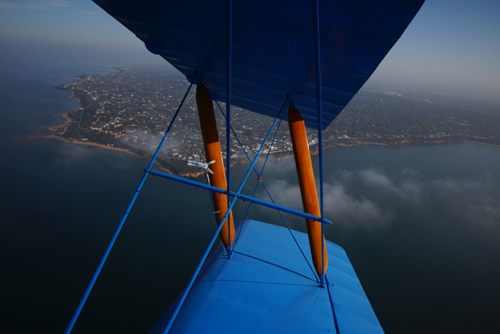
It was booked through RedBalloon and was in a vintage Tiger Moth.

The de Havilland Tiger Moth is a biplane that was first built in the 1930s and was primarily used as a trainer. This one had a six-cylinder Gipsy Major engine.

The one I flew in was painted in PMS300, my favourite shade of blue.

Lionel, a local Bayside character, was my pilot and he took me on a wonderful 35 minute adventure over the city and the bay. We left Moorabbin Airport at 8am, the sky was a little hazy but the air was warm and still, so the flight was very smooth.

Our flight path took us north to the city, via Flemington Racecourse, then over the Melbourne Sports Precinct and the MCG. From there we went to the top of the CBD, and over St Patricks Cathedral, the Exhibition Buildings, then across to the Queen Victoria Market.

Flying west we then headed over the Docklands Stadium and out towards Williamstown. Dropping from our cruising altitude of 1,400 feet to 500 feet we flew down the bay and past the Tasmanian ferry terminal. Then hugging the coast we flew south past the Bayside suburbs of Middle Park, St Kilda, Brighton, Sandringham, Black Rock, Beaumaris and then circled back to Moorabbin.

I managed to take 107 snaps as the wind rushed through the cockpit and my moustache.

I am not sure how those ‘Flying types’ kept a stiff upper lip and their mo in control, back in the day.

DSC05790

In Tokyo it’s always peak hour. (October 2013)

Friday, November 8th, 2013

Tokyo is big.

It is regarded as a Megalopolis and one of the three command centers for the world economy, along with New York and London. It is also has the largest metropolitan area of any city in the world.

Tokyo has over 13 million inhabitants and each day a further 2.5 million people commute into the city centre.

It’s a city that never seems to stop yet there is no road rage, raised voices or even looks of annoyance.

The Japanese are too polite for that.

In the mornings and evenings it’s the people from the ‘City’, with their black suits and white shirts, that stream through the railway stations, single-mindedly heading to the office.  Trying to walk in the opposite direction was described to me as, “You feel like you’re a salmon swimming up-stream”

The business people of Tokyo work long hours and they will never leave the office if their boss is still there.

The crowds don’t stop once the business people are at work. Then the groups ‘Nanas’ are out with their friends, visiting shrines and sites of historical importance. The older women are not alone as, in equally large numbers, school kids are also out on excursions to the same places.

Late in the evening, after business shuts down, Tokyo again fills up, this time with young ‘Hipsters’ heading to the bars, clubs or whatever is the most trendy place at the time.

We were told that a Hawaiian pancake shop had just opened and that was the current hot spot. The proof of its popularity were the hundreds lining the streets just to sample this latest fad.

On our first day we had arranged to do a morning tour of Tokyo.

The rain was back, a result of our fourth or fifth typhoon, we had lost count. The new camera was relegated to the hotel room.

It’s easier to take snaps, while holding an umbrella, dodging puddles and chasing a fast moving tour guide, with the much smaller RX100.

Our first stop was the Tokyo Tower, where we were whisked up to the observation deck to get a ‘special’ view of Tokyo. It was very special indeed, as the windows were either obscured by the condensation, or scaffolding and netting from the current renovations.

Tokyo Tower is 333 meters high and was built in 1958. It’s just slightly higher than the Eiffel Tower, which is 320 meters. After the war the people of Tokyo wanted their tower to be taller than the one in Europe. That post war sentiment is still in existence today, hence the line:

“The Tower makes you happy.”

Tokyo Tower is very similar in design to the one that Gustave built back in 1889.

“The Japanese are copycats” was a quote from our guide on the morning tour.

The rain continue and so did we.

Meiji Shrine was next.

After the emperor’s death, in 1912, the Japanese Government decided to build the shrine to commemorate his part in the Meiji Restoration. Construction started in 1915 and was finally completed in 1926.

It was destroyed during WW2 and rebuilt by public funding in 1958.

The final stop of our morning tour was the East Garden of the Imperial Palace. This is the only area of the palace that is accessible to the general public. Except on January 2nd, for New Year and December 23rd, for the Emperor’s birthday. Then the public can enter through the Nakamon, or inner gate, where the current Emperor usually gives a short speech.

The palace is built on the site of of the old Edo castle and the area, including the gardens, measures 3.41 square kilometers.

During the Japanese property boom of the 1980s, the land was said to be worth more than all the real estate in California.

In the afternoon, free from the umbilical cord of the tour guide, we went into Tokyo city.

The Ginza is regarded as one of the most luxurious shopping strips in the world. That’s easy to understand when you see the big brands lined up shoulder-to-shoulder along this wide boulevard.

It was Saturday and the road was blocked to traffic, so we were able to meander from side to side.

Ironically this mecca of luxury was a former swamp that was reclaimed in the 16th century.

Trying to master the complexities of the Tokyo Metro, we headed down to Kaminarimon Gate, Asakusa Shrine and the 5 storied pagoda. The shrine was constructed in 1649, during the Edo Period.

It was dusk and the shrine and pagoda were illuminated against the deep blue evening sky.

In the same area, just near the Sumida River, is the Asahi Brew Hall.

This was designed by the French architect and industrial designer, Philippe Starck. Completed in 1989 it is one of the most contemporary pieces of architecture in Tokyo.

The main building is a black cube with illuminated glass steps on all sides. It is topped with golden styalised beer foam.

The locals call it the ‘Golden Turd’.

We had booked another tour, this one was an all day affair, called the Nikko World Heritage Tour.

It involved a reasonably early start and a long drive to Nikko, which is to the north west of Tokyo in the middle of Honshu Island.

We did get our one and only glimpse of Mount Fuji as we were driving out of Tokyo.

Unfortunately the main gate of the Nikko Toshogu Shrine was being renovated and was surrounded by a huge temporary construction.

It was Sunday and I am sure that half of Tokyo’s 13 million inhabitants were out on the road after a wet few days. Many of them had come to Nikko, so the shrine was awash with day trippers. It was difficult to get a clear view of anything, let alone a good shot, as there were so many people.

Our time at the shrine was cut short as we had been held up in the traffic jam coming out of Tokyo.

Our guide, Yasushi, told us the Japanese are very liberal when it comes to religion. Ninety percent of the population follow Shintoism, eighty percent Buddhism and fifty percent get married in a Christian church. However when they are asked, they deny having any religion and most of them only visit the shrine as a tourist.

There were a lot of tourists there that day.

We then went to Tamozawa Imperial Villa. The villa was constructed in 1899 for Prince Yoshihito, who was later to become emperor. It was used by three emperors and three princes until 1947. The current emperor was evacuated to the villa in 1943 and spent about a year there as a young prince.

There are 106 rooms in the villa and many of them overlook a beautifully crafted Japanese garden. It is only one third of its original size but still very impressive.

It was opened to the public in 2000 after extensive renovations.

Kirifuri Falls, just out of Nikko, was our final destination for the day. It was late in the afternoon and the low light illuminated the Autumn leaves that surrounded the 75 meter drop.

It had been a long 12 hour day, with half of it sitting on a bus.

I think I am over escorted tours, well at least for the time being.

On our third day we took ourselves south west of Tokyo to the Miura Peninsula. Firstly to Hase to see the Big Buddha and then to Kamakura.

In the past few weeks we have been warned several times about the problems that deer and monkeys pose to tourists, here it was kites.

In Hase they were constantly circling the shrine and wire had been strung across the garden to deter them from swooping on unsuspecting visitors.

Hasedera Temple in Hase has its origins dating back to 721 AD when the monk Tokudo Shonin commissioned two large statues of Buddha from a giant camphor wood tree.

Just up the road from the shrine is the Great Buddha Kamakura. Construction of this national treasure was started in 1252 and continued for ten more years. It is truly great, measuring 13.4 meters high and weighing 121 tones.

Hase is a fishing village and the beach was full of fishing boats with fishermen mending their nets.

We then took the train back a few stops to the the seaside town of Kamakura. This was the capital of Japan from 1192 to 1333.

After a couple of false starts we found the Tsurugaoka Hachimangu Shrine that dates back to 1063.

Here there were many children, with their families, celebrating either their third, fifth or seventh birthdays. They go there to be blessed for a lucky, healthy life, dressed in traditional costume. Most struggle up the steep stairs, unaccustomed to wearing the classic Japanese sandal, a style of thong that is worn with socks.

On our last day we tacked the morning metro rush and headed to the Tsukiji Fish Market. This was our first real experience of the metro crush. The carriages are so tightly packed that you can barely move and when the train jolts to a stop, there is little fear of falling over, as there just isn’t enough room.

This is the largest fish market in Japan and the variety on offer was amazing. Frozen Tuna is a specialty of Tsukiji and cold carcasses are everywhere. They are so large that the wholesalers cut them into manageable pieced with a bandsaw.

In between the siteseeing we had a great lunch with our nephew Mike, his lovely wife Natsumi and their delightful children Manami and Josh.

It was a good opportunity to get a bit of insider information about the workings of Tokyo from Natsumi.

I have always loved Japanese woodblock prints, especially the ones by Katsushika Hokusai (1760-1849) so we headed back to the Kaminarimon Gate.

Buying the real thing was out of the question but I did manage to find a well made copy, ’36 Views of Mt. Fuji [The Great Wave off Kanagawa]’ actually done as a woodblock and the same size as the original.

Then back down to the river to get a few shots of the Asahi Beer Hall in daylight.

One last trip on the subway took us to the Tokyo Railway Station.

Opened in 1914, the station is said to be based on the Amsterdam’s main station, however the architect, Terunobu Fujimora, denied this.

Its other claim to fame is that the Prime Minister Hara Takashi was assassinated there in 1921.

We were set an ambitious four week itinerary, by Mina from Japan Package Tours and despite the typhoons, we managed to tick most places off the list.