Archive for the ‘Travel’ Category

A hotchpotch of places.
(December 2014/January 2015)

Saturday, February 14th, 2015


Hotchpotch

We arrived in Barcelona in early December, with no plans other than catching up with Evan, Stephanie, Hayden and Andrea.

We did manage to squeeze in some sightseeing in Barcelona, pre and post Christmas, and then in Paris, on the way to the UK.

In London we spent time, both before and after our Christmas trip to Iceland.

This blog and the accompanying photos is a hotchpotch of miscellaneous sites and experiences from these various trips.

Barcelona, December 2014.

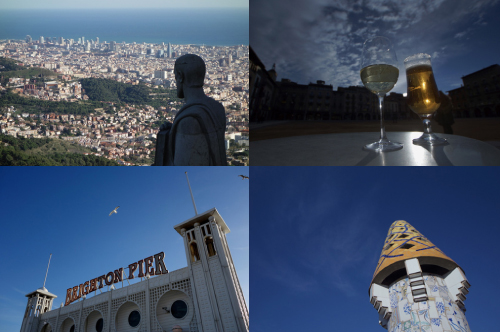
I have been to Mount Tibidabo a number of times but never to the top of the Temple Expiatori del Sagrat Cor. This is a Roman Catholic church and minor basilica located on the summit and visible from everywhere around the city.

The view of Barcelona from Tibidabo is always spectacular, especially on a clear day. This particular day was clear but very cold and the views past the statues of the twelve Apostles gave a new perspective to one of my favourite cities.

Paris, December 2104.

We took the fast train to Paris and spent two nights in a small hotel in the Montmartre area.

The hotel was small as were the rooms.

We spent most of the time walking around soaking up the pre Christmas Parisian atmosphere.

One highlight was a stroll along the Promenade Plantée, a disused elevated railway track.

London, December 2014.

London was the next stop with just enough time to buy a few Christmas gifts to take to Iceland.

The hotel room here was smaller that the one in Paris – I didn’t think this was possible. I wrote in my hotel review that there wasn’t enough room to ‘swing a budgie’. I think this description may have been lost on many.

The lights in London were better and brighter than Paris. This could have something to do with the fact that they were sponsored.

The Regent Street lights not only promoted the festive season but also the latest version of the annoyingly stupid, Night at the Museum, ‘Secret of the Tomb’

We spent a pleasant afternoon in Harrods where most people seemed to be like us, looking rather than shopping.

Then it was off to Iceland for Christmas.

London 2014/15. 

We returned to London to celebrate the New Year with Denis and Martine, our friends from Switzerland.

We rented an apartment in Canary Wharf, which turned out to be a great springboard for some long London walks.

And it was also a lot larger than the hotels we had been experiencing.

We strolled along the Thames, Camden Canal, Hyde Park and the Houses of Parliament and visited a couple of museums.

This was punctuated by frequent stops at London pubs.

After the New Year we had two cultural experiences. These were both photographic exhibitions that were poles apart, as far as subject matter and the way in which they were curated.

The first was at the Tate Modern and titled ‘Conflict Time Photography. This showed a large collection of photos that were taken after various conflicts, covering the 150 years since photography was invented. The exhibition was divided into time periods and covered the events seconds after, weeks after, months after and even decades after.

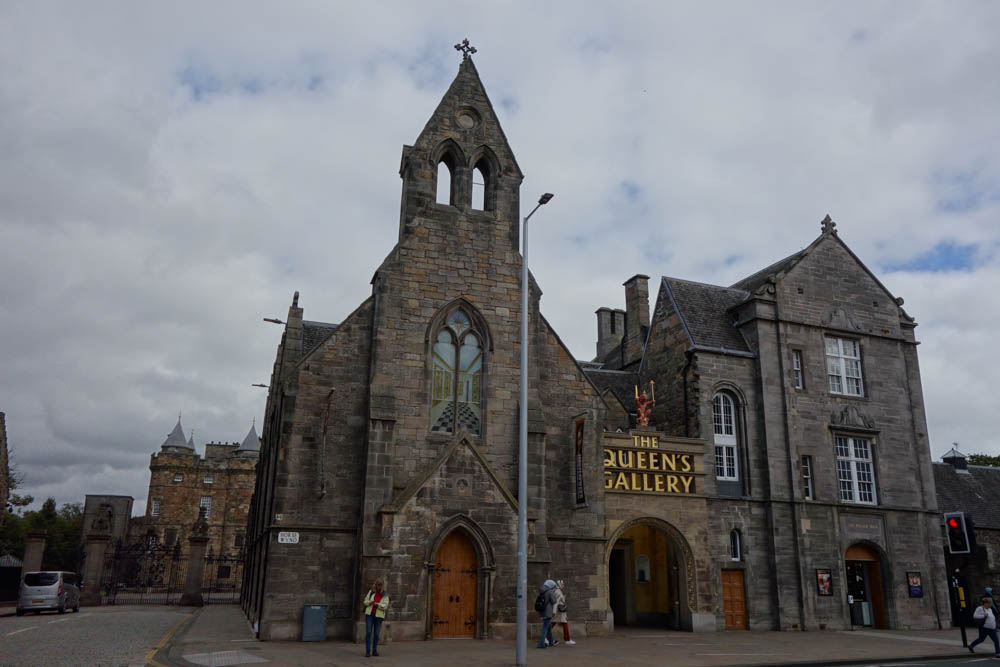
The second exhibition was at the Queen’s Gallery, Buckingham Palace and titled ‘Cairo to Constantinople, Early Photographs of the Middle East’. This was the work of the Royal Photographer, Francis Bedford (1815-1894) and chronicled the four month journey that the then Prince of Wales (later King Edward) took in 1862.

The Prince toured Egypt, Palestine, the Holy Lands, Syria, Lebanon, Turkey and Greece. It was interesting to see some of the places we had seen in 2010, 150 years later.

Our passports were groaning under the weight of stamps and visas. So much so, that we were forced to get them renewed.

We had to wait to get an appointment at Australia House and this gave us enough time for a side trip to Brighton.

Brighton by the sea 2015.

A walk along the famous pier, with its collection of bars, restaurants and amusement arcades gave us a real feel for this very British seaside resort.

Our hotel was right on the ‘front’ so we upgraded to get a room with a view. This was wonderful for our first day, as we could see the sun setting over the channel. It was a waste of money for the remainder of our stay as, in typical English fashion, the weather turned sour.

Our recent strategy has been, when it rains visit a shopping centre, and as Churchill Square was just around the corner we went there for a few hours.

The one place we did want to visit was the Brighton Pavilion, with its amazing history and faux Indian architecture, combined with Chinese interior design. The eccentricities of the British are encapsulated in this bizarre monument to King George IV.

On our last day we enjoyed a long Sunday lunch in an English pub, with excellent English ale, Spanish wine and typical British fare.

Then it was back to London for our passport interview. We paid for the quick service, to get our passports processed in three days. This was far cheaper than staying in a small London hotel for three weeks.

Then clutching our virgin passports we headed back to Barcelona. On arrival they were duly stamped on the first page – a good start to 2015.

Barcelona 2015.

Having seen all the significant sites around the city, we made it a plan to walk, rather than take the metro, to some of the places we had already visited. By doing this we would hopefully see some new things along the way.

We hiked to the top of Montjuic and back, twice.

On our first trip we walked around the fort, and the second time we visited the Botanical Gardens and the Montjuïc Cemetery.

Another day we visited the Barcelona Pavilion. This was the German stand for the 1929 International Exhibition and designed by Ludwig Mies van der Rohe (1886-1969). It’s a landmark building in modern architecture, using a very minimalist approach in its design.

Featured in the building, both then and now, is the Barcelona Chair, also designed by Ludwig Mies van der Rohe, with Lilly Reich (1885-1947).

The Barcelona Pavilion is very close to the Museu Nacional d’Art de Catalunya, so we spent a pleasant couple of hours there. This was made even more enjoyable by the fact that on Saturday afternoons, it’s fee.

Lacking a bit of Catalan culture we decided to visit Casa Batlló.

This is one of the most famous of the Antoni Gaudí houses in Barcelona, that was remodeled in 1905 on an existing building. Casa Batlló is privately owned and the commentary is much more commercial than in the state owned properties.

Despite the hard sell to buy at the gift shop, Casa Batlló was yet another exquisitely designed Gaudí masterpiece.

We also spent a very pleasant afternoon at the Palau Güell that was built between 1886 and 1888. This mansion was built for the extremely rich industrial tycoon, Eusebi Güell and is situated in the Raval district, very close to where we stayed.

It has been completely renovated in recent years and is a showcase of Gaudí’s early work. It highlights his use of the parabolic arch in the windows, fireplaces and the facade. Eusebi Güell was a main sponsor of Gaudí and even at the dawn of his career, believed in his talents.

Another who believed that Gaudí would prove to be a modern master was his university professor, Elies Rogent (1821-1897) who apparently wrote on Gaudí’s diploma, “We have given this title to a madman or a genius, only time will tell.”

We discovered another of Gaudi’s masterpieces, this one by accident, as we were wandering through the Gràcia area. Casa Vicens was another of his earlier works and built for the industrialist Manuel Vicens between 1883-1889. It was made a UNESCO World Heritage Site in 2005 and is only able to be viewed from the outside.

Casa Vicens shows the Moorish influence on Gaudi’s work, with red brick and an abundance of ceramic tiles. Manuel Vicens owned a tile and brick company, so it’s no surprise that Gaudi favoured these materials.

There were many architects in the Art Nouveau period but Gaudí stands out and being one of the most influential and creative minds of all time.

So much so, that the city of Barcelona continues the Gaudí tradition in the way they encourage new and exciting architecture. Even the design of street furniture in local parks and gardens seems to have been influenced by the spirit of his genius.

We enjoyed our ‘long Sunday lunch’ in Brighton so much, that we decided to make it a ritual.

Sitges.

We took a train ride 35km south down the coast to Sitges.

This is a beautiful coastal town overlooking the Mediterranean.

Our primary reason for the trip was lunch but there were some good opportunities to take some snaps.

My serious cameras hadn’t been out of their bag since Iceland so I almost needed a refresher course.

The Church of Saint Bartolomeu and Santa Tecla sits on top of a large rocky outcrop that divides the coastline. This dominates the scenery and seems to appear in most of my shots.

Barceloneta. 

Another Sunday, another lunch, this time down on the beach at Barceloneta.

We walk down to the beach via the Three Chimneys Park on the Parallel. The authorities in Barcelona seem to have a love of preserving old chimneys.

Where we lived in Montgat, in 2012, there were chimney stacks remaining from industrial revolution factories – long after the factories had disappeared. Then there are the Three Chimneys in Sant Adria del Besos. Originally built for a giant thermoelectric plant, they are now just a landmark that dominates the skyline.

After a wonderful lunch, outside and overlooking the Mediterranean we wandered down to watch a group of Slackliners – this is a type of gymnastics on a loose tight rope.

Their skills were amazing.

Vic.

Having lunch on Sunday was becoming a habit. This time we took the train 60km north to Vic.

This is a medium size town with a long history dating back to Roman times.

The highlight for me was the Roman temple which dates from the second century AD. It wasn’t unearthed until 1882 after it was discovered beneath the Castle of els Montcada. The temple was in excellent condition with only the portico needing major reconstruction.

We were completely at odds with the locals. We had coffee when they were drinking beer and wine. The opposite was the case in the late afternoon.

The Plaça Major is the centre of Vic, with a huge earthen rectangle surrounded by a mixture of colonnaded buildings. The only restaurants and bars that were open on this chilly Sunday afternoon faced west, making the most of the winter sun.

Raval.

After our travels in Paris, the UK and Iceland we returned to Barcelona, as we needed to stop, take stock and rejuvenate.

We had been travelling for over five months and needed to formulate a plan for the future.

Through Ev, Steph, Hayden and Andrea we had discovered the wonders or AirBnB, so we decided to give it a go.

We ended up in Raval.

Now this is a much maligned area of Barcelona, having been the centre of drugs and prostitution and now containing a large proportion (over 47%) of residents with overseas backgrounds.

We have found Raval to be one of the highlights of our trip, as it’s vibrant colourful and very entertaining. It offers a far richer experience than you normally find in the more sanitised tourist area of this wonderful city.

Raval is an area that is upwardly mobile, to use a hackneyed seventies expression. There is an ever increasing number of trendy restaurants and bars as well as ‘vintage’ clothing shops popping up at a frantic rate.

The Sant Antoni market, built between 1872 and 1882, in is in the midst of redevelopment and will be a focal point of this exciting part of Barcelona.

Raval also has art, and in particular a wonderful sculpture titled, ‘El gato del Raval’ by Fernando Botero. He’s the same artist who had several similar pieces in the Cascade in Yerevan, Armenia.

Like the Gothic quarter, frequented by the tourist hoards, Raval is a labyrinth of lanes and alleys. The big difference being that there are real people here, living and working, without any reliance on the tourist dollar.

There are no postcards for sale in Raval.

I am certain that there are more hairdressers or peluqueros here than any other place on earth. There are at least six within a hundred meters of our apartment and they are all offering a men’s haircut for €4, about AU$5.90.

Ironically, in a country that prides itself on its jamón (ham), there is also an abundance of Halal butchers.

Many of the local mini marts and a number of the bars and restaurants are run by the local muslims, yet many of them serve or sell alcohol.

Raval is a area of paradoxes and that’s what makes it such an exciting place to stay.

Our last day in Barcelona.

For six weeks we had been promising ourselves a visit to the Parc del Laberint d’Horta.

This large garden complex, situated on the outskirts of the city, is located in the former estate of the Desvalls family. It was built during the 18th and 19th centuries and featuring a rather challenging maze.
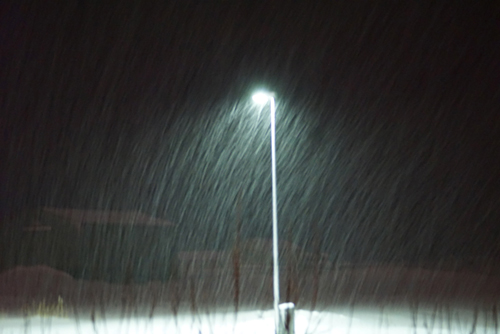
The light is always perfect, there’s just
not much of it. (December 2014)

Sunday, February 8th, 2015

DSC02982

All the family came together in Barcleona to help Hayden celebrate the defence of his PhD. And as we were going to be in Europe for Christmas, we asked everyone where they would like to go – it was our shout. The only restrictions being that it had to be close to Europe and a place that none of us had been to before. It was our first Christmas together in seven years, so it had to be special.

Iceland came out the clear winner.

Now winter in Iceland offers two guarantees – the temperatures are low and the days are short. The sun rises around 11am and sets again four hours later at 3pm. However the twilight extends the available light for another two hours. Iceland is located at 64°08′ N and tucked up under the Artic circle. In winter the sun barely peeps above the horizon, even when it has fully risen.

But what magic light it is.

In winter the low light adds to the eeriness of the bleak, white landscape.

We arrived late in Reykjavik and once we were settled into our AirBnB, we very tentatively headed out over the icy streets to find dinner.

Staying upright was a challenge and we were constantly warning each other to beware of the slippery conditions.

We walked around Reykjavik, this included the Hallgrímskirkja church, port area, shopping street, lake and the flee market full of retro clothes and shoes.

Hallgrímskirkja is an Iclandic Lutheran church that was designed by Guōjón Samúelsson in 1937. It took 38 years to build with work starting in 1945. Its expressionist style looks far more contemporary than a building designed in the first half of the 20th century.

With a smaller population than Canberra, Iceland is better educated, more sophisticated and more self reliant than most countries. The locals eat, drink and consume Icelandic products and produce – not because they have to but because they want to.

They are fiercely independent and very proud of their heritage. Reykjavík is one of the cleanest, greeness and safest cities in the world.

There are more book shops per capita than any other place on earth.

Due to volcanic activity geothermal heating is available to 90% of all buildings in Iceland.

We decided to hire a car and ended up getting a Toyota Hiace 4WD van, as we needed room for six people and their luggage. We wanted a 4WD as the road conditions were deteriorating with the onset of winter. When we picked up the Hiace we were given all sorts of dire warnings about the conditions of the roads.

We were therefore very glad that we had chosen to get something that could handle the icy conditions.

On our drive to Vik we made a detour to visit the Mid-Atlantic Drift fault line, in the Thingvellir National Park.

In the North Atlantic, this fault line separates the Eurasian and North American plates that passes through the centre of Iceland.

We also stopped off at Geysir, which is the original geyser and the origin of the name. The Great Geysir doesn’t do much any more but the nearby Strokkur Geyser erupts every few minutes, spouting boiling water about 30 metres in the air.

Next day we made the two hour drive to Svinafellsjökull Glacier, a magical place where the ice on the glacier is clear and blue. We spent over one and a half hours exploring an extremely small area. This is a glacial tongue that comes from the Vatnajökull ice cap. It’s the largest ice cap in Iceland, covering an area of 8,100 square kilometres and, in places, over 1,000 metres thick.

We walked along the black sand beach near Vik with the famous, Reynisdrangur rock formations just off the coast. And in what was left of the afternoon light we visited the 62m high Skógafoss and Seljalandsfoss waterfalls. Their slippery ice paths almost take you to the base of the falls.

In the evening we went looking for the Aurora Borealis. It was only moderate but we got a good idea of the spectacle.

I took some snaps using my Gorilla Grip but they weren’t a patch on Evan’s shots using a traditional tripod.

On Christmas Day we did the very Australian thing and went to the beach.

This wasn’t to play cricket, on the golden sands after a big turkey lunch. Instead we went before our lunch of roast Icelandic lamb and the sand on the beach was black.

It then started to snow, which made our white Christmas experience complete.

Later that afternoon we made a strange looking snowman, which we later called a ‘Snowblowie’, and threw snowballs at each other.

The locals must have wondered who this mad group was, that acted as though they had never seen snow on Christmas day before.

Our time in Vik was over so we packed and drove back towards Reykjavik, with a two hour diversion to the Blue Lagoon geothermal spa. The lagoon is outside so this experience was made even more bizarre by the fact that it snowed. We were sitting neck deep in the hot (39° C) mineral springs with snowflakes dropping on our heads.

You can also rub silica into your skin to get that ‘smooth as a baby’s bottom’ sensation.

That evening, while walking to dinner, the aurora gave us a show that was brief but far more spectacular than what we had seen in Vik.

We decided that we were having too much fun and not enough culture so we visited the Reykjavík 871±2 Museum. This is dedicated to the Viking settlement of Iceland. and built over the ruins of one of the first houses in Reykjavík. The oldest relics found of human habitation in Iceland were from 871, plus or minus a year, hence the museum’s name, Reykjavík 871±2.

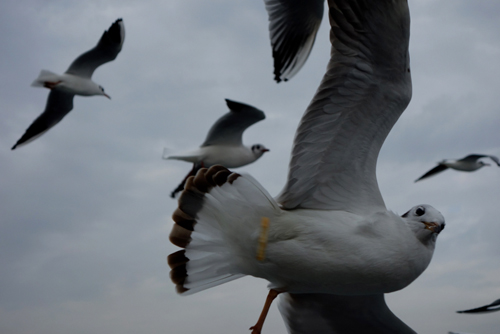
The Reykjavík sits on the Tjörnin lake, which freezes in winter and is a haven for the local bird life. Swans, ducks, geece, arctic terns, elder, scaup and pigeons congregate around the slipway, in the hope of a free feed.

On our last afternoon we visted the Reykjavík Graveyard or Hólavallagarður. This is both a park and cemetary in one, that was concsecrated in 1838. It’s the burial ground for over thrirty thousand of Reykjavík’s former citizens and a favourite spot for bird watchers.

The snow and ice on the headstones made for some interesting snaps

We flew back to London on Icelandic Air, there were even faux Aurora Borealis lights flickering in the cabin.

Istanbul, our full stop on the Silk Road.
(December 2014)

Saturday, February 7th, 2015

DSC03201

Istanbul, on the Bosphorus, was a symbolic last stop on our Silk Road journey. We had been on the go for three months, since leaving Hong Kong in the South China Sea.

Three months without a seascape.

So it was a very pleasant change to arrive in Istanbul to the sound of seagulls and the smell of salt air.

In Turkey you can put on weight, just by drinking the coffee.

Turkish Coffee that is.

I usually drink an espresso without sugar but in Turkey a good local coffee is hard to resist and I like mine sweet.

Having been in Istanbul just over 18 months ago, visiting sites wasn’t a high priority, so we just wandered around and had the occasional coffee.

That’s the beauty of ‘slow travel’.

We did cross over the Golden Horn to do some shopping.

The last time we were in Istanbul we discovered a wonderful sports store, that’s just over the Galata Bridge, so we returned.

This time to buy some warmer clothes.

The weather was getting colder, and we were planning to go to Iceland for Christmas, and what we had in our packs was not sufficient.

On another occasion we made a quick ferry trip across the Bosphorus, back into Asia. We were hoping to find a restaurant that we had visited in 2012, but we couldn’t even find the restaurant area.

Things are changing rapidly in Istanbul and the city skyline is a forest of construction cranes.

What has also changed are the prices.

We seem to be paying twice as much as we were thirty months ago.

Call it a conspiracy theory but I believe that the government, under the conservative leadership of Recep Tayyip Erdoğan, have increased taxes on luxury items, especially alcohol.

This won’t concern the majority of Turks, who are Muslin, but it will affect the very important tourist industry – it will also rile the secularists who dominate the western part of Turkey.

Recep Tayyip Erdoğan knows what side his support comes from, as he represents the conservative views of the eastern part of Turkey.

He has been so audacious as to try to belittle the importance of Mustafa Kemal Atatürk, a proponent of secularism and the first Prime Minister of Turkey – a man regarded by many Turks as a god.

Istanbul put on fine weather for our last day.

We visited the Basilica Cistern, one of many water reservoirs that lie beneath the city.

This was built in the 6th century during the reign of Byzantine Emperor Justinian I.

The roof is supported by a forest of 336 columns. Two of them have the head of Medusa, mysteriously one of them is upside down.

The cistern is capable of holding 100,000 tons of water, which is just a fraction of what’s there now.

The rest of our time was just spent wandering around.

We walked through Gülhane Park, where there was an army of gardeners planting thousands of bulbs in anticipation of spring.

The autumn, that had been chasing us for three months, was over and winter was right on its heels.

A celebration of wine. (November 2014)

Friday, February 6th, 2015

DSC01587

We had hired a driver, with the intention of viewing a few sites on the way from Yerevan to Tbilisi.

Gore was a young man in a hurry to get on with life. The trouble was he didn’t know where he was going or how he was going to get there.

We were just thankful that he knew how to get to Tbilisi.

Our first stop was the church at Hovhannavank, it was closed so the stop was quick. This is a medieval monastery with the oldest part being built around the start of the 4th century. It sits on a precipice overlooking the Kasagh River Canyon.

Next was the Saghmosavank Church, this was open but there was no power. It did however come on later in our stay. This monastic complex was also on the Kasagh River and built in the 13th century.

As we climbed higher it started to snow, so we were glad to be in Gore’s 4WD.

The Monasteries at Sanahin and Haghpat, founded in the 10th century were built by a father and son who tried to outdo each other. The Armenian translation of Sanahin means: “This one is older than that one” referring to the younger monastery.

We had been stopped many times by traffic police in China, Central Asia and Iran but finally something came of it in Armenia. Gore made a dubious overtaking move, on a mountain road very near the border with Georgia. The problem being that he was right behind a police car when he did it.

The result was, after much argument, Gore got a ticket.

Now it’s a little different in Armenia, in that he got issued with an infringement notice, but didn’t sign it. If you sign it you will automatically get a fine, as you have admitted liability. If you don’t, the case will go to court, or be dropped, if the police don’t believe they can get a conviction.

Gore’s argument was that they had no witnesses or video evidence and it was his word against theirs.

In Tbilisi we opted to do our usual tour of a city and used the Hop-On-Hop-Off Bus. This gave us an idea of the layout, which we could explore in more detail later on.

We had a live guide, which is rare these days, as most come with multilingual head sets. There was only a handful of passengers, so she sat up the top of the bus, with us English speakers, to give her informative commentary.

Tbilisi is on the crossroads between east and west on the Silk Road – evident by a large Caravansarei just near our hotel.

There is a mixture of European and Central Asian architecture, with each style sitting side by side.

The city, like so many we have visited, is divided into the old and new sections. Our hotel was in the old part and we were surrounded by crumbling Georgian architecture. Much of it was built with a combination of timber and brick. Like Armenia, Georgia also suffers from a lot of seismic movement, resulting in many buildings leaving the tower in Pisa looking rather straight by comparison.

Over the course of its 2,500 year history, Tbilisi has been destroyed and subsequently rebuilt, somewhere between 29 to 40 times – this depends on what version of history you read.

Also open to conjecture is Georgia’s claim to be the birthplace of wine, as the Armenians believe they are as well. Wine is certainly celebrated in Tbilisi, as there are wine shops and wine bars on just about every corner of the old city.

On our second day in Tbilisi the rain came down. We spent the morning walking around the city and took the cable car to the fort.

The rain continued so there was nothing to do but go for a ‘long lunch’

We found a small cafe near the Sulphur Baths and settled in for the afternoon.

I had a feeling that we were the only ones paying, as all the other patrons seemed to be related to the owners.

There was a table of local ‘heavies’ but they also seemed to have some relationship with the owners.

We watched for a few hours and never saw hard currency change hands.

As we have been told on all of our travels, from China through Central Asia to Europe, corruption is widespread and a ‘greased palm’ is the way of life and survival.

It was still raining on day three so we decided to go to the ‘Social Science Museum’ aka the Tbilisi Mall.

This was way out of town, at the base of the foothills surrounding the city.

It was very new and much of the space was empty. The busiest part was the Carrefour, a little piece of France in the heart of Georgia.

We certainly had the feeling we were getting closer to Europe.

Tbilisi appears to be a capital city that’s gearing up for a big increase in tourism.

Development is everywhere.

The international hotel chains seem to agree, as there were at least four new hotels under construction.

Many of the city’s old buildings and monuments are also undergoing a facelift.

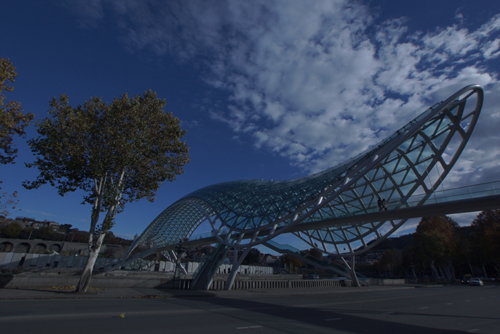
There is also some stunning contemporary architecture. One of the most prominent examples is the Bridge of Peace over the Mtkvari River. This elegant steel and glass bow-shaped pedestrian bridge was designed by the Italian Michele De Lucchi and opened in 2010.

With the Georgians love of food, wine, beer and jazz there is no shortage of infrastructure to cater for the tourist palate.

Many of the restaurants in the old part of the city have live music playing most nights of the week.

We returned to restaurant Kali, just to hear the three piece combo. It was Trad Jazz in the old school style. There was some sheet music but most was improvised. The drummer had no music at all and just picked up on what the other two were playing.

They didn’t start till 9pm, by which time the dinner guests had departed and a new group were warming the seats.

The trio seemed to have little in common, apart from the music and there was about a 40 years age gap between them. They seemed to be as diverse as the patrons – single women, men dining together, couples and a pair of very-out-of-place Aussie tourists.

The one problem Tbilisi has is traffic.

Even at three in the afternoon the roads coming into the city are at a standstill. I am not sure how they’re going to cope with the expected increase in tourists.

The rain was still coming down on our last day so we decided to remain in doors and went to Museum of Georgia. It contained a unique display of metallurgy, especially bronze, silver and gold work, from the 5th-1st century BC.

The craftsmanship of this work was exceptional.

We decided to spend more time in Georgia and hired a Renault Duster, then headed into the Georgian wine region, 75km east of Tbilisi.

We wanted to see where all this wine was coming from.

It had been snowing in the mountains but the road was clear, so the 4WD didn’t get used.

We had booked a night at the Schuchmann Wines Chateau in Kisiskhevi Village.

November is the low season in Central Asia and the Caucuses, so we did feel a little obvious when we discovered we were the only guests in the chateau.

After dinner, alone in the restaurant, we went up to our room. It was the best in the house, well we were the only ones there. The temperature was dropping and there was an open fireplace, so we lit a fire.

We were becoming Zoroastrians, chasing the warmth of the open hearth.

Most of the Schuchmann wines are made for export, with only 30% being consumed locally.

They make a Georgian style wine which is matured in terra-cotta jugs, buried in the ground. They also make European style wines in stainless steel vats and matured in timber barrels. The interesting thing is that they use the same grape varieties, from the same vintage, allowing you to compare.

What does make choosing a wine in Georgia rather challenging, is that they use grape varieties we have never heard of.

The next day we visited Ikalto Monastery, that was built between the 10th and 13th centuries. There was a wine press, of industrial proportion, behind the church and many of the wine jugs lying around the garden

Winter was with us as we drove around the Georgian countryside. The sky’s were grey and there was a constant drizzle.

We spent two nights in a country style hotel in Telavi which is located in the foot-hills of the Tsiv-Gombori Mountains.

On our third day with the car we again drove into the countryside, along the wine trails.

There were no tastings, as many were shut, so were were just driving, looking and listening to music.

The Duster didn’t have many smarts but it did have a USB connection, so we could plug in our iPhones.

Just before arriving to have a coffee in the tiny mountain Village of Signagi, we were listening to the Bee Gees. As we arrived in the cafe, they were playing the same track from the Gibb brothers.

Irony or were they just as out of touch with contemporary music as we are?

On our last day in Georgia we left enough time to do some sightseeing before our flight to Istanbul.

This didn’t eventuate.

The Garmin GPS couldn’t find the airport and we had to do it the old school way with a map and searching for road signs.

We retraced our tracks back over the mountains, as we had seen a turn off to the airport on the way from Tbilisi.

There had been a fresh fall of snow on the top of the pass.

A snowscape still takes my breath away.

Armenia and Georgia had been an unexpected and interesting penultimate part to our Silk Road adventure.

Only Istanbul remained to complete our journey.

Never say never. (November 2014)

Thursday, February 5th, 2015

DSC01438

We travelled along the Armenian Silk Road to Yerevan. It was foggy and the roads were less than perfect. At the start, it was all twists and turns, as we drove through the Vorotan Pass at 2,344 metres, then it was straight down into the Yeghegis Valley towards Yaravan.

On the way we stopped to visit the Monastery of Tatev, this involved a ride on the aerial tramway known as The Wings of Tatev. Completed in 2010, this is the world’s longest non-stop double track cable car. The foggy conditions didn’t allow us much of a view but what we did see was stunning.

This amazing ride allows year round access to the Monastery of Tatev, which is one of Armenias most important religious complexes.

The Tatev Monastery, built in the 9th century, is suspended on a cliff above the Vorotan River. In the 14th and 15th centuries it was the centre of science, religion and philosophy in Armenia.

From the heights of Tatev we descended down into Yerevan, the capital of Armenia.

The formal part of our adventure was over so the rest of our time was unplanned. We therefore spent the next day catching up on emails, photo editing, blog writing and planning the next few weeks.

We had lucked upon what was probably the best hotel of our trip, the Republica Hotel in Yerevan was just 100m from the main Repiublica Square and walking distance from most of the other sites in the city.

But that wasn’t its real attraction.

The room, staff and restaurant, especially the restaurant were excellent. The design was contemporary and the menu was a creative fusion of Central Asian and European cuisines. It was so good that we ate there three night out of the four that we spent in Yerevan.

I have always been of the belief that you never eat at a hotel restaurant, unless you really have to. We have been guilty of doing just that a number of times this trip, but it has always been purely out of necessity.

With the restaurant at the Republica Hotel, it was because we wanted to.

Never say never.

Having no real plan, and glad of it, we wandered around the city centre.

We had heard about the Cascade, so that was our first stop. This is a giant stairway that climbs up from the Kentron area to the Monument district with a great view of the city across to Mount Ararat. What makes the Cascade so interesting is the art gallery that is under the stairway, going up the hill.

It was first stated in 1971 and the initial part was completed in 1980. A large museum was planned to go at the top of the Cascade, however work started but was never finished.

We then slowly meandered back to the hotel, passing the Opera House on the way.

The next day we hired Garik, a driver and guide, to take us out of Yerevan and explore some of the country to the north and west of the city.

This area is on what’s now called the Black Sea Silk Road. The name and strategy is an EU initiative, designed to help broaden tourist interests and economic development in this part of the Caucuses. The main partners are Greece, Turkey, Georgia and Armenia.

Our first stop was at Garni where there is a Roman temple to Mihr, god of the sun. The temple was built in the 1st century AD, with a palace, winery and bath house built in the 3rd century.

Stone crosses or Khachkars are everywhere in Armenia, some are over 500 years old. They are carved memorial stones with a cross and a variety of other motifs. In 2010 the craft and symbolism of Khachkars was inscribed in the UNESCO List of Intangible Heritage.

The Monastery at Geghard is another UNESCO site with caves and many Khachkars. The monastery was founded in the 4th century while the main chapel was built in 1215. There was even a choir hall with incredible acoustics and an echo that lasts for fourteen seconds.

The monastery was built near an old pagan temple, that was probably Zoroastrian.

We then drove to Lake Sevan, the second highest lake in the world, after Lake Titicaca in Peru.

It’s 80 km in length and can be over 80 metres deep in some parts. In winter it freezes over.

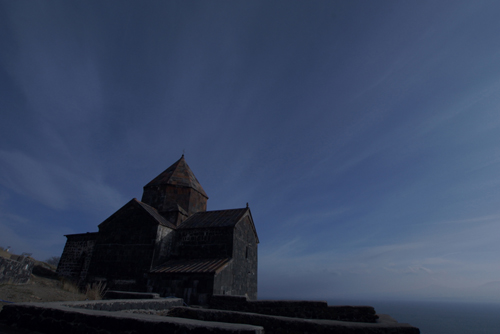
On the north west shore of Lake Sevan, is Sevanavank, a monastic complex containing a hermitage and St Harutiun Church. It was established by Grigor Lusavorich or Grigor the Illuminator in 305 AD. Originally Sevanavank was an island but due to the draining of the lake during the Stalin era it became a peninsular.

On the northern side of Lake Sevan is the Monastery at Gosh. Built in the 12th to 13th centuries and named after Mkhitar Gosh who was involved with the rebuilding the the current monastery after an earthquake destroyed the original one in 1188. Within the monastery is one of the world’s best collections of Khachkars.

It was a relentless day of sightseeing with Garik at the wheel. No sooner had we viewed one historical site we were into the car and off to another.

He was determined that we would get our money’s worth.

The Haghartsin Complex was built between the 10th and 14th centuries and is located near the town of Dilijan. At its dedication an eagle was seen soaring over the dome and it became known as ‘The Monastery of the Soaring Eagles’

By the time we reached our last stop for the day, the church at Tsaghkadzor, the sun had set. We were exhausted and Garik had done a great job.

The Armenian Apostolic Church is derived from the fact that it was started by the Apostles Bartholomew and Thaddaeus (Judus). It’s the world’s oldest national church and understandably there is a wealth of tradition in every aspect of church life, architecture and ceremony.

Many of the original Christian churches in Armenia were built over the site of pagan temples, as were many in ancient Christendom – they also borrowed much of their symbolism.

The design of the Armenian churches elaborated on the pagan temples and became the basis for all Christian architecture in Eastern European countries.

We had seen so much of history with Garik on the road, that he suggested we visit the Armenian History Museum and get a more academic point of view.

There was a wonderful collection of coins from the 3rd century BC to 150 BC and wooden carts and chariots from 15th to 14th centuries BC.

Another outstanding object was a 12th-11th centuries BC bronze plate showing a symbolic model of the solar system, with a round earth, including water and atmosphere, the sun, moon, Mercury, Venus, Mars, Jupiter and Saturn. This ancient concept of our solar system, was visualised way before the Greeks suggested it in the 3rd Century BC.

So proud are they of this ancient artifact that it has become the museum’s logo.

From crescent moons to Armenian crosses. (November 2014)

Wednesday, February 4th, 2015

DSC01142

We arrived early in Tabriz, after the overnight train from Tehran. Our driver and guide, Aydin, picked us up from the station and after a brief stop at our hotel we were back on the road again.

It has been suggested by some that Tabriz is the famed biblical ‘Garden of Eden’. I find that hard to believe as it is in a rather arid mountain zone with little greenery. It may however be true as I am sure that that the world’s climate was a little different back in the days of the Old Testament.

Tabriz is the largest city in the northwest of Iran and with cold winters and temperate summers, it’s a popular summer resort town.

During the Iran-Iraq war of the 1980s, Tabriz was a target of Iraqi air strikes, especially the industrial zones, the oil refineries and later the residential area.

Our first stop was Azerbaijan Museum designed by the Frenchman, André Godard, the same architect who was responsible for the museum in Tehran.

Maqhbarat-o-shoara or Mausoleum of Poets, constructed in the 1970s, celebrates the lives of some important poets, mystics and scientists from the Tabrizi area. There is a graveyard close by, dating back to Medieval times, that contains some of their graves.

It was Friday so a visit to the Jameh or Friday Mosque seemed appropriate. It’s always crowded and you sometimes feel that you are imposing when you visit any mosque on a Friday. I don’t think for a moment that we blended in, but we certainly weren’t made to feel unwelcome.

The Arg-e Tabriz, unlike the Jameh Mosque, was only a lifeless shell, with just the southern part remaining. Built in 13th century this grand mosque has been damaged by the Ottoman Turks, and most recently by the Iranian Revolutionary guards.

There has been an attempt to restore the parts that are still standing, as evident by the butterfly shaped plaster moulds affixed to the repaired areas. The idea is that if they crack at the weakest point, then more work is needed.

We took a trip to the mountains on the Tabriz Telecabines. The residents, and in the summer the tourists, love to go walking and climbing in the mountains. The cable car gives them a great opportunity to escape the city and get into the rugged mountain range that is the backdrop to Tabriz.

On Saturday life returned to the city, after the quiet of Friday and we started to explore again. Our first stop was the Blue Mosque, constructed in 1465, it was severely damaged in an earthquake in 1779, leaving only the entrance.

A cheap reconstruction began in 1973, where the original indigo blue tiles were replaced by paint. Unfortunately these below average renovations are still going.

Iran has an abundance of historical sites, many of them world class, and an increasing number have been designated World Heritage by UNESCO.

However, and it’s a big however, litter remains a real distraction to what you see. It’s everywhere, not so much in the streets of the cities but surrounding the all important tourist attractions.

This was very evident in Kandovan Village, also known as Kanvān, a settlement of troglodyte homes carved out of the rock and about an hours drive from Tabriz. The village is similar to Cappadocia, in Turkey, which is in far better condition. Kandovan is littered with plastic bags and bottles and has a long way to go before it gets the tick from UNESCO.

The Grand Bazaar of Tabriz is one of the oldest bazaars in the Middle East and one of the world’s largest covered bazaars. So it’s no wonder that it’s a UNESCO World Heritage Site.

I love trivial information, and our guide Aydin was a wealth of it. He told us that most houses have two knockers on the front door. The one on the right is for the men to use and the one on the left is for women. This alleviates the embarrassing and culturally difficult issue of a woman answering the door to a man who is not a direct relative.

More symbolism was hidden in the number of bolts contained in the door hinges of a mosque. Apparently the door of a Shiite mosque has three, while a Sunny Mosque has five.

Leaving Tabriz we travelled north along the Silk Road. There was even a caravansary along the way to remind us of the history we had seen over the last two months.

Our trip took us along the Arax River to the Monastery of Saint Stephanos, a World Heritage Site since 2008.

The monastery was built in the 9th century and rebuilt in the Safavid era as a result of another horrendous in earthquake.

The Arax was one of the first rivers we had seen that seemed to have a decent level of water.

As we were to find out later, this wasn’t the case as it’s been dammed upstream and is now only a trickle, compared to what it was in the past.

We left Iran without any issues – that was after waiting for the officials to finish their lunch.

That wasn’t the case with Armenia, as our e-Passport hadn’t registered and we had to redo it the old fashioned way, by filling out a form at the border.

In Armenia we were picked up by Artak the driver and Roza our guide.

As we drove through the mountains towards Kapan it was obvious that we were back in a former Soviet country.

The roads were rough and the villages were poor.

Even at the border the presence of Russia was evident, as there was a large photo of Vladamir Putin adorning the wall in the customs hall.

As we drove through the mountains Roza explained that Armenia has an abundant supply of minerals, especially in the Kapan region. In fact the bronze that was used, by the French, in the Statue of Liberty came from Armenia.

Armenia is a country steeped in history, and tragedy, with Kapan having many memorials to attest to that.

They have been violated by just about every country in the region, over the course of their 6,000 year history. The Greeks, Pantheons, Byzantines, Seljuks, Turks and Mongols, and more recently the Azerbaijanis, have all had a go.

The reason for the last conflict is far from black and white.

In ancient times Armenia was many times larger than it is today. It stretched from the Caspian Sea in the east to the Mediterranean in the west.

It was the called the Kingdom of Van and then Medes. After their moment in the sun came invasions from Cyrus the Great and then Alexander the Great.

Mount Ararat, the famed landing place of Noah, was once in Armenia – it’s now part of Turkey.

Armenians have been fighting for their independence for most of their history.

In Kapan, near the main bridge, there’s a monument to a local hero and 18th century freedom fighter Davit Bek. In usual fashion he is sitting astride his steed and charging into battle.

There is another smaller statue in the park of a local soldier, Senior Sergeant Hunan Avardis (1914-1944) who sacrificed his life for his comrades in the Great Patriotic War of 1941-1945 (WWII). He was awarded the Order of Lenin and made a Hero of the Soviet Union. His monument was erected in 1959.

Just out of town is the memorial to Garegin Noshed (1886-1955) a military strategist and a key political and military figure in the First Republic of Armenia. He was instrumental in the establishment of the Republic of Mountainous Armenia, an anti-Bolshevik state that lead to the inclusion of Armenia into the Soviet Union.

High on the hill outside Kapan is a large memorial park that commemorates those who died in the Great Patriotic War and more recently in the conflict between Armenia and Azerbaijan. There are graves there of soldiers who died in border skirmishes as recently as 2004.

Apart from the more recent monuments, most were built in the 1970s. Because during the Stalin era local patriotism was never condoned – it was all about Mother Russia or nothing.

On the grey and gloomy afternoon we were there, I discovered a half empty bottle of vodka, sitting next to an old Soviet tank. I assumed that this was left by some inebriated locals, but I was told this is a common way to honour the fallen.

Christianity spread into the Armenia as early as AD 40 and in AD 301 King Tiridates III (AD 238–314) made Christianity the state religion. In fact Armenia was the first country to do this.

Symbolism is in everything Armenian.

The churches and monuments have symbols that are part of their medieval history. New monuments or buildings contain materials from older structures, thus maintaining an unbroken line of historic continuity.

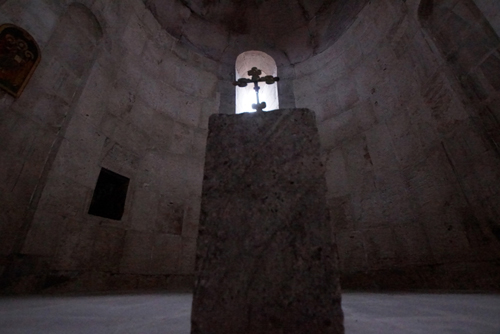
We visited the new Armenian Apostolic Church, that was built in 2011 and uses local basalt rock. It has a cruciform interior with a high spacious dome.

As our guide Rosa explained, every aspect of the design and decoration has a meaning.

Even the cross is unique to the Armenian Apostolic Church, as it depicts Christ as having the duality of a living and spiritual being.

As we have seen throughout our travels the pomegranate plays an important part in culture, as it is regarded as representing growth and fertility – this was also evident in Armenia.

Again this symbolism was found in the 10th -11th century Vahanavank Monastery, that’s about seven kilometers from Kapan and built by Syunik’s ruler Dzaghik’s, son Vahan.

There were stone crosses or Khachkars, engravings and steles all with special meanings.

Restoration began in 1978 but sadly ended, before their completion, twelve years later.

It was a foggy day in Kapan and the mist added a somberness to our photos, highlighting even more the tragedy of Armenia’s history.

A very excellent road trip. (November 2014)

Tuesday, February 3rd, 2015

DSC00773

We only spent an afternoon and a night in Kashan before heading to Tehran.

It is another oasis town with a history dating back to pre-historic times. There are buildings still standing that were constructed 7,000 years ago.

It is believed that the Magi or Three Wise Men came from Kashan.

We visited the Fin Garden or Bagh-e Fin, a classic Persian Garden now on the UNESCO World Heritage list and a traditional house, Khan-e Tabatabei, which was built around 1880.

While we were walking through the streets of Kashan we came across a traditional bakery making ‘stone bread’ This is made by laying the dough over hot bluestone rocks in the oven. Once the bread is baked the rocks then have to be plucked from the bread, leaving very distinctive pock marks.

In the Kashan bazaar I again discovered more of the weirdly spooky store mannequins.

The Muslim faith requires that you give to the poor and to that end there are ‘Poor Boxes’ throughout Iran. Sometimes you can find one on every corner of an intersection.

Our trip in Iran was amazing and made even more enjoyable by our guide and driver, Rasoul and Hamid, who were with us for the majority of the time.

It was an excellent road trip, of approximately 1,500km, with great companions, interesting sights and lots of good natured humour along the way. These kilometers don’t include the side trips around various cities looking for a good cup of coffee.

Even choosing dinner was an event. We were always offered a number of options and while we were on the way to our chosen one, they would come up with an alternative plan.

I think we got up to ‘Plan F’ one night.

Rasoul loved music and poetry and had an excellent all-round knowledge of the sights and their history.

Hamid is a documentary film maker and enthusiastic photographer. When he wasn’t driving us around, he was often off somewhere taking snaps.

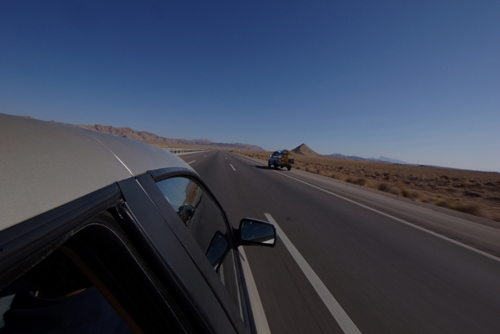
The next day it was a relatively short drive to Tehran, made easier by the excellent Iranian motorways.

We drove into Tehran with enough hours left in the day to do more sightseeing.

The first stop was the Azadi Tower, previously known as the Shahyād Āryamehr. It’s the symbol of Tehran and built in 1971 to commemorate the 2,500 anniversary of the Persian Empire

Then we had a quick visit to the Carpet Museum, built in 1976 and featuring a large range of Persian carpets from all over Iran.

After that went in search of digital hardware.

Thea had taken over 8,000 snaps and I wasn’t far behind. Our computers will filling up, as were our memory cards and our portable hard-drives were sagging under the weight of pixels.

Hamid, our driver, knew where the best deals were to be had on digital storage.

A 2TB portable hard drive and 3, 32GB memory cards, solved our storage issues and were half the price we would pay at home.

Our hotel in Tehran was a change from the Traditional Houses we had been staying in.

That’s not to denigrate them, as they provided excellent accommodation in a unique Persian environment. It was very close to the former US Embassy which ironically, is now an Iranian army base.

Next was Golestan Palace, the oldest historic monument in Tehran and a UNESCO World Heritage Site.

The Palace Complex consists of 17 palaces, museums and Halls. Almost all of this complex was built during the 200 years of Qajar kings (1794–1925). The palaces were used for coronations and other important celebrations.

During the Pahlavi era (1925–1979) Golestan Palace was only used for formal royal receptions as they built their own palace at Niavaran.

The National Museum is divided into two parts, pre and post Islamic history.

We were only able to visit the pre Islamic building as the other was closed for some strange reason, that no one could explain.

The pre Islamic exhibition was a simple and rather small exhibition set in a very handsome brick building, with Iranian influenced, Art Deco features. It was designed by the Frenchman André Godard and completed in 1937.

The exhibition features artefacts from Paleolithic, Neolithic, Bronze and Iron Ages, through to the Median, Achaemenid, Seleucid, Parthian, and Sassanid periods.

There was an excellent collection of well preserved artefacts from Persepolis.

For lunch Hamid and Rasoul took us to a restaurant on the very edge of the Grand Bazaar.

This was a licence to print money.

When we arrived, the queue to get in was thirty metres long and it hadn’t changed when we left. It was a production line and ‘fast food’ like you’ve never seen. The line moved quickly and we’d were inside in about fifteen minutes. The food was ordered and no sooner had we sat down than it was on the table.

It was tasty and as usual far more than we could eat.

We took a little longer than most of the diners, as the faces on the surrounding tables were constantly changing.

As we descended the stairs to exit we were offered chewing gum and tooth pics.

This meal was in total contrast to the one we had the previous night. That restaurant was in Tehran’s vibrant artist quarter and we opted to have the tasting plates, featuring a selection of their specialties.

It was chic, sophisticated and the hejabs weren’t hiding much hair.

After lunch we made a rather quick trip though the Grand Bazaar.

It was fast for two reasons.

Firstly we needed to walk off the rather substantial lunch and secondly we had been warned about pickpockets. This was the only time in Iran that there had been any suggestion of crime.

The Grand Bazaar yielded another treasure trove of creepy store mannequins.

There seemed to be more activity outside the Bazaar than there was in. There were traders lining the streets selling everything from children’s toys to chewing gum.

As we left the Bazaar area there were hundreds of men on motorcycles waiting to take the shoppers and their purchases home.

Rasoul and Hamid produced yet another excellent coffee, this one at the Ferdowsi International Hotel.

It was then off to Tehran Station for an overnight train trip to Tabriz.

Sadly our last stop in Iran.

The pride of Persia. (November 2014)

Monday, February 2nd, 2015

DSC02456

It was a 400km drive from Shiraz to Esfahan and on the way we stopped off at Persepolis (City of Persians)

Persepolis was the ceremonial capital of the Achaemenid Empire (ca. 550–330 BC) The earliest remains of the city date from around 515 BC.

It is believed that Cyrus the Great founded the site but it was Darius the Great who constructed the terraces and palaces.

It was built as a ceremonial city to celebrate religious and cultural events. Zoroastrianism was the main religion during this period and the celebration of the New Year was an important event. New Year fell on the first day of Spring, a significant time in an agrarian society.

Over the centuries Persepolis has been mentioned by historians but it wasn’t until 1930 that true scientific research was undertaken. This was carried out by Ernst Herzfeld and Erich Schmidt from the Oriental Institute of the University of Chicago.

It was made a UNESCO World Heritage Site in 1979, immediately following the Islamic Revolution of the same year.

It was sacked by Alexander the Great’s forces in 330 BC, apparently in revenge for the burning of the Acropolis of Athens during the Second Persian invasion by King Xerxes.

We had another side trip, this time to the Naqsh-e Rustam Necropolis.

Built on the road used by the caravans, so that the people could look in awe at the glory of the kings. The oldest part of this necropolis dates back to 1000 BC.

There are four tombs of Achaemenid Kings which are carved out of the rock face. The tombs are in the shape of a cross with the entrance in the centre. Each tomb has similar relief carvings depicting the king and also scenes of battles won and vanquished enemies.

The tombs are believed to be of Darius I the Great (c 522-586 BC), Xerxes I (c. 486-465 BC), Artaxerxes I (c. 465-424 BC), and Darius II (c. 423-404 BC)

The Persian Empire under the Achaemenid Kings, especially Darius the Great, ruled an area covering eight million square kilometres, spread over three continents. At the height of its power it ruled over 44% of the world’s population.

The Achaemenid Empire didn’t just conquer and kill, they introduced structure to the societies they ruled. They built roads, created a common language, developed a postal system and employed a professional army and civil service.

Esfahan is one of the most beautiful cities in Iran.

Its wide tree lined streets are complemented by the winding Zayandeh River that is home to some of the world’s most stunning bridges.

Esfahan also has the expansive and elegant Naqsh-e Jahan Imam Square, which is only second in size to Tiananmen Square in Beijing. The Bazaar-e Layafha circumnavigates the square and is, like all bazaars, a hive of commerce.

The city is the vision of Shah Abbas the Great (1571-1629) who was the inspiration behind much of its outstanding architecture.

The young Abbas came to the throne at 16 but very quickly discovered the art of good politics and shrewd management. He moved the Persian capital from Qazvin to Esfahan and turned it into a showcase of Safavid architecture and style.

Shah Abbas reformed the army and civil service by bringing in many thousands of Armenians, Georgians and others from various parts of the Caucasus. This influx of migration helped to make Esfahan a vibrant multicultural city.

He wasn’t all beauty and light, as late in his rule he had his sons either killed or blinded for fear that they might want to usurp his power.

We visited two of Esfahan’s bridges on a couple of occasions. The first time was when we arrived in the evening, they were illuminated and seemed to float over the water of the Zayandeh River. The second time was late in the afternoon and this time they glowed orange in the setting sun.

Seo-se-Pol Bridge has 33 arches and is 298 meters long. It was and still is also used as a dam. Khaju Bridge is 110 meters in length and was built by Shah Abbas II in 1650. It is one of the finest of the Esfahan bridges and also doubles as a dam.

We were very lucky to arrive in Esfahan when we did, as water had just started to flow again in the Zayandeh River – the first time in three years.

Kakh-e Chehel Sotun or Forty Column Palace was completed in 1649 by Shah Abbas II. It has the nickname of Forty Column Palace, yet there are only 20 columns in the facade. The forty comes from the reflection of the twenty, in the pool at the front.

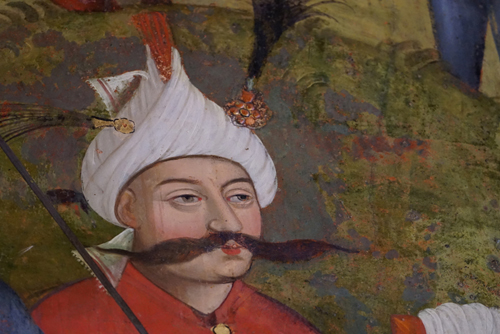
The interior is radiant with bright, colorful frescos, made even more enjoyable by the abundance of ancient Persians with expansive moustaches.

Rasoul and Hamid had us racing around Esfahan visiting the Masjed-e Shah (Shah Mosque), Masjed-e Sheikh Lotfollah (Sheikh Lotfollah Mosque), Kahk -e Ali Qapu (Ali Qapu Palace or high door) and the Masjed-e Jameh (Jameh Mosque)all within a few hours.

Apart from the excellent Islamic architecture in all of these places, a highlight was the music room in the Kahk -e Ali Quip. Here the walls were adorned with tiles that were complemented by cut-out silhouettes of musical instruments.

While the Shah and Sheikh Lotfollah Mosques had elaborate tiled enterances in a stalactite design.

Amidst our Muslim experiences we also had an infidel moment when we popped into the Church of Saint Joseph of Arimathea, built between 1648 and 1655.

It had an Orthodox Cross on the spire but the interior was more Roman Catholic. We later discovered that this is the style of the Apostolistic Church, found in Armenia.

It’s has been deconsecrated and is now just a tourist attraction.

The interior is richly decorated with original frescos that still maintain their vibrant colours. The exterior is another thing, being very austere and surrounded by a high walls that are a combination of Western and Islamic styles.

An oddity that I found amusing was in the Bazaar-e Layafha. There seems to be an abundance of store mannequins left over from the 1970s. These are in various states of repair but they all have one thing in common. A bizare almost “Nightmare on Elm Street’ ghostliness about their appearance. I found this strange phenonomen in other Iranian bazaars and I haven’t seen it since.

Recently Iran was placed 48 in the top 50 countries visited in 2013-14. This hasn’t happened since the Islamic Revolution in 1979.

It’s good for the travel industry but also creates issues for them in the future.

Iran is still under US and European sanctions. This means tourists can’t use their credit cards and must carry cash for the duration of their trip.

Another problem is the scarcity of good hotels, suitable for Western tastes.

There are plenty of small hotels but not the large ones capable of accommodating big tour groups.

There are a number of other cultural oddities that might put tourists off, but these don’t really don’t matter when you consider the rewarding experience.

As Iran is an Islamic state all ‘women’ over the age of nine, when outside, must wear a hejab to cover their hair and loose fitting clothes, to disguise their figure.

Islam in Iran promotes a society that is male dominated but then again three quarters of the world, if not more, has a obsession with testosterone.

Alcohol is banned in Iran however the locals get around this by brewing, distilling and fermenting their own.

It’s not that easy for visitors to do the same, so just regard your stay as an opportunity to cleanse the liver.

There seems to be a total obsession with Islam and this might worry some people of other faiths. However if you take the emotion out, and view everything in an historical context, it all becomes extremely interesting. Especially when you consider that Judaism, Christianity and Islam have so much in common.

Other peculiarities, that might concern western visitors are the very low doors in the traditional hotels and extremely steep stairways.

Most of our hotel rooms seemed to be on the top floor.

Iranian drivers are regarded as the worst in the world but they are also the most patient.

The rules are, there are no rules, but everyone seems to be accepting of this fact and they just get on with reaching their destination, with as little fuss as possible.

Road Rage doesn’t exist and horns seem to be used to alert other drivers that you are about to do something stupid.

Motorcyclist do more stupid things than anyone else and that’s because they are protected by the law. According to the Iranian traffic laws, if a motorbike and a car are involved in an accident, the motorbike is always in the right.

Why? They are smaller, more vulnerable and need protecting.

Shiraz, the place not the wine. (November 2014)

Sunday, February 1st, 2015

DSC00323

After spending some time taking snaps around the Caravansarai Zein-o-din we drove back to Yazd to pick up another car and a driver, Hamid, for the trip to Shiraz.

We stopped off to see a cypress tree at Abarqu that is reputedly 4,000 years old. The cypress is sacred to the Zoroastrians and is also highly regarded by the Shiite Muslims. In fact the symbolic coffin of Imam Hussain, that we had seen in the Ashura ceremonies in Yazd, was based on the shape of the cypress tree.

The roads in Iran are a pleasure to drive on, especially compared to Turkmenistan. The bitumen is smooth and goes the full width of the road.

Most of the pick-up trucks in Iran are either branded Zamyad or Saipa, they are everywhere and they are blue. Their drivers are notoriously bad. There is a saying about them that goes: “There are two things to fear in life, God and blue trucks.”

These pick-ups are manufactured in Iran by Saipa and the current model is based on the 1970-1980 Nissan Junior.

Just outside of Pasargadae and not far from Shiraz, is the Tomb and Palace Complex of Cyrus the Great, founder of the First Persian Empire. The palaces were constructed around 546BC and were set amidst an expansive Persian Garden. They are set in an area of 1.6 square kilometers and regarded as the earliest known example of the Chahar Bagh or Fourfold garden design.

There is some conjecture as to whether the tomb at Pasargadae is that of Cyrus the Great. The tomb was believed to have been visited by Alexander III of Macedon (Alexander the Great to those who weren’t defeated by him) around 334BC.

Due to our forced abstinence, Shiraz was a slightly frustrating place to visit. That’s when you consider that the wonderfully peppery grape that we know as shiraz has the same name.

By the 9th century the city of Shiraz had a reputation for producing some of the best wines in the Middle East. Ironically these wines from Shiraz were white, not red and have no connection to the shiraz wines produced in Australia.

Unfortunately most of the vines were ripped out following the Islamic Revolution of 1979.

Putting personal frustrations aside, this area is more importantly the birthplace of the First Great Persian Empire.

Our hotel in Shiraz, as with Yazd, was a traditional style built within an old house.

These old homes were nothing but a blank wall from the outside but inside there was a cool spacious courtyard, with all the rooms openening onto this communal area.

Because they are in old homes, this style of hotel is usually found in the historical part of town and within walking distance of many sights.

Just round the corner from our hotel was the Nasir-Ol-Mol or Pink Mosque. Completed in 1888, it has hands on top of the minarets instead of crescent moons – this is the sign that it’s Shiite.

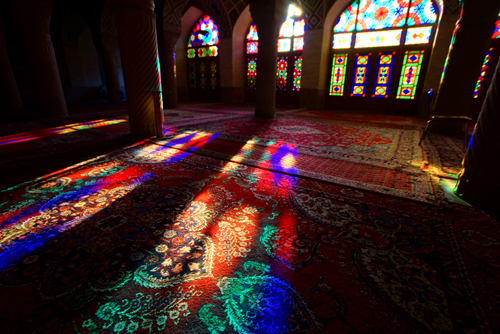
It is called the Pink Mosque due to the use of pink tiles in the interior. For me the most striking feature of the mosque was the stained glass windows.

We visited the mosque early in order to get the morning light streaming through the brightly coloured glass.

Many of the Iranian buildings we had visited use stained glass. These aren’t representational designs, as you find in Christian churches, but abstract.

The Nasir-Ol-Mol Mosque was the the most stunning so far.

The fort of Karim Khan or Arg-e-Karim Khan was built between 1766-1767. It’s shaped like a medieval fortress with one of the towers having a distinctive lean. In the past it has also been a prison, now it’s a museum.

As had been the case with our Iranian touring so far, we were set a blistering pace by Rasoul. Now made even more efficient by having Hamid drive and drop us off close to the sites.

Naranjestan and Khan-e Zinat ol-Molk was built between 1879 and 1886. The Naranjestan is set in a beautiful garden, planted with rows of orange and palm trees. The entrance hall was adorned with mirrors and there were painted ceilings throughout. The upstairs ceilings are painted in a rather European style with Alpine churches and busty German fräuleins.

Just around the corner are the twenty rooms of the Khan-e Zinat ol-Molk, all with beautiful mosaic floors. This was once the Qavam ol-Molk family home.

The Vakil Bazaar, originally built in the 11th century, is regarded as one of the best places Shiraz to pick up your Persian rugs.

We were there just to look.

The Eram Botanical Gardens are another beautiful example of Persian landscape archiecture. They were completed during the middle of the 19th century but probably started in the 18th. Not surprisingly they have been listed as a UNESCO World Heritage Site.

Later in the day we also visited the Mausoleum of Saadi and Mohammed Taghi. Two more of the revered Iranian poets. The fish pond below Saadi’s Mausoleum is said to be imbued with magical qualities.

Then it was off to the Aramgah-e Shah-e Cheragh Mausoleum, where it is believed that one of Imam Reza’s 17 brothers was martyred there in 835 AD.

Ever since our arrival in Iran we have been witness to an outpouring of religious grief and emotion. The Iranians place their faith and heroes on a very high pedestal. At the heart of this piety is an almost medieval belief in the superstition and mysticism that these historical figures hold. From what we have learned the more intensely you believe, the better you will be rewarded.

This belief in the ‘magic’ of people, places and events goes beyond religious figures, as even the great poets of Iran are placed high above mortal man.

One of the larger crowds was at the Mausoleum of Hafez. It was a Thursday night and there was a festive atmosphere as family groups, couples and gangs of young men came out to pay homage to their hero.

Just as fans flock to Graceland in Memphis or Abbey Road Studios in London, Iranians visit mausoleums in Mashhad, Yazd and Shiraz.

Imam Hussain. (November 2014)

Saturday, January 31st, 2015

DSC02012

Our new guide, Rasoul met us at the airport, he was to be our companion for twelve days.

We only had one day of site seeing planned on Yazd, as a religious holiday was on for the following two days.

This holiday is for the mourning ceremony of Imam Hussain or ‘Muharram’. It’s ten days of activities, with the final two days being a public holiday – the last day is known as Ashura.

Imam Hussain was the grandson of the Prophet Muhammad. He was killed along with 70 members of his family, including a baby, in 680AD by armies of the Caliph Yazid in Karbala, Iraq.

He is seen by the Shiite Muslims as a martyr and a champion of peace.

The first stop, on our only official day of sightseeing in Yazd, was the Zoroastrian Fire Temple, or Yezd Atash Behram, that was established in 1932. This particular fire has been burning since then and was gathered from 16 sources.

It’s regarded as one of the holiest in Zoroastrianism.

From there we went to the Towers of Silence, which is a burial ground for Zoroastrians. Here the bodies of the dead are placed in a circular open area and left to the scavenging birds. This was because the Zoroastrians  believed that human flesh should not come in direct contact with the earth. The Nasellar, or pall bearer, was the only person who could handle the corpses and he was isolated from the rest of the community. There is one remaining Nasellar in Yazd, believed to be in his 90s, he makes a good living from having his photo taken.

Masjed-e Jãmeh or Friday Mosque was next. Built in the Persian style in the 12th century and rebuilt in the 13th and 14th, it features the highest pair of minarets in Iran.

Less spiritual and more practical, we also went to the Yazd Water Museum. This contained Qanats or wells that are built on exactly the same principals as the Kares wells in Turpan, China.

The Bagh-e Dolat, built in 1750, with Iran’s tallest Badgir or wind tower and is situated in the Dowlat Dolat Gardens is another UNESCO site. This is a beautifully proportioned building that’s studied by Iranian architectural students. There was a group making measurements and their professor took much delight in giving us a geometry lesson.

Old Yazd is a City Museum and due to be made a UNESCO Wold Heritage Site in 2016.

It’s easy to understand why.

Our secular site seeing was over and we were back into the religious activities of the Muharram. A big part of it revolves around a theatrical celebration of Imam Hussain’s life. Within the city there are many areas that are set aside for ‘Nohe Khani’ or performances with the ‘Sineh Zani’ or chanting and chest beating.

On our first night in Yazd we went looking for a place to eat.

Not every hotel in Iran has a restaurant and it was suggested that the Sonati Mehr Hotel, a sister hotel to ours, might be able to provide a meal. When we arrived there were hundreds of locals milling around. We asked if there was a table available and were immediately ushered into a huge banqueting hall and sat with a German couple, their guides and an Iranian family.

There were hundreds of locals already there and a handful of western tourists.

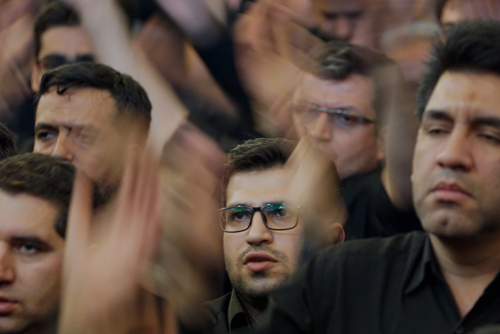
We watched a Nohe Khani, that involves a lead singer and a large chorus of men, all dressed in black. They sang in response to the singer and beat their chest to create a rhythm – they became human percussion instruments.

You could smell the testosterone.

Eventually, after a number of these groups performed, the meal came out, and it was free, provided by the hotel.

Free food is offered to anyone who wants it during the Muharram. People line the streets to receive a handout. As it was explained to us, they are not poor, it’s just courtesy to accept what is offered.

The tradition is born out of a superstition that if you ask Imam Hussein to grant you a wish, and that wish is granted, then you need to ‘pay it back’

Offering free meals is a common way of repaying your debt.

Just as we were continually invited to weddings in Uzbekistan, we were also asked for lunch in Iran.

This is against the law but they invite you anyway.

We were fortunate to enjoy a very pleasant meal with a local family. Our plates were piled high and we weren’t allowed to refuse a thing.

The next evening we went to another Nohe Khani where we were interviewed for a promotional video, made by the Imam Hussain Fan Club.

This was the largest we had seen and we were given VIP viewing positions overlooking the performance. No sooner had one group finished than another would start. There were thousands of performers and it was bedlam as the changeover took place.

I know how inappropriate it is to use a Yiddish word to describe a Muslim festival, but it was another shamozzel.

We were then whisked away to have another free meal, this one was with the locals in a neighborhood of Yazd.

As we were told, Iranians will always find a way to do things that is frowned on by the authorities.

They brew beer, and ferment wine, when alcohol is outlawed, install satellite dishes to watch world TV, when it’s banned and continually invite tourists home for lunch or dinner – even though it’s forbidden. I don’t know why, apparently we are all spies for the western authorities.

In Yazd there was so much happening, in so many places, that I felt a bit like a war correspondent. going from hot spot to hot spot, but never having enough time to file a story.

Ashura is the tenth day of the Muharram and the most important.

Our last day in Yazd was the Ashura and we were put on a big green city bus and taken out of town to see some of the final day celebrations – again this was all free.

There was a Muslim cleric on board and he gave us a briefing on the importance of Imam Hussein to the Iranian people.

Coincidently, on the morning of this bus tour, an article appeared on the ABC website about an Ashura procession in Sydney’s Botanical Gardens. The cleric was so impressed about the positive coverage in Australia, that he read the article out to the tourists.

Our first stop was Mehriz where we were witness to a theatrical re-enactment of the Battle of Karbala, where Imam Hussein was martyred.

This included a sacrifice of some local livestock.

I certainly wasn’t ready for that.

After the parade the tourists were bundled off to lunch, for yet another free meal.

Yazd turned out to be very cheap place to stay.

Our second stop was at Taft to see the lifting of the symbolic coffin of Imam Hussein. This ceremony happens all over Yazd and Iran. This particular ‘coffin’ is one of the largest and weighs 9,000 kg and requires 300 men to lift and then carry it around a rectangle three times. The coffin is in the shape of a cyprus tree, which is a symbol of freedom for the Shiites.

We have been very fortunate with our time in Yazd as we have been able to visit the sites and join in a local festival.

After our final day’s activities we raced out of Yazd for an overnight stay in the Caravanserai Zein-o-din.

Caravanserais are said to have originated in Iran over 2,500 years ago. This one was built by Shah Abbas over 400 years ago and is part of network of 999 such hostels. They were built to unify the trade routes and make them safer.

They were resting places for the travellers on the trade routes that covered Central Asia, North Africa and Eastern Europe.

They were especially popular along the Silk Road.

The Caravanserai Zein-o-din is round while most others are rectangular. It wasn’t just a shell fitted out as a four star hotel, like others we have seen, but retained many of the original features.

All the rooms came off a large circular hallway and were curtained off. There was a common washroom and a large central courtyard, covered with a sunshade.

After dinner we were entertained with an impromptu concert by a few of the Iranian guests. One multi talented fellow sang, played the recorder and the Tar, a Persian instrument that is shaped like a gourd.

After much prompting, another guest  whistled, not using his lips but his tongue.

It was a very relaxing night, after a hectic day.