Archive for the ‘Photography’ Category

Ernest has a lot to answer for. (November 2012)

Thursday, December 20th, 2012

Ernest Hemingway is said to have put Pamplona on the map.

The inhabitants of this, usually quiet, medieval town in Navarra certainly seem to think so. There are bars, hotels and monuments in his honor.

Hemingway first visited Pamplona in 1923 and became fascinated with bullfighting and the bull run or ‘Encierro’ at the the San Fermín Festival.

As a result he wrote “The Sun Also Rises’ and the rest is history.

The San Fermín Festival happens annually, from July 6th to 14th, with vast numbers of tourist converging on Pamplona to watch or take part in the action.

The local authorities have had to do a lot to stop the visitors from killing themselves.

Firstly there’s the bull run, which happens every morning at 8am and involves hundreds of people running in front of 6 bulls.

This is expected to have a fair number of casualties and there are appropriate measures in place to limit the injuries, or at least patch up those who don’t run fast enough.

Then there are the casualties that happen as a result of the ‘idiot’ factor.

With the population of Pamplona swelling from 200,000 to over 1 million there’s a shortage of accommodation. This results in every available bit of spare space being occupied with revelers. Now there is a lot of spare space on top of the ramparts of the Citadel, unfortunately there is also a 5 meter drop to the dry moat bed below.

Fences are now put in place during the festival.

There is also a 4 meter high fountain, just outside the Palace of the Marquis of Rozalejo, that the party goers love to climb and subsequently fall off.

This is now dismantled every year.

We were there in December, there were no bulls and very few tourists, so our adventure was much more sedate.

We stayed at a hotel that was a fair distance out of town and caught the local bus into the old city centre.

The old part of Pamplona is an oasis of classically beautiful buildings surrounded by a desert of very average contemporary architecture.

The people of Pamplona seem to be better off than the average Spaniard. The shops are busy, the restaurants full and the people are elegantly dressed, especially the older men in their oversized berets.

There is also disproportionate number of very young children, all being wheeled around in designer prams.

The biggest surprise in Pamplona wasn’t in fact in the city but a 40 minute bus ride south to the small medieval town of Olite.

A highlight of Olite was the Royal Palace, originally built during the 13th and 14th centuries, with construction continuing into the 15th century. This ongoing building has resulted in a haphazard design that gives it a very Disneyesque feel.

It was badly damaged by fire in 1813 but a painstakingly detailed restoration was started in 1937 by Javier and José Yárnoz and finally completed in 1972.

Next door, the Old Palace or Palacio Viejo, now a Parador, is a more sober structure with a fortress like feel.

The streets are narrow and you can get a real feel of what life would have been like in this medieval town. Even the street names give you an idea of the inhabitance. Rúa de la Judería, is where the Jewish community lived and Rúa Tafureía is the gambling street.

However there was no Rúa Toro.

Architecture and Oranges. (November 2012)

Thursday, November 29th, 2012

Valencia was a total surprise.

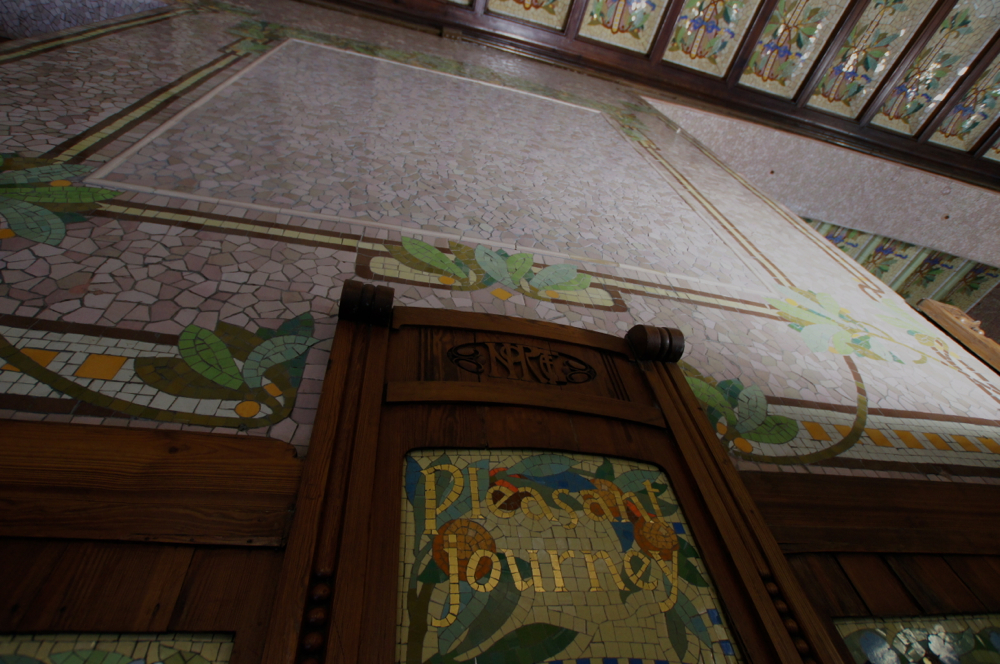
From the moment we arrived at the beautiful Art Nouveau, Estación de Norte, the Valencian architecture continued to delight.

This was our first trip without the Renault, so we were relying on the Spanish railway network.

Our commuter Renfe (Red Nacional de Ferrocarriles Españoles or Spanish National Railway Network) took us from Montgat straight to Sants Estació, where we picked up a long distance Renfe to Valencia.

Our hotel was walking distance from the station, so it was a rather effortless four hour journey.

We had arrived early enough in the afternoon to take the last city tour on the Hop-On-Hop-Off, tourist bus, This was around the historical centre of Valencia and gave us a good idea of where the sites were.

Our bus tickets were valid for 24 hours, so the next morning we took the second half of the city tour. This was around the new area of the city and down to the port.

It was cold and wet but the driver insisted that the best views were from the top of the bus, so he put up the vinyl roof and dried off the seats. There we were, the only tourists on the bus, with the best seats. In fact we had been the only takers the previous evening, so had the best seats then as well.

Having got a good perspective on the city, we decided to walk around the old centre in the afternoon.

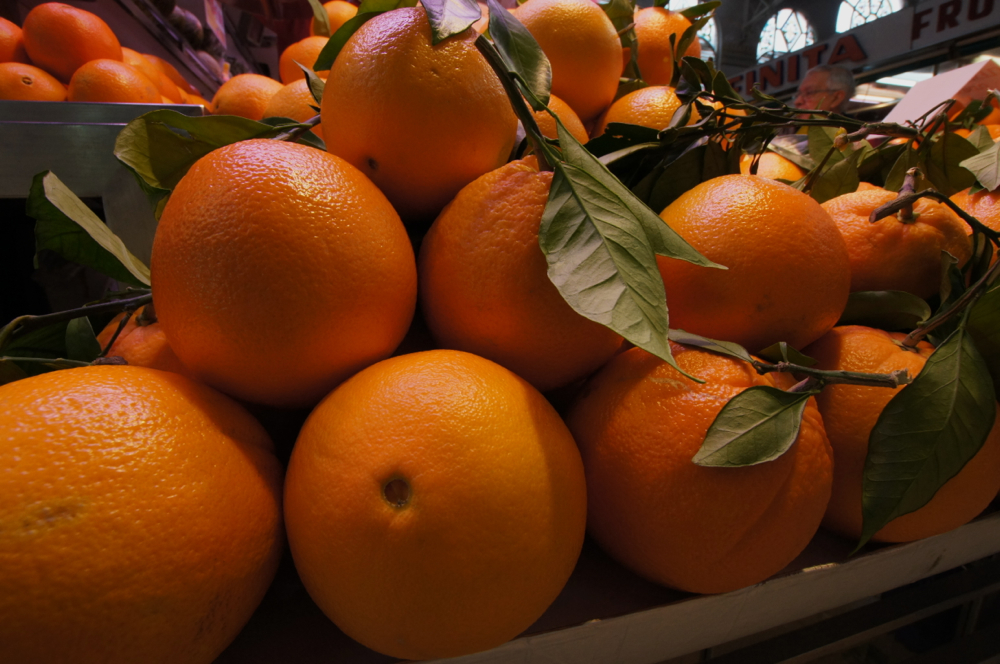
This took us to the Central Market, where we bought some juicy Valencia oranges for lunch. We then visited the Silk Exchange, Generalitat Palace, Our Lady’s Basilica in the Virgin Square, the Santa Catalina Church Tower, the Bullring and finally back to the Estación del Norte, to take some more snaps.

Oranges are a feature of the station’s decorative mosaics, both inside and out.

The highlight of the old city was the Lonja de la Seda or Silk Exchange, built between 1482 and 1548. It’s a world renowned example of a secular building in the Late Gothic style and a UNESCO World Heritage site.

This is the 16th Century version of today’s stock exchange, with a large decorative trading hall, where the riches of the East and the New Wold were traded.

There were other beautiful buildings close to our hotel, like the town hall, post office and the Bank of Valencia.

Even our hotel had an ornate Art Nouveau entrance.

That was the old, now for the new.

Our second bus tour took us along the Antiguo del Rio Turia. This is the bed of the river Turia that was diverted after a catastrophic flood in 1957.

This area has now become a sunken recreational parkland and home to the City of Arts and Sciences.

Designed by Santiago Calatrava and Félix Candela, the City of Arts and Sciences it is a group of breathtakingly contemporary buildings and bridges that has become the cities most popular, ‘modern’, tourist attraction.

This complex has done for Valencia what Frank Gehry’s Guggenheim Museum did for Bilbao.

Integrated inside this complex is L’Oceanogràfic, the largest marine park in Europe with 45,000 animals and 500 different species of mammals, fish, birds, reptiles and invertebrates.

Not surprisingly it’s centered round the Mediterranean, Atlantic and the Americas.

It was getting late in the day so we wandered back to the hotel along the riverbed. The light was low and I could’t resist taking a few more snaps of the stunning architecture.


A quiet day in Barcelona. (November 2012)

Monday, November 26th, 2012

Thea was having her hair cut, and that can take a long time, so I spent four hours wandering around the Gothic Quarter and La Rambla.

What struck me was how quiet everything was.

The streets were free of pedestrians, the shops of customers and the restaurants of diners.

There were still plenty of tourists about but nowhere near as many as we had seen a month earlier.

Even the prized seat, at the front of the double-decker city tour bus, was empty.

The only disturbances to my peaceful stroll, were the graffiti cleaners and the jackhammers of the workers repairing the pavement around the cathedral.

“If I have seen further it is by standing on the shoulders of giants.”* (October/November 2012)

Thursday, November 22nd, 2012

Our last road trip was a combination of catching up with friends and trying to get into the minds of some of my creative heroes.

Wherever you travel in Europe someone famous was born there, raised there or lived there.

Trying to get closer to what inspired their work became my focus. Some encounters were planned and others just happened.

We travelled out of Barcelona to Lyon, another of those beautifully preserved French provincial cities.

In the Place des Terreaux is the Bartholdi Fountain.

It was originally created in 1857 for Bordeaux by the then 23 year old, Frédéric-Auguste Bartholdi, the designer of the Statue of Liberty.

Due to budget constraints it was never built there, and that was Lyon’s gain.

Four rampaging horses, the great rivers of France, complete with steaming nostrils, strain against their reins, under the control of an almost placid Paris, depicted as a female figure.

Paul Bocuse, the legendary French chef, is featured along with other heroes of Lyon on the painted facade of a riverside apartment building.

The Basilica of Notre-Dame de Fourviere, built between 1872 and 1884, sits high on the hill overlooking the city. It was undergoing serious internal renovations but beneath the scaffolding were a series of delicate, beautifully crafted, mosaics.

We overnighted at Chateau d’Etoges, in the Champagne region. This grande 17th century residence was once owned by the valet of King Louis XVI. He lost his head during the revolution, as a result of being a little too cosy with the monarchy.

Autumn was well advanced in the Champagne region around Epernay. The vineyards were a patchwork of browns, yellows, reds and greens.

We then headed north into Germany and weather turned even colder.

We picked up Hayden in Mannheim and then drove towards Heidelberg to catch up with our German friends in Bammental.

After an unexpectedly early snowfall the weather brightened up again and the sunflowers were soaking up the last of the Autumn warmth.

From there we travelled further north to Nieder Weisel, the hometown of a brave group of Germans who escaped from the troubles in Europe and took the long voyage to Australia in the 1850s’

Thea’s great, great grandmother was one of them and there’s a plaque near the church that commemorates their feat.

Next was Paderborn, a university town in Germany, where Hayden is spending 4 months as part of his PhD.

We visited, Schloß Neuhaus, just outside the town and situated on the Pader River, the shortest river in Germany. We also scoured Paderborn cathedral in search of the famous ‘Three Hare Window’, but it remained elusive.

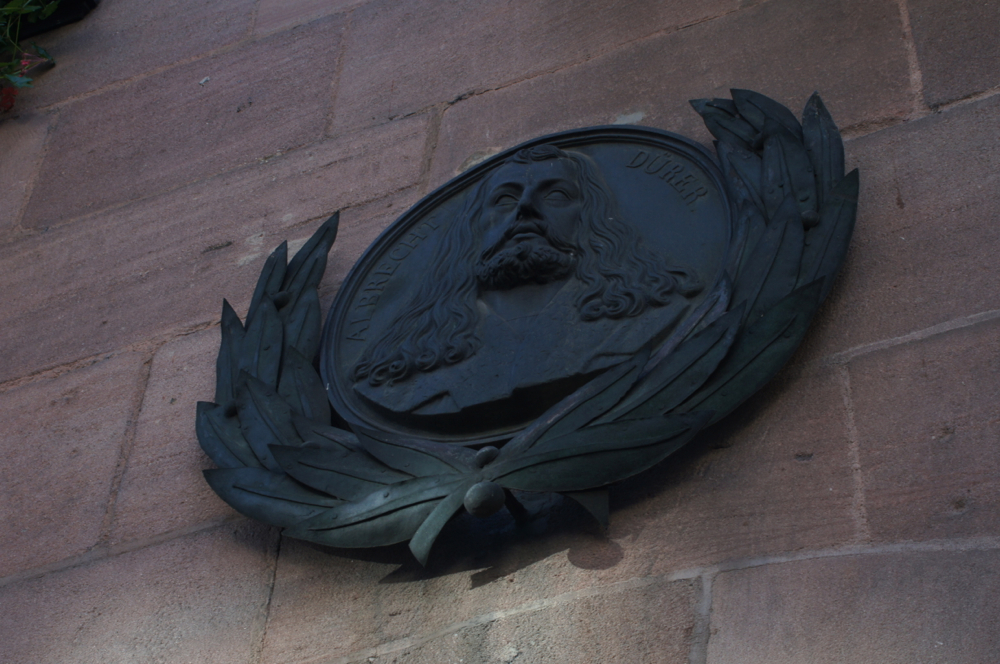
We left Hayden to his studies in Paderborn and drove to Nuremberg, home to Albrecht Dürer (1471-1528) Germany’s most famous graphic artist, painter and art theoretician.

There is no original work on display but it’s interesting to visit the house where much of his great art legacy was created.

Nuremberg was also home to the Nazi Party Rally Grounds, covering 11 square kilometers. There is also the Documentation Centre with a permanent exhibition ‘Fascination and Terror’ which provides graphic information about the causes, context and consequences of the National Socialist regime.

Adolf is definitely no hero of mine.

Just on the outskirts of Nuremberg, in Stein, is the factory and family residence of the famous stationery company, Faber-Castell.

I grew up very envious of those kids lucky enough to have a box of their pencils.

Next was Ulm, with the world’s tallest church steeple, and the birthplace of Albert Einstein.

Albert only lived for a short period in Ulm and according to him, it had no impact on his life.

The original house was destroyed in 1945.

The snow was still on the ground in Saint Gallen, Switzerland, and the skies were grey.

The cathedral has recently been restored and has elegant Renaissance frescos on the ceiling and 16 elaborate confessionals.

By my reckoning that gives the church the ability to forgive 32 sinners in a single sitting.

Next was Arnex-sur-Orbe, Switzerland, an idyllic village, where one of my oldest friends has lived, with his family, for nearly 30 years.

From there we visited the ‘Collection de l’Art Brut in Lausanne’ This is a gallery, created in 1976 by the French artist Jean Dubuffet.

He describes what Art Brut is below.

“Art Brut works are produced by self-taught creators firmly entrenched outside the mainstream, harboring a rebellious spirit and impervious to collective norms and values.

These include psychiatric hospital patients, prisoners, eccentrics. loners and outcasts…”

This exhibition was an eye opener with some of the most original and creative, of off-the-wall art, I have seen in years.

Aix-en-Provence and the world of Paul Cezanne was the next stage of our cultural adventure.

There are numerous tours you can do to try and get a insight into the mind of the father of modern painting, or as Picasso described, “the father of us all”

We decided to do just three.

The walk around Aix, with emphasis on where Cezanne lived and studied, Cezanne’s studio on the Lauves Hill and The Painters’ Ground, with spectacular views of Sainte-Victoire Mountain.

We also spent a day just circling around the Aix region, where Sainte-Victoire Mountain is ever present.

Even if you aren’t a student of art, the rugged escarpments of white rock, contrasting with the red earth, is spectacular.

It’s no wonder that Cezanne immortalized the region with his art.

The next leg took us from the sublime to the sometimes absurd, with a three day tour around the Dalí Triangle.

Salvador Dalí’s life embodied the ideals of Surrealism and you can gain a small understanding of this very strange man by visiting three of his most significant buildings.

The Dalí House at Port Lligat was the home that Dalí and his wife, Gala, built over a forty year period. It is a maze of odd shaped rooms on many levels, the result of Dalí buying up the surrounding fisherman’s cottaged and ingeniously combining them together.

You are greeted at the entrance by a giant stuffed polar bear – that sets the tone for the entire house.

Stuffed animals and bizarre objects are a vital ingredient in much of Dalí’s architectural decoration, however he was sane enough to include a BBQ in the back garden, near the pool.

Next was the Theatre Museu Dalí, at Figures, the largest Surrealist object in the world.

The exhibition is housed in what was the former Municipal Theatre, however it was extensively ‘renovated’ to suit the Dalí aesthetic.

Apart from a wide variety of sculptures, paintings and drawings by Dalí, there are also works by other artists.

Like most great artists Dalí studied the Masters and there’s even a reference to Albrecht Dürer’s Rhinoceros in one of Dalí’s etchings.

There is no doubt that this museum was built by Dalí as a homage to himself, as his tomb is in the crypt.

Dalí always fancied himself as the modern Renaissance Man, not confined to one medium or form of self expression. He used film, sculpture, painting, architecture and technology to convey his message.

However it’s his jewelry, in the Dalí-Joies collection, that best demonstrated how his talents could be expressed in alternative ways.

He used many of his reoccurring themes and turned them into beautifully crafted bracelets, broaches and necklaces.

The final part of the triangle was the Casa-Museu Castell Gala Dalí.

This is the 11th century Castle Púbol that Dalí purchased and then renovated as a gift to his wife, Gala. She accepted it on one condition, that Dalí could’t set foot inside the the castle unless he was given a written invitation.

The interior is less extravagant than the other two buildings we visited but still contains many examples of Dalí’s weird sense of humor.

There was no BBQ in the garden but there are some of Dalí’s strange elephant sculptures.

We spent a few hours in Girona on our way back to Barcelona.

Although it has a rich history and has been under siege 25 times, I could’t find any of my heroes in Girona.

*Isaac Newton

Paradores de Tourism de España. (October 2012)

Tuesday, October 30th, 2012

After experiencing the wonders of Gaudi’s Barcelona we decided to see the city from a different perspective and climbed both Montjuïc and Mount Tibidabo. They are on opposite sides of the valley and the views give you an excellent understanding of the city’s layout.

We then drove along the coast to Tarragona, past the Roman aqueduct and on to Tortosa to start our Paradore experience.

The first Spanish Paradore was opened by King Alfonso XIII in Gredos, Ávilia, in 1928.

There are now over 90 of these luxury hotels spread over Spain and the Canary Islands.

There are even some in North Africa.

Many of the hotels are in former palaces, fortresses, castles, convents and monasteries.

Being built in either public or religious buildings, a large number of Paradores occupy the high ground.

Our first night was in Paradore Tortosa.

This hotel is in a converted 10th century castle, it dominates the skyline and sits proudly over both the town and the river below.

The Gothic Cathedral of Santa Maria of Tortosa has a flat roof, this is very evident when you view it from the the Paradore above. Inside you wouldn’t know, as it has all the arches and vaults of a traditional Gothic Cathedral.

Apparently many churches were built with this flat roof style.

From Tortosa we drove via Valderrobres to Paradore Alcaniz, formerly a 12th Century Castle housing the convent of the order of Calatrava in Teruel.

We took the tour of the castle, not knowing it was only in Spanish, then tried as best we could, to understand what was going on.

It was a good lesson in what it’s like for tourists who don’t have a narration in their native tongue, or English as a second language.

We did learn, mainly from the leaflet that was in English, that these Gothic wall paintings are unique, in that they show civil scenes as well as conquests and religious themes.

The next day we went via Lleida to Cardona.

The Cathedral at Lleida also has a flat roof but again you wouldn’t know if from the high, lofty interior.

The Paradore ‘Ducs de Cardona’ is built in a ninth century castle with a tower dating from the second century.

It was the most spectacular of the three we visited.

There is a long, steep, winding driveway that takes you to the top of the hill and the Paradore. From there you have an commanding view of the town and the salt mines that have made the area famous.

It is estimated that the mountain of salt, that is opposite the hotel, is 2km deep.

We drove down into Cardona in the evening and were lucky enough to capture the sun setting on the Paradore high up on the hill.

On the way back to Barcelona we climbed the 9km of winding road to visit Monserrat.

The weather had turned stormy and the clouds hung low over the mountain, creating an erie backdrop to the monastery.

Contrasts. (September 2012)

Friday, October 12th, 2012

We left grey, damp England and arrived in dark, stormy France.

Our first stop was the WWI cemetery at Armentières, where we visited the grave of Patrick O’Farrell, Thea’s third cousin, who died on February 24th, 1917.

Then to the Somme and the other historic battlefields of the Great War.

The weather suited the location of this somber place.

Names such as Villers-Bretonneux, Pozières and Le Hamel conjure up images that have been etched in our consciousness.

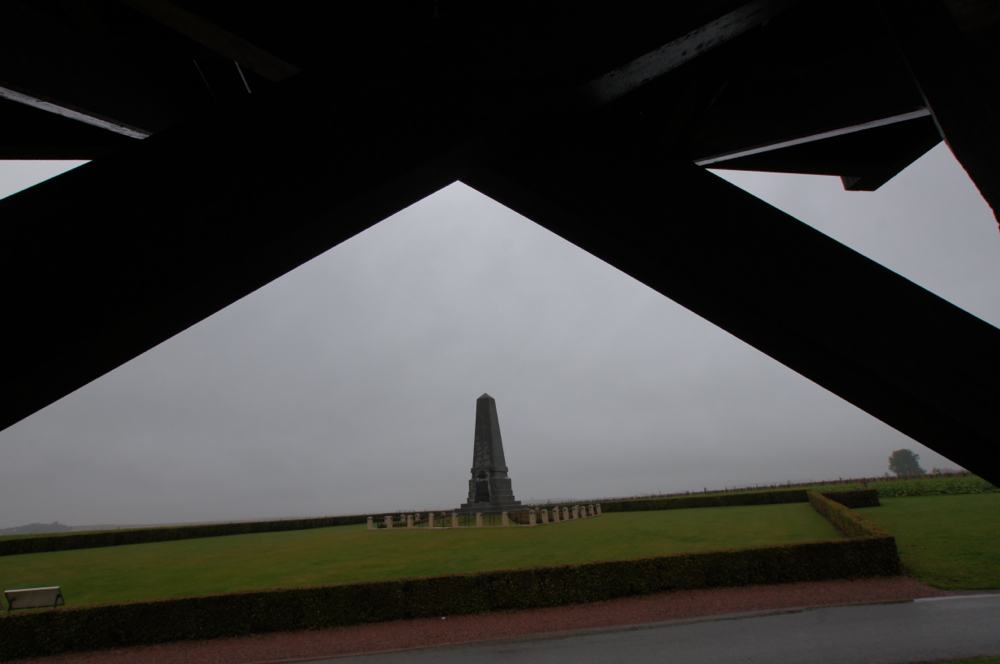
The Australian Memorial Park at Le Hamel, opened in 2008, commemorates General Monash’s brilliant victory on July 4th, 1918.

The site has panoramic displays that explain Monash’s strategy and the significance of particular areas of the battlefield.

There is even a panel dedicated to Manfred Von Richthofen, the Red Baron. He was shot down over this area on April 21st, 1918.

Who actually shot him down is a subject of some conjecture.

From the darkness of the Somme we journeyed to Chaufour Les Bonnières, which is only a few kilometers from Giverny, the home and garden of Claude Monet.

In total contrast, the day was bright and sunny. It even managed to warm up in the afternoon.

Monet, the founder of the French Impressionist movement, was an avid gardener and transformed the old farmyard into an Impressionist wonderland.

It’s Autumn, yet the variety and colour of the blooms were as fresh and vibrant as if it was a balmy day in early Spring.

It’s no wonder that he painted some of his most memorable pieces, en plein air, in this idyllic location.

As well as gardening, Monet’s other passion was for things Japanese, especially their woodcuts.

The house is full of these delicate impressions of Japanese 19th Century life. You can certainly understand how Monet’s love of Japan influenced his art and featured in many of the paintings from Giverny.

Even the famous bridge over the lily pond is a replica, taken from a Japanese photograph, that can be seen in the house.

The village of Giverny has been home to many artists but it’s Monet who draws the crowds.

Apart from his art it could be his influence on the weather that has something to do with it, as the next day it was back to dark and stormy skies for our return to Barcelona.

A green and pleasant land. (September 2012)

Tuesday, October 9th, 2012

We have just been in England.

After 8 months of struggling with foreign languages, it was a change to be able to read a menu, understand it, then order food from it, and be understood.

The rain was ever present and the cloudy skies our constant companion.

England is green for a reason.

Our first stop was Land’s End in Cornwall.

This is a rugged, windswept coastline with the sea on three sides. Our hotel is about as far west as you can get on the English mainland and the wind tried hard all night to get into our room.

From Land’s End we headed to Dorset with a side trip to St. Michael’s Mount. This bears a striking resemblance to Mont St. Michel in France, which we visited only a few days before.

There is also an historical connection.

The church, built on the summit of the mount after the Norman invasion, around 1066, was granted to the Benedictine Abbey of Mont St. Michel.

Mount St Michael is still home to the St. Auburn family, who have been in the castle, on and off, since 1647. In 1954 the island was given to the National Trust, with the family retaining a 999-year lease to live in the castle.

Next we spent few days with friends in Burton Bradstock, Dorset, a beautiful little village on the Jurassic Coast.

The Jurassic Coast has 153 km of World Heritage coastline, that can document 180 million years of geological history.

It was made famous by the paleontologist Mary Anning, whose discoveries changed the thinking about prehistoric life.

We visited the fishing towns of Lyme Regis and West Bay, where we enjoyed an excellent lunch of local seafood, in the rain.

Then, in an attempt to stay dry, we visited Althehampton in Dorchester, a quintessential English Manor House, with beautifully preserved rooms and formal gardens.

Apart from the many water features in the gardens, there is a finely detailed marble statue of a rather stern Queen Victoria.

From the coast we drove inland to visit the Cerne Abbas Giant. Aptly named a giant as he is large in every respect.

There is a lot of conjecture about his actual age, as some say he is from the Bronze age, while common belief is that he is a lot younger.

Then to the Avebury Standing Stones, not as impressive as Stone Henge but a lot more tiring to walk around.

The final stop on our prehistoric investigation was to see the Uffington White Horse, dating back 3,000 years.

On our way to London we did a circle around the Cotswalds, starting and finishing at Burford in Oxfordshire.

In London the grey skies were still with us.

We walked along the Thames between London and Tower Bridge and got a rare view of the bridge opening to let a Brazilian war ship pass under.

To shelter from the weather, and to tie up a few loose ends, we visited the British Museum.

Having discovered how important the Rosetta Stone was to deciphering Egyptian hieroglyphics, I wanted to see the real thing.

This visit also gave us the opportunity to see the other 50% of the remaining marble sculptures from the Parthenon and Acropolis. There is still a great deal of sensitivity surrounding the ‘acquisition’ by Lord Elgin of these ancient artifacts. So much so that the only free piece of literature in the British Museum, is a leaflet setting out their side of this argument.

We also visited the Natural History Museum, this time to see some of the amazing fossils Mary Anning discovered in Lyme Regis.

Our final day was spent in seaside town of Southend-on-Sea.

Apart from the world’s largest pleasure pier, it doesn’t seem to have much else going for it.

Except the Turnstones.

These migratory birds, who get their name from turning stones to find their dinner, seem to spend a lot of time on one foot.

The next day we headed south to Folkestone and the Eurotunnel. This amazing engineering accomplishment takes you from England to Europe, by train, in just 35 minutes.

Autumn. (September 2012)

Sunday, September 30th, 2012

When we left Barcelona the heat had subsided and we were experiencing the comfort of temperatures in the mid 20s’, not mid 30s’.

It was still warm and humid but a lot more bearable.

When we arrived in San Sebastian, only 570km north, everything was very different.

Autumn had arrived.

The temperature had dropped 10 degrees, the skies were overcast and it was raining. This was something we hand’t experienced in 4 months.

We were on the road to England through North East Spain and France, so I guess this was to be expected.

After San Sebastian we headed into the famous region of Bordeaux. Apart from wine the area is also known for the city of Bordeaux, a beautifully preserved 18th Century, UNESCO World Heritage listed city.

Certainly not part of the UNESCO listing, but still interesting, is the remains of the German U-Boat pens in the old port area.

From the city of Bordeaux we made a slight detour east, to Saint Emilion. The vines were changing colour and the grapes were plump, ripe and ready to pick.

The next few days were spent touring around Brittany, visiting some of the famous French Chateaus like Trécesson, Josselin, Kergrist and Tonquédec. On the way we also discovered some interesting ancient churches like the Chapel at St Cado and the Parish Close at Guimiliau as well as the Enchanted Forest at Huelgoat.

The current chapel in Saint Cado was built in the 12th century on the site of the original Romanesque church built by Saint Cado.

Saint Cado was a Welsh monk and a prince of Glamorgant who came to Brittany in the 6th century. He later returned to Wales where he was martyred.

Its not surprising then that many place names around this area sound decidedly Welsh.

The Parish Close at Guimiliau, dating from the 16th and 17th centuries, a is an elaborately decorated church surrounded by walled churchyard.

Apart from the historical wonders of Brittany and Normandy, there is one geographic peculiarity that make this area unique.

Massive tides play an important role in day to day life and have also had a big influence on the regions architecture, especially the ancient fortifications around Saint Malo.

At the end of the 17th Century, Louis XIV commissioned the famous military engineer, Marechel de Vauban, to strengthen the defenses around Saint Marlo. Vauban cleverly used the topography of the many tidal islands to build a series of fortifications.

And Saint Malo certainly needed defending as it was the main port of the Bretton Corsairs, who continually plundered British ships as they sailed into the English ports, laden with riches from the East.

In fact there was so much wealth in Saint Malo that Louis borrowed money from these Corsairs to pay for some of his exploits.

In more recent history, 80% of Saint Malo was destroyed during WW2 but has been painstakingly rebuilt. A walk around the 2.5km of ramparts gives you a wonderful appreciation of this wealthy pirate town.

These super tides have also had a big influence on another of the region’s landmarks, the famous island of Mont Saint Michel.

Another UNESCO Word Heritage site, Mont Saint Michel was at risk of losing its status as an island. Heavy silting from the damming of the canal, that was built at the end of the eighteen hundreds, had reduced the distance from the mainland to the island, from 1.5km to just a few meters.

Started in 2010 and due for completion in 2015, there is now a massive engineering project underway to restore the surrounding waterways.

The car park and causeway will be removed and a low profile bridge built, that will link the island to the mainland. Mega tones of silt will be trucked away, allowing the sea to surround Mont Saint Michel once again.

As impressive as the Abbey and the surrounding town is, the real feature of Mont Saint Michel is the way it dominates the landscape from many kilometers away.

On the road again. (August 2012)

Sunday, September 2nd, 2012

“Goin’ places that I’ve never been

Seein’ things that I may never see again…”

In the spirit of Willy Nelson we are back touring.

This time it’s a shortish trip from our temporary home in Barcelona to Granada, the Sierra Nevada and Cordoba and beyond.

Our excuse was to drive Hayden to Granada, so he could spend some time there with Andrea and then bring them both back to Barcelona.

Granada is Andrea’s birth place so she was our guide, and a very good one at that.

We wandered the streets, enjoyed the tapas, which is free here, and visited the tourist attractions.

Granada is a beautiful city with a huge Moorish influence.

This is best experienced in the Alhambra Palace that proudly stands guard, high on a hill, overlooking the city.

The evidence of Granada’s Arabic and Muslim past also affects your other senses.

You can smell the spice bazaars all over the city and shisha pipes are still found in some tea houses.

The Alhambra is the most popular tourist attraction in Spain, with over 8,000 visitors a day during the high season.

It was the high season so we had to book days in advance to get an entry time, in the late afternoon, when the sun had lost some of its sting.

The Alhambra was built during the middle of the 10th century by the Berber ruler Badis ben Habus.

After the conquest by the Catholic Kings in 1492 some parts were used by the Christian rulers. Then in 1527 The Palace of Charles V, Holy Roman Emperor was built into the centre of the Alhambra.

The sight of a Spanish Renaissance palace in the middle of the Nasrid fortifications is a little incongruous, but that’s part of the charm of the Alhambra.

After the heat and history of Granada we headed into the Sierra Nevada, via the Cabo de Gata, the largest terrestrial-maritime reserve in the European Western Mediterranean Sea.

However we stayed on land, so there wasn’t much to see there, except the sea.

We then travelled north, to the southern side of the Sierra Nevada, and the small village of Capileira.

This is the highest of three villages that cling to a steep mountain side.

Tourists and Spaniards alike come to these parts for walking, mountain bike riding and Flamenco dance lessons.

We opted for the walking, and at the suggestion of the hotel, did the 7.5 km Peña del Angel track. This gave us the opportunity to see the villages from higher up the mountain and also view the panorama that sweeps down the valley and out to the Mediterranean.

Apparently on a clear winter’s day you can see Morocco.

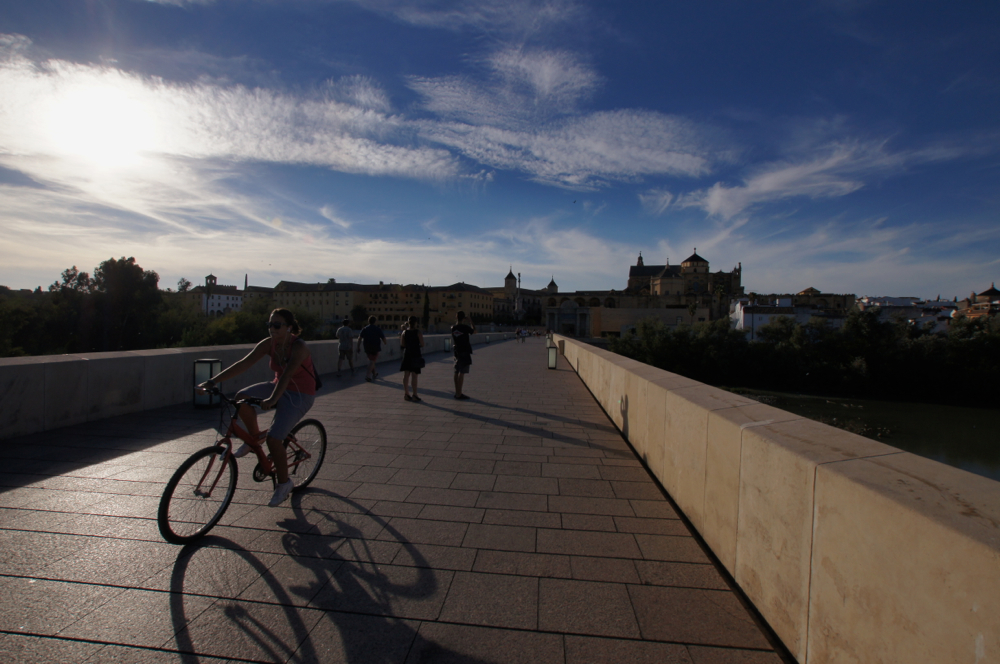
From the mountains we headed north again to the ancient city of Cordoba. There we visited the amazing Cathedral of Cordoba or as the locals call it Mezquita-Catedral, as it’s both a church and a mosque

Originally the site was a pagan temple then the Visigothic Basilica of San Vicente and in 785 the conquering Moors built the mosque.

When the Catholic Kings reclaimed Spain it became a Christian church again and later a Catholic Cathedral was inserted into the middle of the mosque structure. Even the minaret had a bell tower built around it.

On the way back to Granada we visited the historic cities of Baeza and Úbeda, both surrounded by hills of olive groves.

These cities are World Heritage Sites, built in a style known as Civic Renaissance. There is also evidence of Roman, Moorish, Romanesque and Gothic styles but it’s the beautifully preserved Renaissance buildings that this area is famous for.

The halcyon years for Baeza and Úbeda were during the 16th Century, as the 17th Century brought hard times and civic construction halted.

Because of this economic down turn, no new building were constructed, thus saving the Renaissance buildings from being plundered for building materials.

It was then back to Barcelona for a few weeks, so we could plan our next road trip.

La Festa de Gràcia. (August 2012)

Saturday, August 18th, 2012

Almost every year since the early eighteen hundreds, La Festa de Gràcia has been held in the old district of Gràcia in Barcelona.

This year is the 196th anniversary of the festival.

It starts on August 15, the Assumption Day public holiday, and runs for seven days.

It’s the height of summer in Barcelona, so it’s hot and the streets are full of tourists.

This year 18 streets and plazas will take part in the festival. Each one is decorated in a theme and prizes are given for various categories.

Not everyone in the streets help, in fact there is some resistance to the disruption caused by scaffolding, painting and the crowds of extra people flooding into the narrow streets.

Life has to go on, so the residents work around the mayhem by squeezing past the weird and wonderful creations that are now dominating their normally quiet environment .

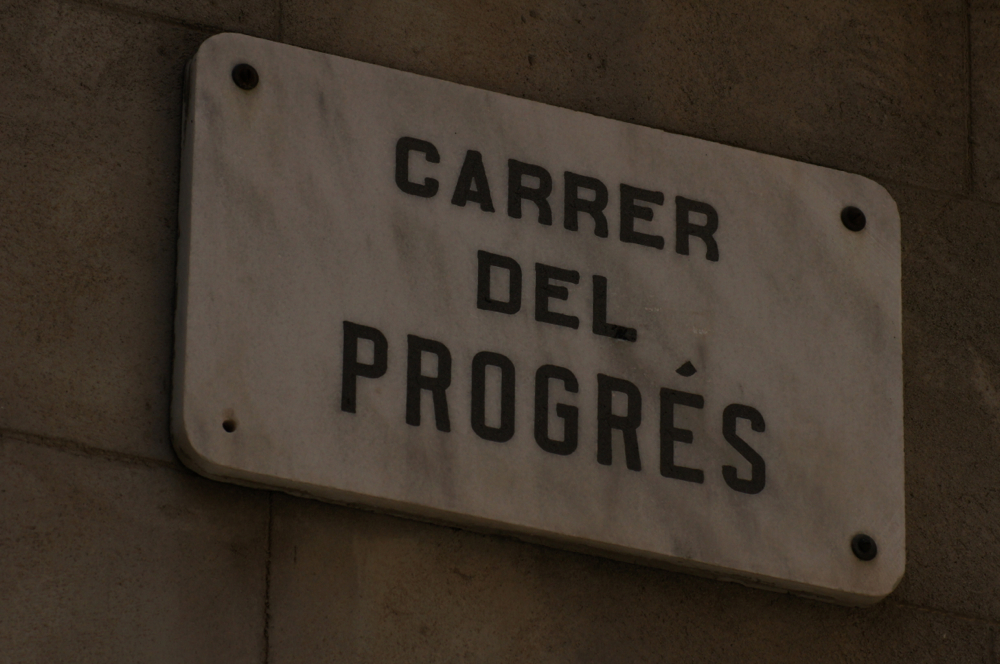
Hayden has spent four years living in Gràcia, three of them in Carrer Progress, one of the participating streets.

This is the third year that he has been part of the dedicated group who make it all happen.

As we were in Barcelona, staying with Hayden, we volunteered to put in a few hours work on the last night before the festival opened.

When we arrived, at around midday, I wondered how it would all come together, there appeared to be more to do than had been done.

When we left at 8:30 that evening, it still seemed an insurmountable task to get everything completed for a 2pm start the next day.

Hayden, like a number of other volunteers, didn’t get to bed that night.

Carrer Progrés had chosen Star Wars as their theme and images from the George Lucas classic were everywhere.

Apart from Darth Vader there were Jawas, Chewbacca, Jabba the Hutt, C-3PO, Yoda, several Storm Troopers and the Mos Eisley Cantina band.

All were very popular backdrops for the hundreds of people who personalised their visit with a snap in front of their favorite character.