Archive for the ‘Photography’ Category

The pride of Persia. (November 2014)

Monday, February 2nd, 2015

DSC02456

It was a 400km drive from Shiraz to Esfahan and on the way we stopped off at Persepolis (City of Persians)

Persepolis was the ceremonial capital of the Achaemenid Empire (ca. 550–330 BC) The earliest remains of the city date from around 515 BC.

It is believed that Cyrus the Great founded the site but it was Darius the Great who constructed the terraces and palaces.

It was built as a ceremonial city to celebrate religious and cultural events. Zoroastrianism was the main religion during this period and the celebration of the New Year was an important event. New Year fell on the first day of Spring, a significant time in an agrarian society.

Over the centuries Persepolis has been mentioned by historians but it wasn’t until 1930 that true scientific research was undertaken. This was carried out by Ernst Herzfeld and Erich Schmidt from the Oriental Institute of the University of Chicago.

It was made a UNESCO World Heritage Site in 1979, immediately following the Islamic Revolution of the same year.

It was sacked by Alexander the Great’s forces in 330 BC, apparently in revenge for the burning of the Acropolis of Athens during the Second Persian invasion by King Xerxes.

We had another side trip, this time to the Naqsh-e Rustam Necropolis.

Built on the road used by the caravans, so that the people could look in awe at the glory of the kings. The oldest part of this necropolis dates back to 1000 BC.

There are four tombs of Achaemenid Kings which are carved out of the rock face. The tombs are in the shape of a cross with the entrance in the centre. Each tomb has similar relief carvings depicting the king and also scenes of battles won and vanquished enemies.

The tombs are believed to be of Darius I the Great (c 522-586 BC), Xerxes I (c. 486-465 BC), Artaxerxes I (c. 465-424 BC), and Darius II (c. 423-404 BC)

The Persian Empire under the Achaemenid Kings, especially Darius the Great, ruled an area covering eight million square kilometres, spread over three continents. At the height of its power it ruled over 44% of the world’s population.

The Achaemenid Empire didn’t just conquer and kill, they introduced structure to the societies they ruled. They built roads, created a common language, developed a postal system and employed a professional army and civil service.

Esfahan is one of the most beautiful cities in Iran.

Its wide tree lined streets are complemented by the winding Zayandeh River that is home to some of the world’s most stunning bridges.

Esfahan also has the expansive and elegant Naqsh-e Jahan Imam Square, which is only second in size to Tiananmen Square in Beijing. The Bazaar-e Layafha circumnavigates the square and is, like all bazaars, a hive of commerce.

The city is the vision of Shah Abbas the Great (1571-1629) who was the inspiration behind much of its outstanding architecture.

The young Abbas came to the throne at 16 but very quickly discovered the art of good politics and shrewd management. He moved the Persian capital from Qazvin to Esfahan and turned it into a showcase of Safavid architecture and style.

Shah Abbas reformed the army and civil service by bringing in many thousands of Armenians, Georgians and others from various parts of the Caucasus. This influx of migration helped to make Esfahan a vibrant multicultural city.

He wasn’t all beauty and light, as late in his rule he had his sons either killed or blinded for fear that they might want to usurp his power.

We visited two of Esfahan’s bridges on a couple of occasions. The first time was when we arrived in the evening, they were illuminated and seemed to float over the water of the Zayandeh River. The second time was late in the afternoon and this time they glowed orange in the setting sun.

Seo-se-Pol Bridge has 33 arches and is 298 meters long. It was and still is also used as a dam. Khaju Bridge is 110 meters in length and was built by Shah Abbas II in 1650. It is one of the finest of the Esfahan bridges and also doubles as a dam.

We were very lucky to arrive in Esfahan when we did, as water had just started to flow again in the Zayandeh River – the first time in three years.

Kakh-e Chehel Sotun or Forty Column Palace was completed in 1649 by Shah Abbas II. It has the nickname of Forty Column Palace, yet there are only 20 columns in the facade. The forty comes from the reflection of the twenty, in the pool at the front.

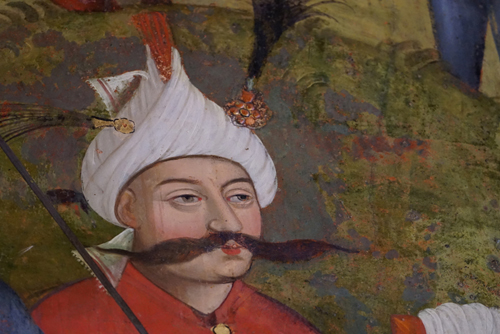
The interior is radiant with bright, colorful frescos, made even more enjoyable by the abundance of ancient Persians with expansive moustaches.

Rasoul and Hamid had us racing around Esfahan visiting the Masjed-e Shah (Shah Mosque), Masjed-e Sheikh Lotfollah (Sheikh Lotfollah Mosque), Kahk -e Ali Qapu (Ali Qapu Palace or high door) and the Masjed-e Jameh (Jameh Mosque)all within a few hours.

Apart from the excellent Islamic architecture in all of these places, a highlight was the music room in the Kahk -e Ali Quip. Here the walls were adorned with tiles that were complemented by cut-out silhouettes of musical instruments.

While the Shah and Sheikh Lotfollah Mosques had elaborate tiled enterances in a stalactite design.

Amidst our Muslim experiences we also had an infidel moment when we popped into the Church of Saint Joseph of Arimathea, built between 1648 and 1655.

It had an Orthodox Cross on the spire but the interior was more Roman Catholic. We later discovered that this is the style of the Apostolistic Church, found in Armenia.

It’s has been deconsecrated and is now just a tourist attraction.

The interior is richly decorated with original frescos that still maintain their vibrant colours. The exterior is another thing, being very austere and surrounded by a high walls that are a combination of Western and Islamic styles.

An oddity that I found amusing was in the Bazaar-e Layafha. There seems to be an abundance of store mannequins left over from the 1970s. These are in various states of repair but they all have one thing in common. A bizare almost “Nightmare on Elm Street’ ghostliness about their appearance. I found this strange phenonomen in other Iranian bazaars and I haven’t seen it since.

Recently Iran was placed 48 in the top 50 countries visited in 2013-14. This hasn’t happened since the Islamic Revolution in 1979.

It’s good for the travel industry but also creates issues for them in the future.

Iran is still under US and European sanctions. This means tourists can’t use their credit cards and must carry cash for the duration of their trip.

Another problem is the scarcity of good hotels, suitable for Western tastes.

There are plenty of small hotels but not the large ones capable of accommodating big tour groups.

There are a number of other cultural oddities that might put tourists off, but these don’t really don’t matter when you consider the rewarding experience.

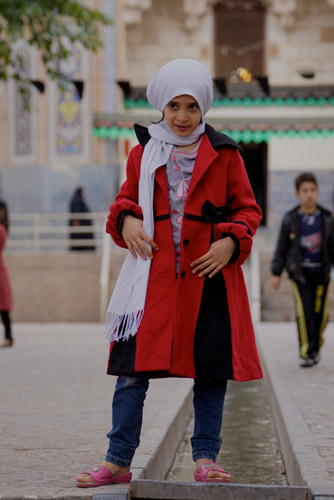
As Iran is an Islamic state all ‘women’ over the age of nine, when outside, must wear a hejab to cover their hair and loose fitting clothes, to disguise their figure.

Islam in Iran promotes a society that is male dominated but then again three quarters of the world, if not more, has a obsession with testosterone.

Alcohol is banned in Iran however the locals get around this by brewing, distilling and fermenting their own.

It’s not that easy for visitors to do the same, so just regard your stay as an opportunity to cleanse the liver.

There seems to be a total obsession with Islam and this might worry some people of other faiths. However if you take the emotion out, and view everything in an historical context, it all becomes extremely interesting. Especially when you consider that Judaism, Christianity and Islam have so much in common.

Other peculiarities, that might concern western visitors are the very low doors in the traditional hotels and extremely steep stairways.

Most of our hotel rooms seemed to be on the top floor.

Iranian drivers are regarded as the worst in the world but they are also the most patient.

The rules are, there are no rules, but everyone seems to be accepting of this fact and they just get on with reaching their destination, with as little fuss as possible.

Road Rage doesn’t exist and horns seem to be used to alert other drivers that you are about to do something stupid.

Motorcyclist do more stupid things than anyone else and that’s because they are protected by the law. According to the Iranian traffic laws, if a motorbike and a car are involved in an accident, the motorbike is always in the right.

Why? They are smaller, more vulnerable and need protecting.
Shiraz, the place not the wine. (November 2014)

Sunday, February 1st, 2015

DSC00323

After spending some time taking snaps around the Caravansarai Zein-o-din we drove back to Yazd to pick up another car and a driver, Hamid, for the trip to Shiraz.

We stopped off to see a cypress tree at Abarqu that is reputedly 4,000 years old. The cypress is sacred to the Zoroastrians and is also highly regarded by the Shiite Muslims. In fact the symbolic coffin of Imam Hussain, that we had seen in the Ashura ceremonies in Yazd, was based on the shape of the cypress tree.

The roads in Iran are a pleasure to drive on, especially compared to Turkmenistan. The bitumen is smooth and goes the full width of the road.

Most of the pick-up trucks in Iran are either branded Zamyad or Saipa, they are everywhere and they are blue. Their drivers are notoriously bad. There is a saying about them that goes: “There are two things to fear in life, God and blue trucks.”

These pick-ups are manufactured in Iran by Saipa and the current model is based on the 1970-1980 Nissan Junior.

Just outside of Pasargadae and not far from Shiraz, is the Tomb and Palace Complex of Cyrus the Great, founder of the First Persian Empire. The palaces were constructed around 546BC and were set amidst an expansive Persian Garden. They are set in an area of 1.6 square kilometers and regarded as the earliest known example of the Chahar Bagh or Fourfold garden design.

There is some conjecture as to whether the tomb at Pasargadae is that of Cyrus the Great. The tomb was believed to have been visited by Alexander III of Macedon (Alexander the Great to those who weren’t defeated by him) around 334BC.

Due to our forced abstinence, Shiraz was a slightly frustrating place to visit. That’s when you consider that the wonderfully peppery grape that we know as shiraz has the same name.

By the 9th century the city of Shiraz had a reputation for producing some of the best wines in the Middle East. Ironically these wines from Shiraz were white, not red and have no connection to the shiraz wines produced in Australia.

Unfortunately most of the vines were ripped out following the Islamic Revolution of 1979.

Putting personal frustrations aside, this area is more importantly the birthplace of the First Great Persian Empire.

Our hotel in Shiraz, as with Yazd, was a traditional style built within an old house.

These old homes were nothing but a blank wall from the outside but inside there was a cool spacious courtyard, with all the rooms openening onto this communal area.

Because they are in old homes, this style of hotel is usually found in the historical part of town and within walking distance of many sights.

Just round the corner from our hotel was the Nasir-Ol-Mol or Pink Mosque. Completed in 1888, it has hands on top of the minarets instead of crescent moons – this is the sign that it’s Shiite.

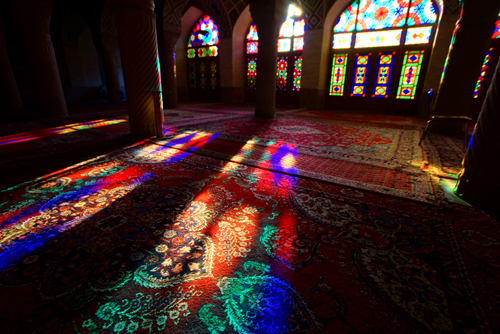
It is called the Pink Mosque due to the use of pink tiles in the interior. For me the most striking feature of the mosque was the stained glass windows.

We visited the mosque early in order to get the morning light streaming through the brightly coloured glass.

Many of the Iranian buildings we had visited use stained glass. These aren’t representational designs, as you find in Christian churches, but abstract.

The Nasir-Ol-Mol Mosque was the the most stunning so far.

The fort of Karim Khan or Arg-e-Karim Khan was built between 1766-1767. It’s shaped like a medieval fortress with one of the towers having a distinctive lean. In the past it has also been a prison, now it’s a museum.

As had been the case with our Iranian touring so far, we were set a blistering pace by Rasoul. Now made even more efficient by having Hamid drive and drop us off close to the sites.

Naranjestan and Khan-e Zinat ol-Molk was built between 1879 and 1886. The Naranjestan is set in a beautiful garden, planted with rows of orange and palm trees. The entrance hall was adorned with mirrors and there were painted ceilings throughout. The upstairs ceilings are painted in a rather European style with Alpine churches and busty German fräuleins.

Just around the corner are the twenty rooms of the Khan-e Zinat ol-Molk, all with beautiful mosaic floors. This was once the Qavam ol-Molk family home.

The Vakil Bazaar, originally built in the 11th century, is regarded as one of the best places Shiraz to pick up your Persian rugs.

We were there just to look.

The Eram Botanical Gardens are another beautiful example of Persian landscape archiecture. They were completed during the middle of the 19th century but probably started in the 18th. Not surprisingly they have been listed as a UNESCO World Heritage Site.

Later in the day we also visited the Mausoleum of Saadi and Mohammed Taghi. Two more of the revered Iranian poets. The fish pond below Saadi’s Mausoleum is said to be imbued with magical qualities.

Then it was off to the Aramgah-e Shah-e Cheragh Mausoleum, where it is believed that one of Imam Reza’s 17 brothers was martyred there in 835 AD.

Ever since our arrival in Iran we have been witness to an outpouring of religious grief and emotion. The Iranians place their faith and heroes on a very high pedestal. At the heart of this piety is an almost medieval belief in the superstition and mysticism that these historical figures hold. From what we have learned the more intensely you believe, the better you will be rewarded.

This belief in the ‘magic’ of people, places and events goes beyond religious figures, as even the great poets of Iran are placed high above mortal man.

One of the larger crowds was at the Mausoleum of Hafez. It was a Thursday night and there was a festive atmosphere as family groups, couples and gangs of young men came out to pay homage to their hero.

Just as fans flock to Graceland in Memphis or Abbey Road Studios in London, Iranians visit mausoleums in Mashhad, Yazd and Shiraz.

Imam Hussain. (November 2014)

Saturday, January 31st, 2015

DSC02012

Our new guide, Rasoul met us at the airport, he was to be our companion for twelve days.

We only had one day of site seeing planned on Yazd, as a religious holiday was on for the following two days.

This holiday is for the mourning ceremony of Imam Hussain or ‘Muharram’. It’s ten days of activities, with the final two days being a public holiday – the last day is known as Ashura.

Imam Hussain was the grandson of the Prophet Muhammad. He was killed along with 70 members of his family, including a baby, in 680AD by armies of the Caliph Yazid in Karbala, Iraq.

He is seen by the Shiite Muslims as a martyr and a champion of peace.

The first stop, on our only official day of sightseeing in Yazd, was the Zoroastrian Fire Temple, or Yezd Atash Behram, that was established in 1932. This particular fire has been burning since then and was gathered from 16 sources.

It’s regarded as one of the holiest in Zoroastrianism.

From there we went to the Towers of Silence, which is a burial ground for Zoroastrians. Here the bodies of the dead are placed in a circular open area and left to the scavenging birds. This was because the Zoroastrians  believed that human flesh should not come in direct contact with the earth. The Nasellar, or pall bearer, was the only person who could handle the corpses and he was isolated from the rest of the community. There is one remaining Nasellar in Yazd, believed to be in his 90s, he makes a good living from having his photo taken.

Masjed-e Jãmeh or Friday Mosque was next. Built in the Persian style in the 12th century and rebuilt in the 13th and 14th, it features the highest pair of minarets in Iran.

Less spiritual and more practical, we also went to the Yazd Water Museum. This contained Qanats or wells that are built on exactly the same principals as the Kares wells in Turpan, China.

The Bagh-e Dolat, built in 1750, with Iran’s tallest Badgir or wind tower and is situated in the Dowlat Dolat Gardens is another UNESCO site. This is a beautifully proportioned building that’s studied by Iranian architectural students. There was a group making measurements and their professor took much delight in giving us a geometry lesson.

Old Yazd is a City Museum and due to be made a UNESCO Wold Heritage Site in 2016.

It’s easy to understand why.

Our secular site seeing was over and we were back into the religious activities of the Muharram. A big part of it revolves around a theatrical celebration of Imam Hussain’s life. Within the city there are many areas that are set aside for ‘Nohe Khani’ or performances with the ‘Sineh Zani’ or chanting and chest beating.

On our first night in Yazd we went looking for a place to eat.

Not every hotel in Iran has a restaurant and it was suggested that the Sonati Mehr Hotel, a sister hotel to ours, might be able to provide a meal. When we arrived there were hundreds of locals milling around. We asked if there was a table available and were immediately ushered into a huge banqueting hall and sat with a German couple, their guides and an Iranian family.

There were hundreds of locals already there and a handful of western tourists.

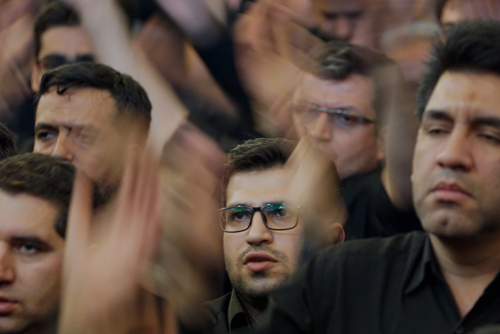
We watched a Nohe Khani, that involves a lead singer and a large chorus of men, all dressed in black. They sang in response to the singer and beat their chest to create a rhythm – they became human percussion instruments.

You could smell the testosterone.

Eventually, after a number of these groups performed, the meal came out, and it was free, provided by the hotel.

Free food is offered to anyone who wants it during the Muharram. People line the streets to receive a handout. As it was explained to us, they are not poor, it’s just courtesy to accept what is offered.

The tradition is born out of a superstition that if you ask Imam Hussein to grant you a wish, and that wish is granted, then you need to ‘pay it back’

Offering free meals is a common way of repaying your debt.

Just as we were continually invited to weddings in Uzbekistan, we were also asked for lunch in Iran.

This is against the law but they invite you anyway.

We were fortunate to enjoy a very pleasant meal with a local family. Our plates were piled high and we weren’t allowed to refuse a thing.

The next evening we went to another Nohe Khani where we were interviewed for a promotional video, made by the Imam Hussain Fan Club.

This was the largest we had seen and we were given VIP viewing positions overlooking the performance. No sooner had one group finished than another would start. There were thousands of performers and it was bedlam as the changeover took place.

I know how inappropriate it is to use a Yiddish word to describe a Muslim festival, but it was another shamozzel.

We were then whisked away to have another free meal, this one was with the locals in a neighborhood of Yazd.

As we were told, Iranians will always find a way to do things that is frowned on by the authorities.

They brew beer, and ferment wine, when alcohol is outlawed, install satellite dishes to watch world TV, when it’s banned and continually invite tourists home for lunch or dinner – even though it’s forbidden. I don’t know why, apparently we are all spies for the western authorities.

In Yazd there was so much happening, in so many places, that I felt a bit like a war correspondent. going from hot spot to hot spot, but never having enough time to file a story.

Ashura is the tenth day of the Muharram and the most important.

Our last day in Yazd was the Ashura and we were put on a big green city bus and taken out of town to see some of the final day celebrations – again this was all free.

There was a Muslim cleric on board and he gave us a briefing on the importance of Imam Hussein to the Iranian people.

Coincidently, on the morning of this bus tour, an article appeared on the ABC website about an Ashura procession in Sydney’s Botanical Gardens. The cleric was so impressed about the positive coverage in Australia, that he read the article out to the tourists.

Our first stop was Mehriz where we were witness to a theatrical re-enactment of the Battle of Karbala, where Imam Hussein was martyred.

This included a sacrifice of some local livestock.

I certainly wasn’t ready for that.

After the parade the tourists were bundled off to lunch, for yet another free meal.

Yazd turned out to be very cheap place to stay.

Our second stop was at Taft to see the lifting of the symbolic coffin of Imam Hussein. This ceremony happens all over Yazd and Iran. This particular ‘coffin’ is one of the largest and weighs 9,000 kg and requires 300 men to lift and then carry it around a rectangle three times. The coffin is in the shape of a cyprus tree, which is a symbol of freedom for the Shiites.

We have been very fortunate with our time in Yazd as we have been able to visit the sites and join in a local festival.

After our final day’s activities we raced out of Yazd for an overnight stay in the Caravanserai Zein-o-din.

Caravanserais are said to have originated in Iran over 2,500 years ago. This one was built by Shah Abbas over 400 years ago and is part of network of 999 such hostels. They were built to unify the trade routes and make them safer.

They were resting places for the travellers on the trade routes that covered Central Asia, North Africa and Eastern Europe.

They were especially popular along the Silk Road.

The Caravanserai Zein-o-din is round while most others are rectangular. It wasn’t just a shell fitted out as a four star hotel, like others we have seen, but retained many of the original features.

All the rooms came off a large circular hallway and were curtained off. There was a common washroom and a large central courtyard, covered with a sunshade.

After dinner we were entertained with an impromptu concert by a few of the Iranian guests. One multi talented fellow sang, played the recorder and the Tar, a Persian instrument that is shaped like a gourd.

After much prompting, another guest  whistled, not using his lips but his tongue.

It was a very relaxing night, after a hectic day.

“Welcome to Iran” (October/November 2014)

Friday, January 30th, 2015

DSC01929

It was an early start for our drive to the Iranian border and then on to Mashhad, as we needed to be there before noon.

The roads as usual made the going slower.

It was harder to get out of Turkmenistan than it was to get into Iran, as there was the usual formalities, questioning and searching. I never did find out what they were searching for.

The customs officer on the Iranian side was obviously a football fan. He had great pleasure in reminding us that even though Australia and Iran drew, 2-2 in their 1997 final group game at the MCG. Iran then went on to play in the World Cup in 1998 and Australia didn’t.

He obviously had a long memory.

Needles to say, after a certain amount of harmless gloating, we easily passed through the baggage search.

The roads in Iran were a vast improvement on what we had experienced in all the Stans, especially Turkmenistan.

And so were the drivers.

We had been told that it was a free-for-all in Iran and I was expecting the chaos we had experienced in China.

It was nothing like that.

Our first stop was Mashhad which has a population of 3 million, but over a year 20 million pilgrims come to visit the Imam Riza Shrine. This is the holiest place in Iran and one of the the most important in the Shi’ite Muslim world.

It has been levelled and rebuilt countless times over the centuries. The current complex is huge covering 598,657 square meters and contains the largest mosque in the world.

No cameras are allowed in the shine however you can still use your mobile phone to take snaps. As a memento we were also given a boxed set of glossy photos.

Thea had to wear a white Chardor. This made her look even more like a tourist as she was a splash of white in a sea of black.

We were ushered around by our guide Hadi, the first stop being the ‘Foreign Pilgrims Assistance Office’ where we were shown an introductory video. He is a volunteer at the shine and a devout Muslim.

He made sure we didn’t miss a thing.

Hadi was a guide who came with more than just knowledge. For the two days he was with us he provided tea and and a variety of biscuits breads and sweets.

He insisted we try everything and then have seconds – there was no refusing Hadi.

His son was our driver and he would prepare the tea while we were off sightseeing.

The poets of Iran are revered almost as much as the spiritual leaders and therefore their tombs are high on the agenda of places to visit.

Our first poet experience was the Ferdowsi (940-1020) Mausoleum at Tush. It was started in 1305 AD and has undergone many repairs and restorations since then. The current building is an elegant marble edifice, constructed in 1964, with a distinctive Art Deco feel. The crypt is spacious with high-relief sculptures of his stories, all in a Monumental style.

Ferdowsi was a highly regarded persian poet who wrote the Book of Kings, the worlds’s longest epic poem.

Just near the Ferdosi Mausoleum is the Razan Gate, a preserved part of the Tush fortifications. Unfortunately these weren’t strong enough to stop the Tamerlane forces in 1389, who subsequently sacked the city.

In Neishapur we visited the Tomb of Omar Khayyam (1047-1123) the famous Iranian mathematician, poet, historian, astronomer and all round Renaissance Man, centuries before that period. His tomb is a ten pointed decagram in a very 70s style.

We also went to the tomb of Sheikh Attar, also known as Attar of Neishapur (1145-1221) He was a Persian Muslim poet, theoretician of Sufism (the mystical dimensions of Islam) and Hagiographer (concerning those with secret powers). Little is known about Attar and it wasn’t until the 15th century that he really became famous.

From the moment we set foot in Iran we were made to feel at home.

For months people had been questioning our need to visit this ‘Islamic hot spot. It’s a country that is portrayed by western media as an evil society, hell bent on destroying the west and all that it stands for.

Nothing is further from the truth, well at least as far as the people are concerned. They welcome westerners and you are constantly greeted by an enthusiastic ‘Welcome to Iran”

Yes there are differences, but accepting those differences is part of being a traveller. You learn not to judge but to observe and to adjust.

A friend, who lives in Switzerland, once said: “A meal without alcohol is breakfast.”

Iran is an Islamic state and alcohol is banned, so for seventeen days every meal was breakfast.

History so tangible you can put it in your pocket. (October 2014)

Thursday, January 29th, 2015

DSC01905

As we drove out of Ashgabat, heading towards Mary and Merv, the sun and the people came out.

It had been a public holiday for the two days we were there, however I still got the feeling that the new Ashgabat has been built for show, not for people.

About 100 km from Ashgabat the road changed, from a smooth multi lane highway, to the usual Luna landscape of potholes.

Oleg our guide, had a love of archeology and a precious collection of artifacts, that he stored in a plastic lunch box.

Our first stop, the 15th century ruins of Abiverd, was interesting to explore as it contained countless fragments of 600 year old ceramics, just lying around.

We did pocket a couple.

Abiverd was a major trading town on the Silk Road, producing cotton, fruit and  specialising in fine ceramics. It’s position was eroded with the demise of the Silk Road and the drying up of the local rivers.

From Abiverd we had a long, slow and bumpy ride to Merv, an ancient city that was believed to have been first inhabited by the Greeks and Romans who survived the Battle of Carrhae in 53 BC. However there is evidence to suggest that there had been people living in the region since the 3rd millennium BC.

During it’s long history many races and religions have lived in harmony in Merv, which is now classified as a UNESCO World Heriate Site. Unlike most cities, where one civilization builds on top of the other, here they developed in different parts. This has resulted in the preservation of each area.

In the 12th century Merv was thought to be the largest city in the world and a major trading centre on the Silk Road.

Merv is like a huge time capsule with the ruins of civilizations spanning 2,000 years.

This was best viewed at a part of the city wall, that was common to all parts of the city and had recently been excavated. It was like pealing back layers of paint on an old door, with each coat revealing something new about the history.

The size of the bricks used is apparently a good indicator of its age – the larger the bricks, the older the construction.

Oleg was determined to show us all his favourite places. We raced around the vast complex, in fading light, trying to absorb thousands of years of history in three hours.

Lonely Planet suggested the best way to see Merv was in a 4X4 with a knowledgable guide.

We had struck pay dirt with Oleg.

We spent the night in Mary and the next day drove to Gonur Depe, along a narrow strip of ragged bitumen. I couldn’t help thinking that the billions that have been spent on the white mausoleum that is Ashgabat, could have been better invested in infrastructure.

Oleg had hired a local driver for the day and he drove us for nearly two hours until we were suddenly in the desert. He then navigated us through the sandunes, for yet another hour, until we finally reached Gonur Depe.

Both Oleg and the driver were ‘big men’ and there wasn’t much legroom left in the back of the Toyota, once they slid their seats back.

Gonur Depe is a Bronze Age site dating back to the first half of the second millennium BC. It is believed that the history of the area goes back 7,000 years. It was the capital of Margiana and built as a rectangular fortress, with powerful defensive walls, semicircular bastions and adobe buildings.

As with Abiverd and Merv, Gonur Depe is literally littered with fragments of ceramics. There is even a ‘pottery graveyard’ that the archeologists intend to bury for future reference.

The Russians did a huge amount of archeological excavation throughout Central Europe. Another legacy of their domination of the region.

Much of it was a search for treasure, undertaken during the Soviet era, intentionally done to build the Party coffers.

In many instances the best of the artifacts were repatriated to Moscow or St Petersburg.

Gonur Depe, like Merv, didn’t escape their attention. It was unearthed by the Margiana Archaeological Expedition in 1970 and directed by the Russian archaeologist Victor Sarianidi. He only died in 2013, having spent forty years working on the site.

He believed that the area around Gonur Depe was home to a civilization to match that of Mesopotamia in sophistication and culture. He also believes that this area could have been one of the main centres, if not the birthplace, of Zoroastrianism.

On our last night in Turkmenistan we had dinner with Oleg. He took us to his favourite ‘Kafe’ in Mary, Gyzylgum.

It was only then that I realised that he hadn’t taken us anywhere where we were expected to buy souvenirs.

This was a pleasant change.

Burning craters, gold and marble. (October 2014)

Wednesday, January 28th, 2015

DSC09719

Leaving Uzbekistan, on our way to the Davaza Gas Craters in Turkmenistan, was almost as complicated as when we arrived. Again everything was searched and we had to re-do our exit forms, as there was a discrepancy in regard to the money we brought into the country and what we indicated we were taking out.

The bureaucracy was with us to the end.

Coming into Turkmenistan was a lot easier as Oleg, our guide for our the entire trip, was there to meet us and appeared to have a very good relationship with the border authorities.

Olec, proudly told us that Turkmenistan was so much richer and more developed than Uzbekistan. That certainly wasn’t my first impression as we drove towards our first stop, Konye-Urgench, just south of the border.

Konye-Urgench was a vast city that in the Middle Ages had vied with Khiva as the regional capital.

The old town, Kunya-Urgench, was destroyed by Genghis Khan in 1221 and again by Timur between 1372 and 1388. It never recovered from the last invasion and the new town of Konye-Urgench was established a few kilometers away.

The old Urgench was declared a UNESCO World heritage Site in 2005.

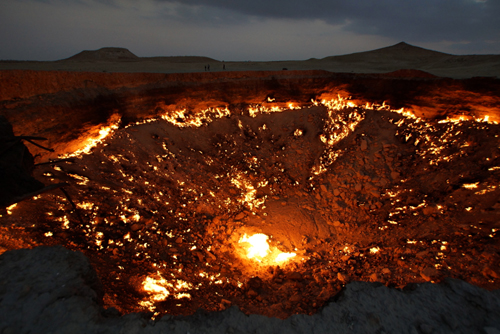
We then made the 260km drive to Davaza and the Burning Crater or ‘Doors to Hell’  The road was so rough in places that we used the dirt track, next to the main road, instead.

The Davaza area is a rich source of natural gas and in 1971 Soviet geologists inadvertently unearthed a cavern filled with the volatile substance. The cavern collapsed and the gas ignited, leaving a 70m wide crater. It was believed that it would burn out within a few days.

It has been burning ever since.

The local village in Davaza was abandoned in 2004, by order of the then president Saparmurat Niyazov, because he regarded it as an eyesore for tourists.

In Bukhara we met a couple of Australian doctors who had done the Mongol Rally from the UK to Mongolia.  They were on the return journey, travelling through the countries they had missed and had mentioned that they were going to the crater. Sure enough these intrepid travellers were there.

When we arrived at the crater there were a few 4WDs parked at a respectable distance from the fiery hole, we followed suit.

As the sun set, more and more small groups of people started to arrived, some to spend the night and others just there to see the site and go.

After we had a camp dinner we returned to the crater to see it in the darkness. When we got there we were shocked to see that there were now bus loads of tourists milling around. Apparently they were part of a train journey that had come up from Ashgabat, the capital.

Our accommodation at the crater was a very small two person tent and a couple of reasonably warm sleeping bags. We were told we had to hire the sleeping bags, as we hadn’t brought our own. We were caught over a barrel and weren’t about to go without the bags for the sake of US$20.

It was a good thing, as the temperatures had plummeted and when we awoke in the morning it was down to zero and raining.

It was too cold and wet to cook a camp breakfast so we we quickly packed and went to a tea house. There we were served up three fried eggs and sausage all washed down with pots of green tea – good nourishment considering the circumstances.

As we left it started snow.

We then visited a second crater, that was no where near as spectacular as Davaza and it started to snow again.

On the way to Ashgabat we made a petrol stop and had a quick tour of a traditional village. There  were lots of camels, old dilapidated trucks and motor cycles. There was even a woman baking bread in an outside ‘dung’ oven.

This confirmed my idea that Turkmenistan, well at least this rural area, it wasn’t at all well off.

Oleg proudly told us, that in the desert areas they collect rain water from the roof and store it in large tanks.

I didn’t have the heart to tell him that this wasn’t a new concept.

The road ran parallel to the railway, that runs north and south through the desert. Obviously the one the tourists had been on the night before.

About 90km from Ashgabat we stopped so Oleg could clean the Toyota Forerunner. There is a law that prevents dirty vehicles entering the city.

It’s either a money making scheme for the police or a car wash owner with friends in high places.

Not surprisingly, as soon as we hit the outskirts of Ashgabat the road became a six lane highway that even had lane markings.

The city is a vision of white marble and ostentatious architecture.

In 2013 the city was included in the Guinness Book of Records as having the world’s most white marble buildings.

The afternoon we arrived it was cold and grey, making the stark white city look a lot like a ghost town.

In total contrast to the previous night, spent in a tent, we had been booked into the Hotel Oguzkent Sofitel. This was also a vast white edifice with a 13 story atrium. Inside the ghost city theme continued as the place was all but empty.

The foyer had framed pieces of white marble. I wonder if this is designed to pay homage to Saparmurat Niyazov (The President for Life who died in 2006)

Apparently he had a penchant for the stuff.

There is one example of Ashgabat’s opulent architecture, that was particularly garish. The Turkmenistan Bank was just next to our hotel and looked a lot like a giant condom with a halo. 

We had dinner in the Sofitel with an: If you can’t beat them, join them mentality. From where we sat, on the 15th floor, we could seem more Doric columns than you would have found in ancient Greece.

Another overt display of Ashgabat’s wealth is that all the police cars in the city are Mercedes Benz. They certainly don’t drive Mercs in the country area.

Everywhere you go in the old and new areas of Ashgabat there are fountains, a legacy of both the Russian, Soviet and current administration. The main thoroughfare outside our hotel had a bank of them down the centre of the road – this would have been about 1 kilometer of continuous fountains.

Now I know where the Aral Sea has gone.

Ashgabat has been completely rebuilt following a devastating earthquake in 1948 where over one third of the population perished. One of the lucky survivors was the very same Saparmurat Niyazov, who became the first president.

I don’t know if Turkmenistan was as lucky as Niyazov.

We were booked for a full day tour of the city but due to the Independence Day celebrations, the road outside our hotel was closed – this gave us the morning off.

We watched the parade from just outside the hotel. There was a lot of military hardware, people in and out of uniform and a variety of floats.

Many of the floats displayed large pictures of the current president, Gurbanguly Berdimuhamedov.

The next day we were back into the site seeing mode with our first stop being the Kipchak Mosque. This mosque was build specifically for Saparmurat Niyazov and designed to be his resting place. It was constructed two years before his death and contains the family Mausoleum, with Niyazov’s mother and two brothers, killed in the 1948 earthquake, also buried there. It is located in Gypjak, the village in which he was born.

Saparmurat Niyazov ruled Turkmenistan for 15 years after the fall of the Soviet Union. The only thing that stopped him from ruling longer, was his death.

During his reign of power this megalomaniac did many strange and eccentric things. Apart from insisting that there were no dirty cars in the streets of Ashgabat, he renamed some months of the year after members of his family, banned dogs from the capital and closed all the libraries. This last act was due to his belief that there were only two books that the Turkmenstanies should read: The Koran and the Ruhnama, a book he wrote himself.

He even had a gold statue of himself built that rotated to follow the sun.

In the afternoon we visited the Parthian Ruins at Nisa just outside of Ashgabat. This was part of an ancient kingdom that lay southeast of the Caspian Sea. From 250BC to 230AD the Parthians ruled an empire that stretched from the Euphrates to the Indus.

The next day we had a whirlwind tour of the city, stopping off at all the monuments and marble palaces built by the the two presidents.

First was Memorial Park, which had just opened. This was a series of monuments that were originally in the downtown area of Ashgabat but for some bizarre reason have been moved to a hill outside the city. The only way to get to the park, which is on the top of the hill, is by climbing hundreds of steps.

The park is dedicated to the victims of the Second World War and the main visitors are older citizens, who have come to pay their respects. As Oleg pointed out, this memorial might now become a white elephant, as most of the people who want to visit are incapable of climbing the steps to it.

The Ertuğrul Gazi Mosque, inaugurated in 1998, is in a Turkish style and based on the Blue Mosque in Istanbul. Built again in white marble, this huge mosque can hold 5,000 but is rarely used as there were a series of accidental deaths during its construction.

Next was the ironically named ‘Palace of Happiness’, which is a wedding registry office, and function centre. And yet another strange piece of architecture, looking a bit like a wedding cake and adorned with the Turkmenistan eight pointed star.

This symbol pops up all over Ashgabat and can be seen on buildings, in street furniture and monuments.

Another similarly strange public building was the Alem Cultural Centre, topped with a large enclosed ferris wheel. It has the dubious honour, according the Guinness Book of Records, as being the world’s tallest enclosed ferris wheel.

The Monument to Neutrality, like the other monuments in the city, have a permanent posting of two guards, in dress uniform and housed in glass boxes. They are in turn guarded by another soldier in full battle fatigues. The second guard is there to stop you taking photos of the other two. The result is that tourists can’t take photos of the tourist attractions.

I am still trying to find the logic in that.

Then there was the Monument to Turkmen Manufacturing, the Monument to the Constitution, the Independence Monument and the Arch of Neutrality.

All built with plenty of white marble.

We also drove up to the new Yyldyz Hotel, which is located on a hill outside, and overlooking the city. Completed in 2013 it has a water droplet shape with a rather pleasant looking design.

Moving away from the modern part of Ashgabat we then explored the old Russian and Soviet era section. There we visited the Lenin statue, Russian Market and the Yimpas Shopping Centre. The last being the only part of the city to show signs of life. Opposite the statue of Lenin, on the Turkmen State Archive, is a rather striking relief sculpture by the Russian artist Ernst Niezvestny.

In the same area was the Alexander Nevsky Russian Orthodox Church. Built 1905 it was a storehouse for potatoes during Soviet times.

Apartments in Ashgabat have been classified into three categories and named after the Soviet leaders at the time they were built. Stalin Apartments (1922 -1952) these are regarded as the best. Then comes Khrushchev Apartments (1953 -1964) these are considered the worst with small pokey areas, often the bathroom and kitchen were housed in the same area. Finally the Brezhnev Apartments (1964 – 1982) these fall somewhere in between the first two.

We then went out of the city to visit the ruins of the 14th century Anau Mosque, which was  destroyed in the 1948 earthquake. Sheikh Djemalledin, a revered Muslim, is believed to be buried here.

Pilgrims come to pray for things like children, good health or a house. They then leave items such as house keys, or even build model houses from the ruins, to reinforce their prayers.

Muslims can’t directly ask God to grant their prayers, like Christians do, but they can ask a deceased spiritual person like Sheikh Djemalledin, because they are close to God.

It was cold and grey for the entire time we were in Ashgabat, which was fitting for a city that has no soul.

Avant-Garde in Uzbekistan. (October 2014)

Tuesday, January 27th, 2015

DSC09626

Just out of Khiva, on the road to Nukus, there’s a thirty kilometers stretch of trolley bus line that seems oddly out of place within the rural landscape.

Through out most of central Asia we have seen dozens of petrol stations lining our route. Strangely the majority of them are closed and those that are open have long queues of customers. For that reason most of our drivers seemed to run on both gas and petrol.

As we drove through fields of sunflowers, corn and cotton, we were entertained by a local Russian speaking radio station, which was good as our driver had little English and our Uzbek was no better.

Commercial radio, the world over, seems so similar. There’s the machine gun banter of the DJ, that’s interspersed with music, humorous sound grabs and the inevitable ads. This particular station played an ‘easy listening’ combination of local and Western music.

We crossed over the Amudaryo River, a feeder to the dying Aral Sea. Judging by the height of the levy banks this must have been an impressive body of water, however it was barely a trickle now.

The Aral Sea was once one of the largest lakes in the world with an area of 68,000 square kilometers. Constant poaching of water from all of the Aral’s tributaries has left this once massive inland sea all but dry.

It is now only 10% of its original size.

On the way to Nukus we visited three old desert fortresses. Ayaz-Qala, Turpra-Qala and Kyzyl-Qala. There are said to be over fifty in the Khorezm area.

By far the best was Kyzyl-Qala Fortress, the smallest but most compact, that sat on the intersection of two canals and was surrounded by farmland. It was probably the fortified residence of an important Khorezmian aristocrat. The fort was built in the 1st or 2nd centuries AD and was occupied until the 4th century and then abandoned. It was then restored during the 12th or early 13th century, just prior to the Mongol invasion.

After our side trip we were back on the highway to Nukus with desert in either side.

Then, not far from Nukus, a bizarre thing happened. The road turned into four lanes, with drivers using the lanes in either direction, as though each road was Independent.

We reached Nukus mid-afternoon and as we were heading to Turkmenistan early the next morning we made a quick visit to the Nukus Museum of Art.

The Museum was open in 1966 and has the world’s second largest collection of Russian Avant-Garde art. It’s the legacy of Igor Savitsky (1915-1984) who collected thousands of artworks from across the Soviet Union. Much of this art work was banned, or at least disapproved of, by the Soviets. Despite the dangers, Igor managed to spirit them away to this remote gallery.

The Uzbeks and the world are better off for it.

The Uzbek School was by far the most interesting as it featured the Avant-Garde style with a distinctly Central Asian flavour.

The treatment of Mosques, Medressahs, Minarets, bazaars and caravans between 1930 and 1970 was unique.

It was comparable to the vividly exotic eye with which Gauguin viewed Tahiti.

Mosques, Madrasahs and Minarets. (October 2014)

Monday, January 26th, 2015

DSC09458

As we headed west from Bukhara to Khiva, a 450km, six hour journey, there were many small villages linked by acres of cotton plantations. These were interspersed with rice paddies and fruit orchards.

This abruptly stopped and we were into the desert, with little more than grey earth and Camel Bush.

At some points I felt that the desert was about to engulf the road and then suddenly we were on a four lane Motorway. I sometimes wonder what motivates governments to build new infrastructure in the most unlikely places.

I guess I probably know the answer.

The obsessive security that we had encountered around Fergana and Tashkent had all but disappeared. Even where there were checkpoints, we were ignored.

Because of the conditions of the roads our drivers are experts at ‘pot hole hopping’. They then curse profusely at themselves when they get it wrong.

Salamat, our guide in Khiva, was a mature woman and a very intelligent guide. She understood when to talk, when to listen and when to give you time to yourself.

We had walked around Khiva on our own the previous afternoon and she now gave us a wonderful insight into the history of what we had seen.

Sightseeing in Samarkand, Bukhara and now Khiva was a much more intensive affair than we had had experienced since leaving Eastern China. These cities are compact and you are constantly trying to focus on a new site and take in new information.

Unlike China, we didn’t have a daily agenda that we could follow.

This was a much more random affair.

We would return to our hotel rooms at night and try to gather our thoughts and put the whole experience into perspective.

Khiva was supposedly founded by Shem, the son of Noah, of Ark fame. He and a group of young men, searching for water dug a well. From that well Khiva blossomed, as it was a central point on the east west trading route.

Salamat, like our guide in Bukhara, also set us a scorching pace. There are so many mosques and madrasahs in Khiva that you can only get a feeling of the place, without going into the detail.

Khiva has two distinctive parts. There is the outer town, called Dichan Kala, that was formerly protected by a city wall. Then there’s the inner town, or Itchan Kala, that is encircled by brick walls.

We visited the statue of Al Khwarizmi (800-847 AD approx) the founder of algebra.

Next was the Muhammad Rahimxon Madrassah and the Islom Xo’Ja Madrassah, which is now the Khiva Art Museum.

Djuma Mosque, constructed in the 18th century, has 212 carved wooden pillars, an open roof for moonlight and is capable of holding 3000 for Friday prayers.

Tosh-hovli Palace, built by Allakuli Khan between 1832 and 1841, was ostensibly a harem where the Khan had four official wives and forty concubines.

Our final stop, on our official tour, was the Muhammad Amin Khan Madrassah. It’s the biggest madrassah in Khiva and was built between 1851 and 1855. It is 72 meters in the length and 60 meters in the width and was the main building at the western gates of the Ichan Kala Castle.

We were finished with our sightseeing by mid afternoon this gave us time for a cup of coffee and a well earned break. By then the sun was getting low and the mud walls of the city were starting to glow orange.

We then returned to the Watch Tower of the Mohammed Rakhim Khan Madrassah to get a view of the city in the afternoon light.

Cultural overload. (October 2014)

Sunday, January 25th, 2015

DSC01560

We left Samarkand early, it was a long drive to Bukhara and our driver wanted to stop at Shakhrisabz on the way.

Shakhrisabz is the home of Amir Timur, the national hero of the Uzbeks. It is not hard to understand why he is so adored, especially by Islam Karimov. Timur ruled in the time after Ghenghis Kaan and although he was no softy he was benign compared to Khan, who devastated cities and massacred countless populations in his quest to control Central Asia.

Within Shakhrisabz is Amir Timur’s castle which currently stands at the end of a vast building site.

The entire town is being turned into a shrine in honour of the national hero and as a memorial to Karimov, the current prime minister.

This is yet another beautification program, initiated by Karimov that involves leveling vast areas of the old town and building boulevards and parks.

The resilient locals, displaced from their homes and businesses, carry on as usual. The market stretched along a raised dirt road, with construction on either side and heavy machinery racing from one end of the site to the other.

Just as we were about to leave it started to rain, then a dust storm came in from the surrounding desert.

All this was exacerbated by the dirt and dust from construction site.

We managed to see a few sites like the Blue Dome at the Dorut-Tilovat Complex and the local market area. However many of the old buildings were part of the reconstruction programme and off limits.

As we drove on towards Bukhara there was another downpour and it was literally raining dirt.

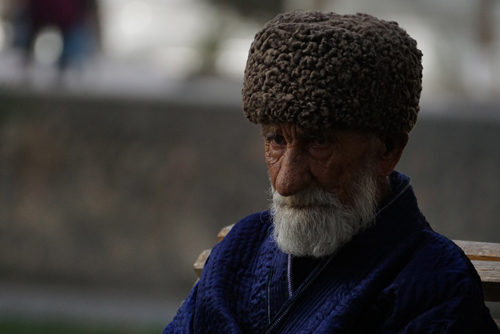
Sometimes a city is defined by headwear.

Bukhara has cloth caps and since we met our driver, who continually wore one, I have seen them on the men of the city.

The last time I encountered a community of cloth caps was in Pamplona, Spain in 2012.

Before Islam there was Buddhism and fire worshiping Zoroastrianism, so there is a rich culture and history in Bukhara, which is believed to be 2,500 to 4,000 years old. The locals believe it’s the latter, while archeologists favour the former. It was the centre of the Silk Road and an important trading point between east and west.

Bukhara is an open air museum, with its historic centre, containing many mosques and madrassahs, listed as a UNESCO World heritage Site.

The city is surrounded by a 12km of wall containing 11 gates. The gates are named by the direction from which the caravans arrived into the city.

This is a small city compared to the others we have visited in Uzbekistan. It’s also one of the most tastefully reconstructed, with less of the glitz and a far more authentic feel. It’s easy to walk around the narrow streets and get lost in the back alleys.

Like most of these ancient cities, they are divided into distinctly different parts. With Bukhara the old part has charm while the new has vast parks and decaying Soviet era buildings.

The old part of the city is very compact and it’s easy to walk from one ancient edifice to the next. We spent an entire day doing just that.

The Arc and Registan Square, the Bolo-Hauz or Friday Mosque and then into the main market. This was a modern market, compared to some we had seen, but still had wonderful produce and interesting faces.

Adjacent to the market is part of the original city wall of mud bricks and straw.

We continued walking and exploring, visiting Ismoil Samoniy and Chashma Ayub Mausoleums, Kalon Minaret and Mosque and Mir-i-Arab and Kokaldosh Medressas. Kokaldosh is the largest one in Bukhara.

On the way we passed Magoki Attori, a Mosque that appears to be in a pit, as it has entrances on two levels. One is at the current ground level while the other is several meters lower. When it was excavated some years ago archeologists discovered that there was another temple below the current one. This was Buddhist, a religion that preceded Islam in Bukhara. It was then back to Lyabi-Hauz, the wonderful square that was near our hotel.

In the middle of all this we also went to Job’s Well, named after the Prophet from the Old Testament.

This is only a legend as the original Well of Job is in Jerusalem.

We crammed so much into the day that I have to check my snaps to actually follow what we did. Our guide, Dilafruz, was on a mission and wanted to get through as much as possible, as quickly as she could.

Our heads were spinning and we had cultural overload.

Bukhara is an oasis with many ponds that are interconnected. In ancient times the quality of water in these reservoirs was so poor that the average age of the Bukharise was only 39 years.

Apart from a number of Caravansaries in Bukhara there is also accommodation for Dervishes or travelling Islamic pilgrims. One such building is the Nodir Devon Begi that was built in 1620.

The Dervishes are best known in Turkey and Egypt where, in a religious fervor, they would spin and whirl.

Because Bukhara is on the Silk Road it’s also the centre of a well worn tourist track, best illustrated by the Coffee Gallery that serves an excellent cup of Segafredo.

After a hard day of sightseeing the Europeans gather to enjoy an espresso.

There were five trading domes built in Bukhara during the sixteenth and seventeenth century. Each one specialised in a particular range of merchandise. There are now only three left and their specialities are hats (many of the cloth cap variety), jewellery and money changing.

The last we visited on our final day as we were running short of Som.

The next day we were off again, our first stop being the tiny Chor-Minor Madrasa, built between 1806 and 1807. Only the entrance portal remains, with its four towers or minarets. Apparently these represent the builder’s four ‘beautiful’ daughters. Supposedly this rather small building is based on a much larger one in India.

Next was Ismail Somoniy Mausoleum, celebrating the sons of Somoniy, the founders of the Samanid Dynasty, who renounced Zoroastrianism and embraced Islam around 900 AD.

Another stop was Chor-Bakr Mausoleum built over the burial place of Abu-Bakr-Said, who died in 970 AD and was a descendant of the Prophet Muhammad.

We also visited some more contemporary sites like the Russian Summer Palace, with the old part being built in the 1860s and the new section in 1913. This had a diversity of styles, featuring both Uzbek and Tsarist Russian architecture.

Cotton and wheat are the staple crops of Uzbekistan. The harvesting of the cotton happens three times a year and as nothing is mechanised everyone needs to help.

The universities give students time off and everyone is expected to give up some time. Our guide, Dilafruz, still spends a few days each season bringing in the crop.

Late in the afternoon, after another exhausting day of sites, and over a couple of cups of coffee we watched the locals pass by, many on bicycles.

I couldn’t resist trying to capture a few on my camera.

Our last day in Bukhara was only our second full day off and we just went wandering. The tourists had been packed into their coaches and cars and were off visiting the sites, as we had done on previous days.

We felt we had the place to ourselves.

One of the bi-products of time off is that you can write a few postcards over a cup of coffee  You then have to find somewhere to post them and this took us into the new part of the city.

In the afternoon we went wandering around the back streets of the old city. I then had time to take photos of things that weren’t tourist sites.

Yet another benefit of time off.

Samarkand, the city of stone. (October 2014)

Sunday, January 25th, 2015

DSC08978

Fazil, our guide and driver in Samarkand was a self proclaimed, ‘Light’ Muslim. He was tolerant of all religions and was completely against the extremist views of the radical few. In fact he felt that much of the Koran was being misinterpreted by these islamists for their own needs and not for the good of Islam.

During both the Russian and Soviet eras each region or main city was designated a manufacturing industry. This enterprise would then supposedly supply their given product to the the entire USSR. Tea packing was the domain of Samarkand.

The original factory, built in the 1860s in the days of the Russian Empire, is still there but only packs a fraction of its former output.

By having these main industrial centers, full employment was guaranteed by the Russians and then the Soviets.

When the Soviet Union collapsed most of these factories couldn’t compete in a free market, where the products were cheaper and of better quality.

We have seen the results of this throughout the former Soviet dominated Eastern European countries and now here in the Stans.

We had a brief afternoon walk around Samarkand, including the exterior of the Registan, as we would be seeing it in detail the next day.

This is another Central Asian city with the indelible stamp of Russia planted firmly on its landscape. This is especially evident in the apartment blocks, factories and the illustrated grave stones in the cemetery.

There is a very large statue of a seated Timo, just near the Registan, which is strange considering he preferred to be mounted on a horse, not a seat. Apparently this was due to his lame leg, as a result of yet another battle wound.

The name Samarkand means ‘City of Stone’

The entire city of Samarkand has been designated a UNESCO World Heritage site. It’s known as the ‘Rome’ of the east with a history going back over 2,700 years.

There are four distinctly different parts to Samarkand.

The Ancient City, that was built into hills by the side of the Zeravshan River. and devastated by Chinggis Khan (Genghis Khan)* in 1219 AD, when he killed 300,000 of its inhabitants.

Before that it was Alexander the Great’s turn in 329 BC.

Then there’s the Old City that was built to replace it. As most of those killed in the Ancient City were living underground, in homes dug out of the river bed, they were buried where they fell. It was therefore not appropriate to rebuild the city over the top of their graves. The city was then built inside the old walls.

There’s also the New City, that expanded from the old and was developed by the Russian Colonialists and later the Soviets.

Finally there’s the Modern City that came after the break up of the Soviet Union when Uzbekistan gained its independence.

Many of the buildings in the Old City have very small doors, this we discovered is because they are made from the wood of mulberry trees. These trees only have a certain amount of usable timber, hence the doors aren’t very high.

We also discovered that the swastika is used extensively in some of the mosques and madrasahs. Used here, this symbol represents the four elements of earth, water, air and fire. The swastika has been used by many faiths and first appeared in Neolithic times.

Fazil is a guide who thinks about the best time of the day to take photographs.

He has delivered us to places of interest when the sun is in the right spot. Unlike most, who get you there when everything is back lit.

There should be more guides like Fazil.

On our first full day in Samarkand we visited the Silk Road Monument. There seems to be one of these in every city we visited.

Then it was onto the monuments of religious importance, like Shakhi Zindi or Living King Ensemble, that was constructed between the 11th and 19th centuries. It is connected, by legend, to Kusam Abbas, the cousin of the prophet Muhammad, who is said to be buried there.

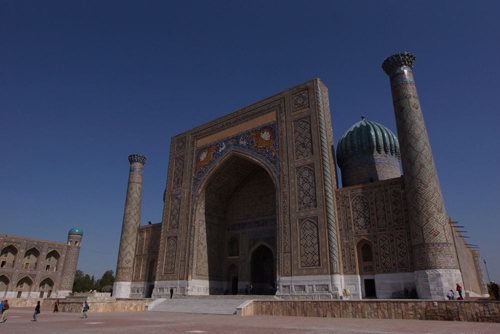
After that we visited the famous Registan. We had a sneak preview the previous night but this was a far more detailed investigation. This was the centre of the ancient city during the rule of Timur. It is a public square that is surrounded by three madrasahs or Islamic schools. Ulugh Beg Madrasah (1417-1420), Tilya-Kori Madrasah (1646-1660) and Sher-Dor Madrassah (1619-1636) These buildings are the epitome of Islamic architecture, vast yet elegant and adorned with beautiful tile work.

Our final stop in the afternoon was to the Amir Timur Mausoleum, Gur-e Amir or ‘Tomb of the King’ The construction of the mausoleum was begun in 1407 for Muhammad Sultan, Tamerlane’s heir apparent and beloved grandson. It later became the family crypt for the Timur Dynasty.

We had run out of Islamic sites in the city so we moved onto other faiths like the Russian Orthodox Alexey Cathedral built 1912 and the Polish Roman Catholic Church of St. John the Baptist.

Late in the afternoon we visited the old Jewish Quarter, a lively area with kids playing football in the street. and old men discussing whatever old men discuss.

We tried on a few occasions to see the Ancient City but a film crew had the road cordoned off. There were however a number of vintage cars and an old bus, full of extras, all part of the filming.

Corruption is everywhere in Uzbekistan.

Despite a government facade that suggests it’s frowned upon, it’s actually encouraged.

You can only get US Dollars, Swiss Francs or Euros when you use your MasterCard or Visa in a bank. You then have to go to another counter to change that currency to the Uzbek Som.

You therefore pay double transaction fees and get a poor rate of exchange to boot.

The Bell Boy at our hotel in Tashkent suggested that we were better off exchanging our US Dollars on the black market, rather than going to the bank. Of course he could give us a very competitive rate.

Fazil our guide negotiated a better entrance fee, at every site we visited. Where the money went, I have no idea. He also got us a great deal on exchanging our money.

The icing on the cake was when we went to see the light show at the Registan.

There were eight or so tourists there to see the lights, that were supposed to come on at 8pm every evening.

Suddenly one of the on-duty policemen came over and suggested that if we a paid him US$10, per person, he could get the lights turned on.

We never did see the Registan illuminated.

Our last full day in Samarkand was a welcome day off. This was the first full day to ourselves since leaving Australia. We found a cafe serving real coffee, not Nescafé and then had a wander around some of Samarkand’s parks and the main Boulevard. And, as usual, brides with their accompanying photographic entourage were everywhere.

Yet again we were invited to a wedding.

*Many names of places, people or sites are spelt differently. This depends on where you are, what translations have been made or what dictionary or encyclopedia is being used.

For instance Chinggis Khan or Genghis Khan, Madressa or Madrassah, Caravanserie or Caravansary.  

Often a person’s name will change according to where it is being used. Alexander the Great was also known as Alexander III of Macedonia, especially in countries where he had vanquished large parts of the ancient population. The same went for Emir Timur, who was also known as Tamerlane, Tamerlan (due to his lame leg) or just Timur the Great.

Alexander is Great in Christian countries while Timur is Great in Islamic ones.